
 SECURITY ALERT

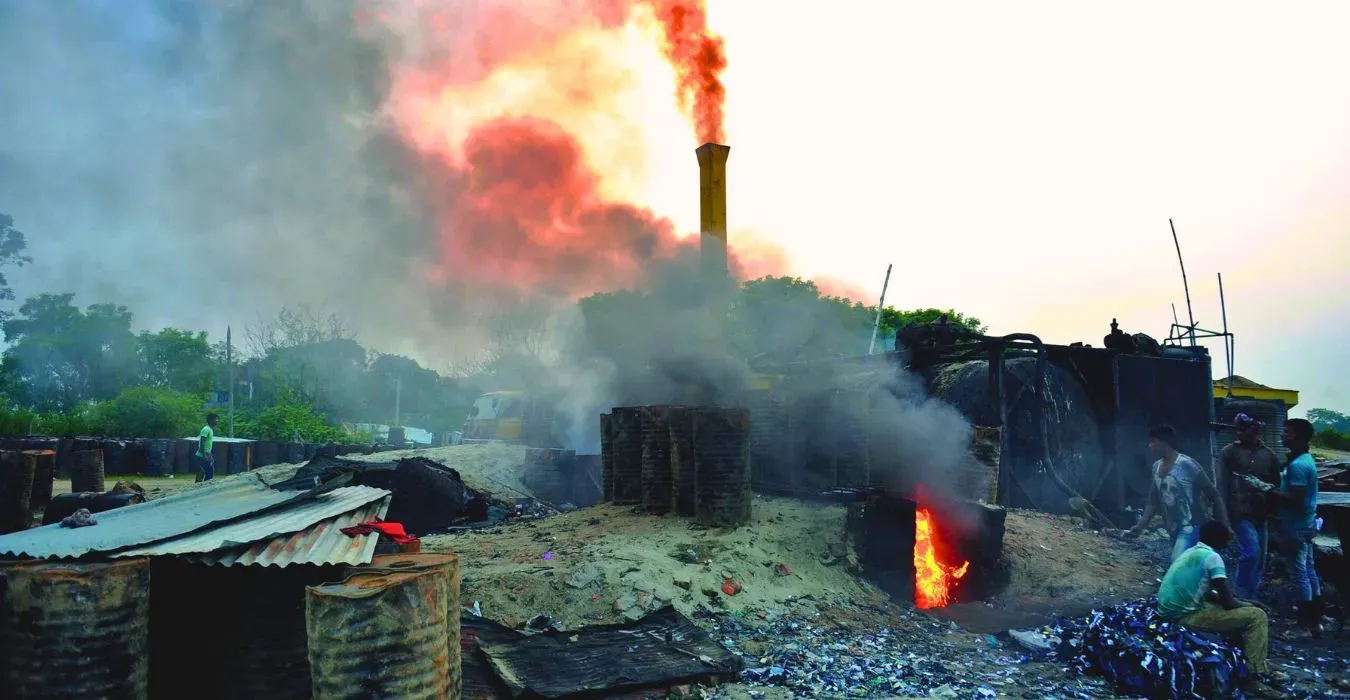
UNDP’s Human Development Report of 1994 highlighted health and environmental security as national security concerns. Air pollution, which adversely affects the environment, is considered a threat to national security due to its negative impact on public health. It weakens the workforce, disrupts social stability and puts enormous pressure on the healthcare system, eventually compromising a nation’s functioning. A silent killer, air pollution is already creating havoc in India, where it affects the entire population. Alarmingly, anti pollution measures seem to be failing in the country despite a 64 percent hike in budgetary allocation for pollution control. India is losing precious lives – 92 per day as per a collaborative study undertaken by researchers from universities in India, Sweden, USA, Israel and Italy – and approximately 1.8 percent of GDP annually to air pollution, while her capital Delhi’s air was more toxic than that of Los Angeles when it was hit by wildfire.
The World Bank says, 1.4 billion people are exposed to unhealthy levels of ambient PM 2.5 – the most harmful pollutant. It emanates from multiple sources, affecting the lungs and entering the bloodstream to cause major health risks. Researchers have examined the link between these particles and mortality over a ten-year period from 2009 to 2019 and found that every 10 microgram per cubic meter increase in PM 2.5 concentration led to an 8.6 percent rise in death. Most importantly, the entire population of India lives in areas where PM 2.5 levels exceed WHO guidelines. THE CHALLENGES According to Professor Joel Schwartz of Harvard T.H. Chan School of Public Health, who co-authored the study published in Lancet, India’s air quality standards are woefully inadequate. Besides, the action plans deal with acute episodes rather than reducing long term exposure, which is the most harmful to health. “These plans apply to large cities only, while our recent models show that essentially all of India – not just metropolitan cities – has air pollution above health-based guidelines,” clarified Professor Schwartz.
NCAP
The National Clean Air Programme (NCAP), introduced to combat air pollution and improve air quality across the country has by and large failed in its objective. “The current mitigation strategies under NCAP are highly location centric. Since, pollution does not limit itself within city or State boundaries, the NCAP failed to deliver the desired results” – says Professor Gufran-Ullah Beig, eminent Air Pollution Expert and Founder-Director of SAFAR (System of Air Quality and Weather Forecasting Research), functioning under Indian Institute of Tropical Meteorology, However, Indian authorities have taken this challenge head on by introducing an emergency response mechanism, the Graded Response Action Plan (GRAP) to minimise impact of air pollution on health. GRAP is a software driven air quality deterioration alert system for multiple stakeholders which helps in initiating immediate action for curbing pollution and launching emergency measures to reduce human exposure to harmful pollutants. However, Professor Beige underscores that GRAP’s impact in places where it is active so far has been minimal. He suggests extended emission curb as its impact is not adequately reflected in pollution concentration. THE WAY FORWARD Air quality management is a progressive process linked to the capabilities of a government and behaviour of businesses and individuals. Keeping this in mind the National Air Quality Resource Framework of India (NARFI) was kickstarted to address the complex and multidimensional nature of pollution through multi-sectoral collaboration among the government, industry and citizenry. “India has several large sources of air pollution that are addressable using known technology,”
Says Professor Schwartz
First, he suggests using scrubbers for coal burning electric plants to remove 95 to 99 percent sulphur dioxide, which are converted into particles (PM2.5) in the atmosphere and spread out widely.
Second, burning of crop residues to make way for new crops is another major source of pollution in India. Those residues can be composted into fertilizer or processed to make gas if farmers are incentivised appropriately.
Third, trash burning is another major pollution source in India due to little trash collection in slums. Obviously, this could change.
Fourth, vehicular pollution, emitting significant PM 2.5 particles, can be controlled by effective monitoring and technological intervention.
Conclusion
Professor Beige advocates shifting to long term strategies based on Airshed approach instead of relying on cosmetic location specific and emission centric quick fixes. The World Bank defines an airshed as a common geographic area where pollutants get trapped, creating similar air quality for everyone. This multilateral institution is developing the country’s first large Airshed Action Plan for the Indo Gangetic plain – across seven Union Territories and States. But enforcement remains the key element for Airshed Management’s success in India, apart from setting up an Air Resources Board for the entire Indo-Gangetic plain, which is crucial for inter-State and stakeholders’ coordination.
