
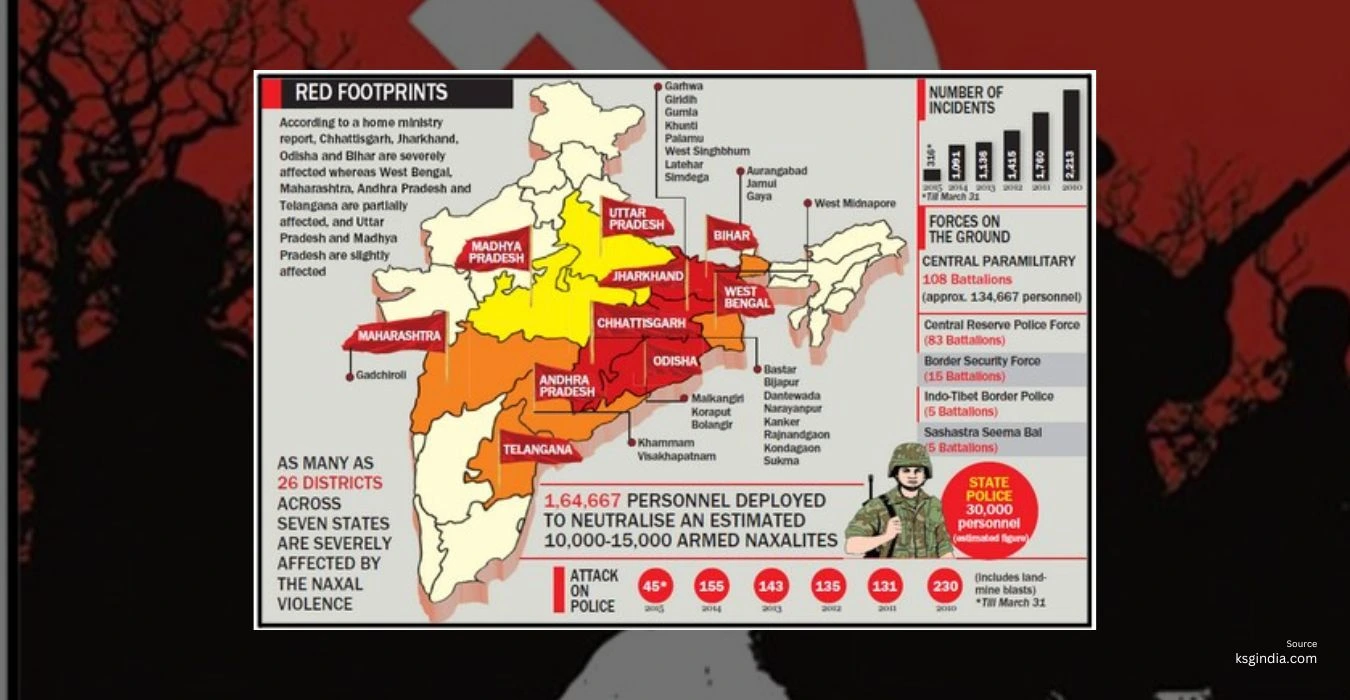
Originating in 1967 from a peasant uprising in Naxalbari, West Bengal, Naxalism has grown into a widespread movement, affecting multiple states, primarily in the “Red Corridor” stretching across central and eastern India. Despite the challenging nature of this insurgency, there has been notable progress in the fight against Naxalism, especially over the past decade, driven by coordinated efforts of the Indian government, security forces and local administrations.
Government Strategies and Programs
The Indian government has adopted a holistic approach to tackle Naxalism, blending security operations with developmental initiatives. One of the most prominent strategies has been the “National Policy and Action Plan to address LWE,” launched in 2015, which aims at achieving economic development while strengthening security in the affected regions. This plan emphasises building critical infrastructure like roads, telecommunications and healthcare facilities in Naxal-affected regions. It also promotes employment and livelihood opportunities through skill development programs, aiming to address the root causes of discontent that fuel the insurgency.
Security Forces and Operations
Security operations, conducted by the Central Reserve Police Force (CRPF), paramilitary forces and state police, have been crucial in curbing Naxal activities. The “SAMADHAN” strategy, adopted by the Ministry of Home Affairs, is a comprehensive approach combining Smart leadership, Aggressive strategy, Motivation and training, actionable intelligence, Dashboard-based Key Performance Indicators, Harnessing technology and Action plan for each area. This has enhanced coordination between state and central forces, leading to more effective operations against Naxal leaders and camps.

Decline in Naxal Incidents
Recent data indicates a substantial decline in Naxal-related incidents and casualties. According to the Ministry of Home Affairs, the number of Naxal-related incidents dropped by over 77% from 2,258 in 2009 to 509 in 2022. Civilian and security force casualties have also seen a reduction of 90% over the same period. Several states, including Andhra Pradesh, Jharkhand and Bihar, have been declared free of LWE influence in most districts, though some remain affected at varying levels.
Focus on Development and Infrastructure
A critical part of the counter-Naxal strategy is improving the infrastructure in the affected areas. Programs like the “Road Requirement Plan (RRP) I and II” have been implemented to enhance connectivity in rural regions, making it easier for security forces to operate and for development schemes to reach the interior areas. The Prime Minister’s Development Package for LWE-affected districts also focuses on improving educational facilities and health services. For example, the “Aspirational Districts Programme” targets 35 of the most affected districts, prioritising poverty reduction, education and employment generation.
Surrender and Rehabilitation Policies
The Indian government has also encouraged Naxal cadres to surrender and join mainstream society. Attractive surrender and rehabilitation schemes provide financial assistance, housing, vocational training and other support to former militants. This has resulted in a rise in the number of surrenders, with over 1,500 Naxal cadres laying down arms in 2022, according to government reports. This strategy aims to weaken the ranks of active militant groups and bring back estranged citizens into the fold of law and order.
Challenges in Complete Eradication
Despite these gains, challenges remain in fully eradicating Naxalism. Some remote areas in states like Chhattisgarh, Maharashtra (Gadchiroli) and Odisha continue to witness sporadic violence, where dense forests and difficult terrains provide a haven for insurgents. The Naxal groups have also adapted to new tactics, leveraging technology for propaganda and coordinating activities through encrypted channels. Addressing these challenges requires sustained intelligence gathering, technological upgradation and continuous dialogue with local communities.
Conclusion: Moving Toward a Naxal-Free India
The fight against Naxalism in India has made significant strides, reflected in the declining number of incidents and the liberation of many districts from LWE influence. A combination of forceful action against militants and a focus on inclusive development has yielded positive results. However, continued efforts are needed to ensure that the remaining strongholds are neutralised and the developmental efforts reach the last mile. As India progresses towards a more stable internal security environment, the government’s approach must remain adaptive to the evolving dynamics of Naxalism while keeping the focus on winning the hearts and minds of the affected population.
