
 SECURITY ALERT

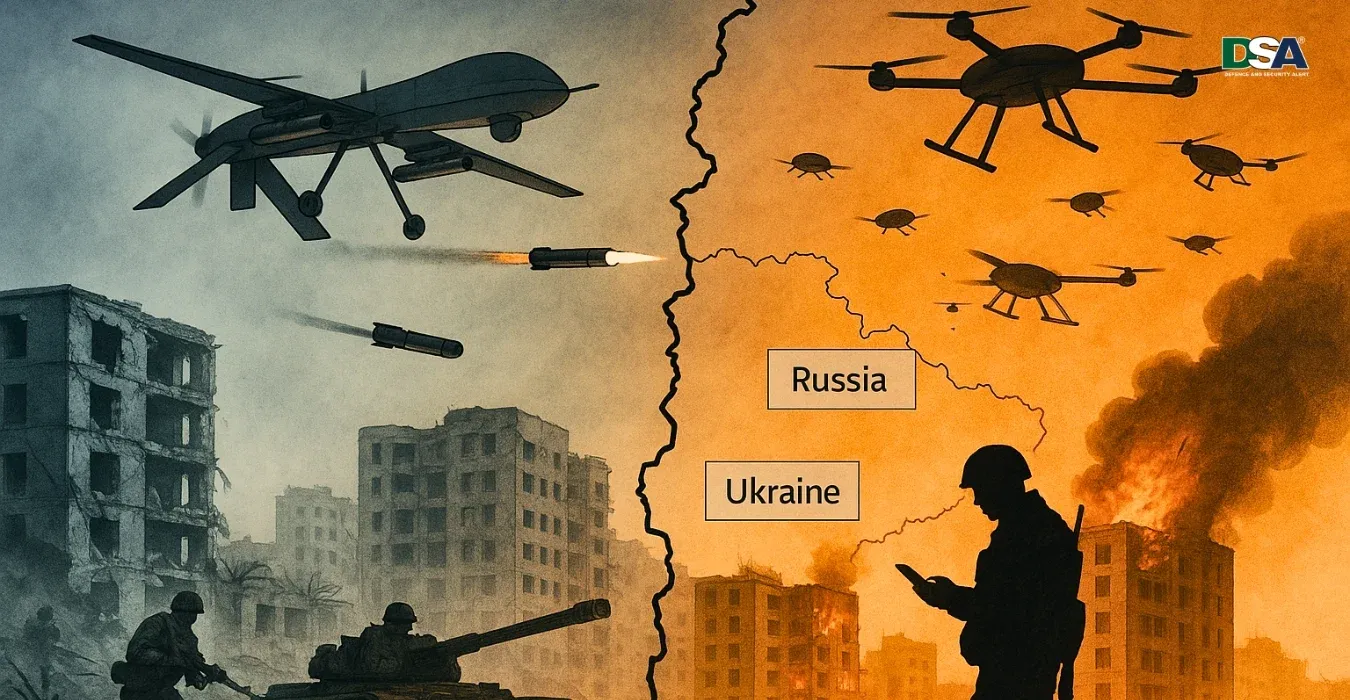
Drone warfare isn’t the future of war—it’s its front-line present. This is no other contemporary war. The Russia- Ukraine conflict has become a live-fire test bed where more than a million Ukrainian FPV drones were being produced in 2024 alone, while Russia is said to be firing 4,000 drones a day. These are no longer surveillance tools. They are kamikaze hunters, AI-assisted assassins, and inexpensive killers that cost $500 but can destroy tanks costing millions. Drones today represent almost 70% of casualties on the battlefield, redefining all rules of conventional warfare.
What started as an off-the-shelf drone and battlefield improvisation has now turned into an arms race of innovation. Electronic jamming, first-person-view (FPV) kamikaze drones, and AI-powered swarms are now essential components of strategy rather than ancillary tactics. War itself is being reinvented as Russia launches waves of Shaheds and Ukraine’s underground workshops modify drones on a large scale.
However, this is not a solitary theater. The tactical lessons learned from the Donbas are currently being applied to Indian counterterrorism operations, Middle Eastern flashpoints, and Chinese military exercises. The ideology is changing, the technology is proliferating and the world defence order is subtly changing. From the trenches to the sky, from high-tech arms races to low-cost resourcefulness, each portion of this article reveals a layer of this metamorphosis.
Even if the war is far from its end, the message is already being felt globally. What does it tell us specifically?
The evolution of drone warfare: tactics, adaptations and innovations
When the war erupted in 2022, very few imagined the sky to be the most disputed territory, and even fewer thought the drones that cost less than a smartphone would reshape the battlefield. Yet that’s exactly what has happened, and today the war has turned into a life experiment in drone technology with adaptation from both sides. The drone warfare unfolded in different phases, each with technological advancements and adaptations.
In the early days of the invasion, Ukraine appeared desperate and unbalanced. But its drawbacks in heavy equipment were made up by civilian drones leveraging commercial DJI drones and Turkish Bayraktar TB2s to conduct air surveillance and guide artillery. This revolution was not only embraced but also became a symbol of resistance against the Russians. Hackers, engineers, and coders became essential assets upscaling the country’s drone capabilities with the help of the Ukrainian government, which launched the Army of Drones initiatives by channeling donations and gaining support from across the world. Drone deliveries were made faster by crowdfunding than by any traditional procurement methods. This helped Ukraine build an ecosystem of drone schools, volunteer network coding teams, and frontline operators, all working cooperatively by late 2022.
By the end of 2022, Russia adopted a flexible drone strategy. They deployed Pant-Sir air defence systems to target larger UAVs, sophisticated GPS spoofing around key locations, and the use of electronic warfare systems like the RB341V Leer 3 to jam communications, which became weapons to counter Ukraine’s dominance. The turning point came after the import of Iran’s Shahed 136 loitering munitions. Though not high-tech and economical, it had the capability of targeting long-range infrastructures and strategic sites. Russia also started its production lines, majorly investing in drone warfare capabilities and introducing layered jamming devices to disrupt Ukrainian drone swarms. The Russian military also created devoted groups for electronic countermeasures and anti-drone technology. Russia’s approach was strategic as it was not just for precision strikes but also to confuse and exhaust their enemy by deploying dozens of drones in certain areas. Although it wasn’t pretty, it was effective and reshaped the military’s thinking.
In the 2nd and 3rd years of the war, drones were not just tools but became a dominant aspect of modern warfare. The new currency for intelligence was now aerial footage. A variety of unmanned systems were used in the battle, ranging from hobbyist-built palm-sized FPV drones to fixed-wing long-range UAVs. Ukrainian volunteers converted racing drones into weapons by offering precision strikes on moving targets at 100+ km/h speed by spending only $500 per unit for production. They also developed drone schools to train 200+ operators weekly. They also created specialized anti-EW drones and implemented 3D printed component production. On the other hand, Russia issued cope cages, increased the use of camouflage, and decoys.
By 2024, hardening vital assets and deploying drones to deliver supplies, surveillance information, and coordinated strikes were the main areas of Russian innovation. Increased patrols and net defenses, attempted harbor fortifications, and electronic warfare ships like the Ivan Khurs were also introduced. Mass production of Lancet loitering munitions, EW systems with automated drone detection, and Iranian-designed Shahed 238 with AI targeting were also seen as Russian efforts to counter Ukrainian innovations such as “Drone hunter” UAV, Saker Scout AI, and crowdsourced apps like Delta.
Ukraine’s success with drones is a result of a decentralized, flexible strategy that includes combining volunteer organizations like Aerorozvidka with military units, field-testing innovative designs in a matter of weeks, and 3D- printing parts close to the front. Rapid changes are fueled by troop feedback via Telegram channels, and modular designs enable speedy repairs. On the other hand, Russia depends on centralized mass production and prioritizes quantity (300+ Shaheds every month) over quality. Russia’s effectiveness in electronic warfare has fallen from 70% to 30% as Ukrainian adaptations surpass their countermeasures, despite Ukraine currently producing more than 50,000 FPV drones per month. The balance of power in modern warfare changes every week as a result of this innovation gap between industrial force and grassroots resourcefulness, with both sides caught in a deadly cycle of adaptation and innovation.

The Human Battlefield
Birdsong no longer interrupts the early hush in today’s frontline trenches, whether they are dug into the frozen borders near Belgorod or into the black dirt of Donetsk. Rather, a high-pitched mechanical whine opens it. Now, both Russian and Ukrainian troops rise to the sound of drones flying overhead, some hunting, some observing. With
$500 drones delivering precise destruction from kilometers away, both sides use their fingertips and FPV goggles to wage battle. The battlefield has been reduced to a screen, and the soldier is now simultaneously a target, an engineer, and a gamer in addition to being a warrior. The distinction between a joystick and a gun trigger has virtually vanished in this next-generation warfare laboratory, which is more than just a conflict between states.
Soldiers Reality
Russian soldiers call it the mosquito war, referring to FPV drones that act like “flying sniper bullets” waiting silently until a target is hit. Ukrainian troops, on the other hand, use over 15 + grenade-dropping drones to clear the trenches before attacking.
According to the diary of a captured Russian officer, “Day 37 without bathing, the drones hear the water, they come for the sound”. This diary entry reflects the harsh conditions the soldiers endured, forcing them to live in fear.
People’s Fears
On the home front, civilians aren’t spared. The residents of Kharkiv (a Ukrainian city) can identify drones just by their sound, for example, the hum of the Orlando 10 is referred to as the “lawn mower” vs the “angry wasp,” which is the shriek of an incoming Lancet. Shahed drones supplied by Iran required almost $1,000,000 in air defence to offset a $20,000 threat when used in large numbers. Russian lancets target harvesters and tractors, whereas farmers use infrared drones to find mines.
The Operators
Many FPV drone pilots, on the other hand, are former esports players. Their reflexes, once beneficial in shooting, now determine real-world outcomes. To avoid “drone hypnosis” or going into a trance state from continuous VR immersion, crews rotate every 4 hours. In such prolonged times, some pilots even develop their signature attack styles, for example, “The Welder” and the “Door Knockers,” the former targeting the engine compartment while the latter specialising in hatch ramming.

A Ukrainian doctor outside Bakhmut summarizes: “We no longer fear artillery fire. It’s that one buzz you don’t hear until it’s 10 meters a way—that’s what keeps soldiers up at night.”
Battle lines are becoming undetectable due to electronic warfare. Fields have become dead zones. Grotesque, personal, and changing more quickly than the laws intended to regulate it, this is war at machine speed.
Global Shockwaves
The effects of the Russia-Ukraine war are not just limited to the front lines; rather, they have spread all across the world, bringing out revolution in military doctrines. What started as an improv on the battlefield off-the-shelf FPV drones piloted by teenagers has today developed into a geopolitical warning to nations ranging from Washington to Beijing. Simple yet powerful $500 drones can outsmart billion-dollar systems in modern warfare.
Russia reported up to 4,000 daily sorties of FPV drones, while Ukraine manufactured over a million in 2024 alone. These figures are paradigm-shifting, not merely startling. Traditional military economics breaks down when a $5 million armored vehicle may be destroyed by a $500 FPV drone. Even the most sophisticated militaries are being forced to reconsider how they gauge power, deterrence, and sustainability in protracted warfare as a result of this asymmetric cost ratio, which is changing the calculus of war.
China
Nowhere is the war watched more closely than in China. The People’s Liberation Army has been in a tussle with the West for a long time. China has now refocused its priorities in modern warfare. Since 2023, Beijing has developed AI-piloted “Loyal Wingman” drones, increased drone swarm exercises with more than 1000 UAVs, and increased the production of suicide drones based on Iran’s Shahed model. The Ukrainian approach provides a cruelly effective opening act for Chinese planners considering an invasion of Taiwan: shoot drones into the air, overwhelmed defences, and destroy the enemy’s command organization before a single boot touches the ground.
Middle East
The Israel-Hamas conflict, too, has become a laboratory for asymmetric drone warfare. Inspired by Ukrainian FPV drone methods, Hamas now uses precision strikes to get past conventional defenses. Quicker transition to laser defenses has resulted from Israel’s Iron Dome, which has been built to withstand rocket attacks, but has trouble intercepting low-cost, low-flying UAVs. High-tech, expensive defenses have been required in response to Hezbollah’s drone attacks into Israeli airspace.
West
The challenge West faces now is whether a trillion-dollar army can defeat $500 threats. Operating a Patriot missile system costs $40,00,000 per hour, which is enough money to buy whole drone battalions. Ukraine is already using thousands of autonomous drones every day, despite the US replicator initiative promising swarms of these drones by 2026. What used to be science fiction is now commonplace in combat.

Now, the question remains who is winning the drone war? Given that it’s sometimes simpler to halt and attack than to breach entrenched lines, drones tend to favour defenders as the Russia-Ukraine conflict makes it clear. In this changing battlefield, quality is more important than quantity. Russia’s larger but less advanced swarms of drones are routinely outmaneuvered by Ukraine’s more intelligent and accurately targeted drones. The rapidity at which either side adjusts is ultimately what gives them the advantage, not the technology itself.
As one Pentagon report concluded, “The FPV drone has done to tanks what the machine gun did to cavalry”.
India’s Drone Awakening
The drone conflict between Russia and Ukraine has echoed in India. Using thermal imaging and live feeds, India’s troops quickly used surveillance drones to pursue militants over dense terrain after the Pahalgam terror strike in Jammu & Kashmir on April 22, 2025.
India demonstrated a fresh offensive advantage by launching Operation Sindoor right after. Local kamikaze drones were utilized for the first time to eliminate militant hideouts situated in wooded gullies. These loitering drones, which are controlled by AI and satellite coordination, precisely strike targets while avoiding danger to the troops.
India’s military drone policy is developing more quickly. New Delhi is adjusting rapidly, from deploying quadcopters for border monitoring to creating swarm drone capabilities through the iDEX program. These days, indigenization, integration, and the development of counter-drone systems that can eliminate threats before they reach Indian territory are the main priorities.
The conclusion is straightforward: drones are weapons of the present, not the future. The side that integrates the best and adapts the fastest establishes the terms of engagement, whether in Pahalgam or Donetsk.

The Inescapable Warfare
The war between Russia and Ukraine has demonstrated one unarguable fact: the age of drone-predominated conflict is not arriving; it has already arrived. What started as DIY aerial cameras has developed into AI-controlled swarms that win wars, with $500 drones easily outsmarting billion-dollar air defenses. A crucial question facing the world is whether any military can afford to overlook these lessons as Moscow and Kyiv continue their lethal innovation race, with Russia mass-producing Shaheds and Ukraine refitting drones in underground workshops.
The consequences are far-reaching beyond Eastern Europe. From Taiwan’s drone-swarm exercises to India’s counterterrorism efforts, states are rushing to catch up. But the war in Ukraine indicates an even more profound transformation: success no longer falls to whoever is equipped with the most advanced technology, but to whoever can innovate quickest. If a teenager wearing a VR headset can obliterate a tank, the very nature of military power is changed.
As the war drags on, one reality becomes increasingly apparent day by day: the drones buzzing above Donbas today will define tomorrow’s conflicts from the South China Sea to the Middle East. The world is paying attention, but is it learning quickly enough?
In this new era of warfare, only one rule is supreme: Evolve or Die.
