
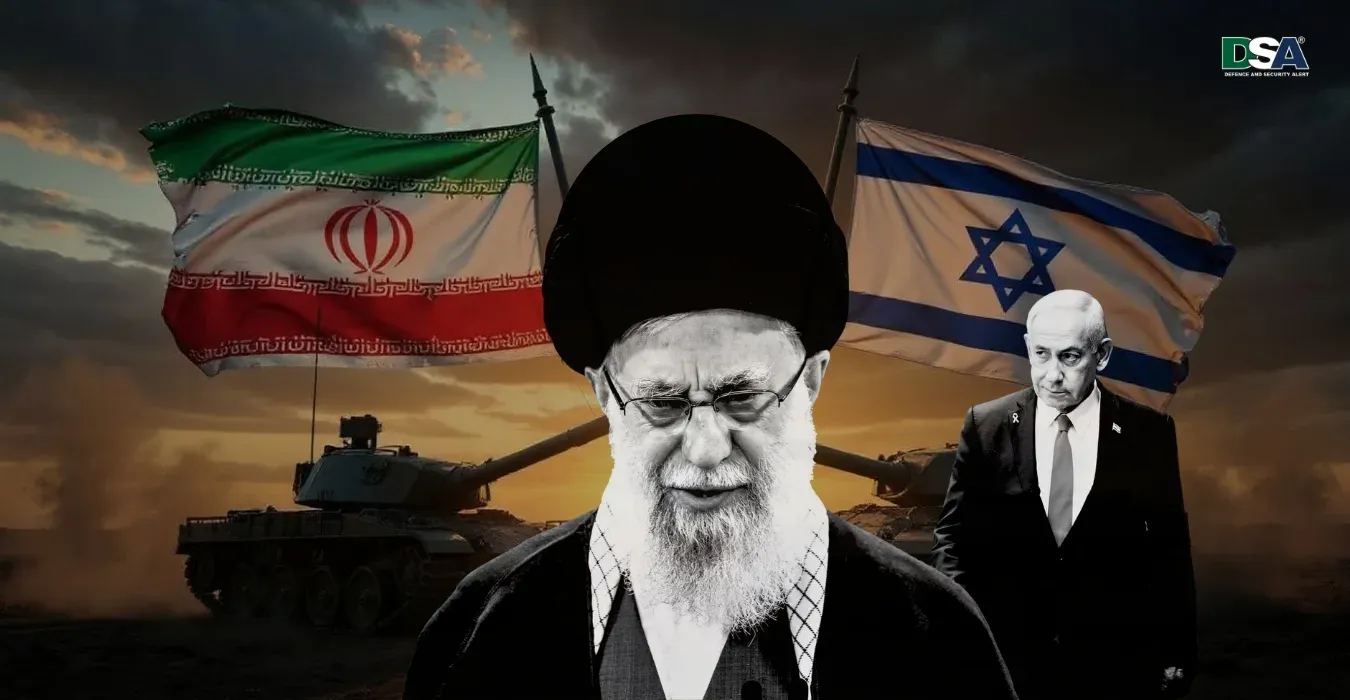
The recent Israeli offensive, codenamed Operation Rising Lion, marks a sudden shift in the balance of power in West Asia. For decades, Iran has protected itself through a ring of proxies—most notably Syria and Hezbollah in Lebanon—which have served as both deterrents and launchpads in Tehran’s asymmetric warfare doctrine. However, this layered security buffer has been systematically dismantled over the past two years, clearing a direct path for the Israeli Air Force (IAF) to strike deep into Iranian territory with minimal resistance.
The Collapse of the “Shia Crescent”
The first step in this strategic unravelling was the effective neutralisation of Syria’s air defence infrastructure. Following years of internal conflict and the eventual removal of President Bashar al-Assad, Syria’s military capabilities were critically weakened. Russian disengagement and Western reluctance to restore Assad’s control created a vacuum that Israel and its allies exploited. Israeli air operations intensified, targeting Iranian weapons transfers and military installations within Syria. These operations not only crippled the Quds Force supply lines but also eliminated key radar and SAM (Surface-to-Air Missile) systems, making Syrian airspace increasingly permissive for Israeli aircraft. At the same time, Syria is no longer in the camp of Iran and likely shares any information with the Islamic Republic.Simultaneously, the Gaza conflict served as a pretext for a full-scale confrontation with Hezbollah. With the group’s attention and resources stretched thin during the war in Gaza, Israel executed precision strikes on Hezbollah’s long-range missile facilities and command infrastructure in southern Lebanon. According to open-source intelligence and recent battlefield imagery, Hezbollah’s ability to launch coordinated, long-range offensives has been severely degraded. The group has also lost critical logistical routes connecting it to Iranian weapons shipments via Syria and Iraq—effectively isolating it from its patron. With Hezbollah neutralised, Syria hollowed out, and Iraq fragmented by internal dissent and Iranian overreach, the traditional arc of Iranian influence known as the “Shia Crescent” has collapsed. Israeli jets now face fewer constraints flying over Lebanese, Syrian, and Iraqi airspace. For the first time in decades, the IAF holds operational dominance from the Mediterranean Sea to the Iranian plateau.
Operation Rising Lion: Striking at the Heart of Iran
This chain of events set the stage for Operation Rising Lion, a bold military campaign that directly targeted Iran’s nuclear infrastructure. High-resolution satellite imagery and Israeli military briefings reveal that the strikes have gone far beyond symbolic posturing. Not only were suspected nuclear enrichment facilities near Kermanshah hit, but extensive damage was inflicted on radar stations, early warning systems, and major missile depots. More alarmingly for Tehran, several of its surface-to-surface missile launch platforms—considered key to its deterrence posture—were reportedly destroyed. Not to forget, last year when first direct confrontation happened between Iran and Israel, Israel bombed missile storage, radar infrastructure and Air defences. Iranian ballistic missiles may have entered Tel Aviv and have caused major destruction but with logistic help from the US, UK and France, Israel would be able to stand its ground in the face of Iranian counter retaliation. The balance of power has been changing since October 7, 2023 in the region but the major blow came on June 13. Military analysts suggest that Tehran’s air defences remain patchy and outdated in key zones around the capital. Morale within the Iranian military appears shaken, as elite units scramble to reposition amidst growing fears of another wave of Israeli strikes. With Tehran exposed and regional deterrents weakened, the path to Iran has not only been cleared—it has been paved with precision, timing, and a well-executed strategy that may redefine regional geopolitics in the days to come.
The Real Objective: Iran’s Nuclear Ambitions
Without discussing the aim of the operation Rising Lion, the article would fail to do justice with the reader. The goal of the operation was not only to weaken Iran but to dismantle their nuclear ambitions and program. Till now the aim was only partially fulfilled. Partially, because Israel’s attack on Natanz nuclear facilities, which is one of the most important facilities in the country, has not been successful. While multiple sites were hit, the Natanz nuclear facility—a hardened, deeply buried installation—survived the initial assault. A report by the International Atomic Energy Agency (IAEA) and The New York Times confirms that Natanz remains operational. However, the operation has not been without strategic gain. Several high-ranking nuclear scientists-key human assets in Iran’s atomic efforts—were killed in the strikes. Among the notable losses are Mohsen Fakhrizadeh’s successors in nuclear planning and advanced enrichment research, including Reza Karimi and Dr. Behzad Naghavi. The loss of such intellectual capital is a crippling blow to Iran’s nuclear timeline.
The Stakes Ahead
Prime Minister Benjamin Netanyahu’s decision to escalate was not made lightly. If Israel fails to permanently degrade Iran’s nuclear capacity, it is widely feared that Tehran will redouble its efforts to develop a nuclear weapon. The time window is rapidly closing. According to defence analysts, Israel is now locked into a phase where there is no choice but to finish what it started—complete destruction of Iran’s nuclear infrastructure.June 13, 2025, will be remembered as the turning point. While the tectonic plates of regional power began shifting after the Hamas-led October 7, 2023 attacks, it is the events of the past 48 hours that have truly defined the new order in West Asia.
A Paved Path with No Return
The road to Tehran has been paved-not with bluster or rhetoric, but with a series of meticulously coordinated military moves. What began with the crumbling of Syria and isolation of Hezbollah has culminated in the direct targeting of Iran’s most protected assets. Israel has altered the rules of engagement. With air superiority achieved and Iran’s deterrent eroded, the region stands at the edge of a new era—one where the final outcome may very well depend on the fate of a few fortified underground bunkers beneath the Iranian desert.
