
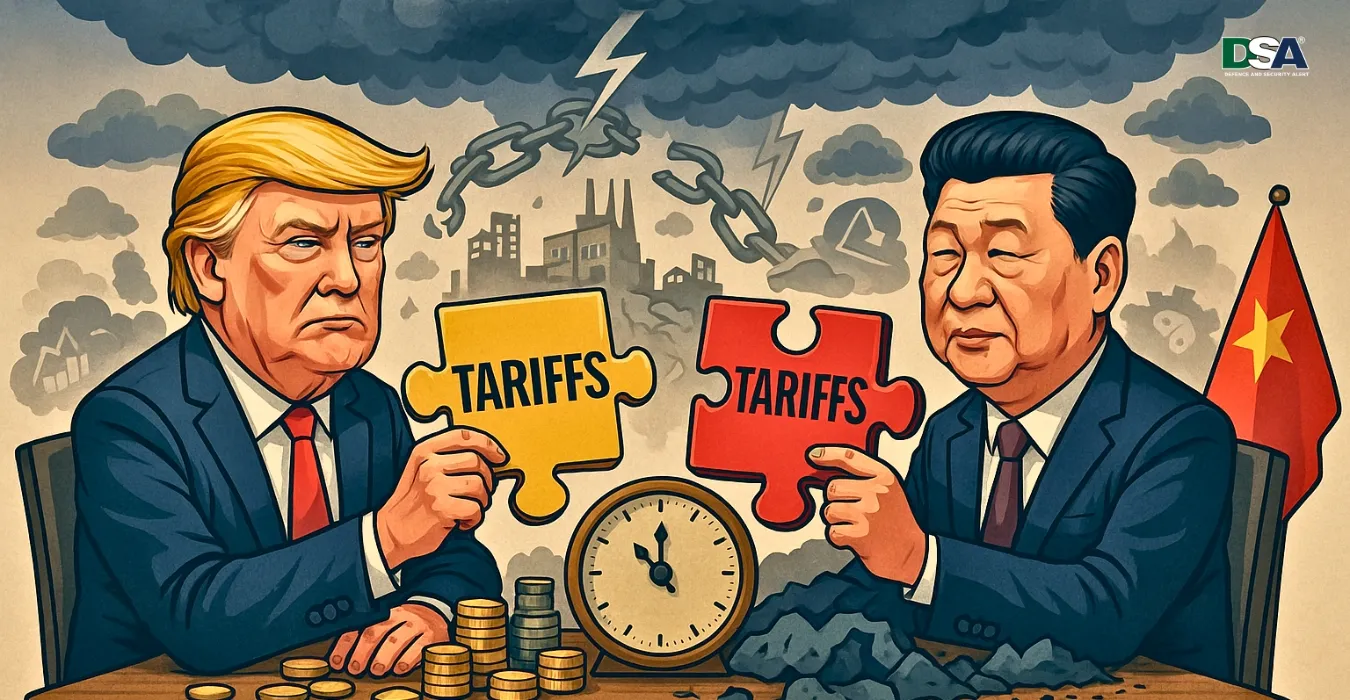
In 2018, U.S. President Donald Trump took to social media to proclaim that trade wars were “good and easy to win,” casting America’s trade deficits as a trump card to pressure other nations. This week, as the Trump administration slapped tariffs exceeding 100 percent on Chinese imports, sparking a volatile new chapter in U.S.-China economic tensions, Treasury Secretary Scott Bessent echoed that bravado. He argued that China’s retaliatory tariffs are a blunder, pointing out that the U.S. exports only a fraction, about one-fifth, of what China sends to American shores. In Bessent’s view, this imbalance hands the U.S. what strategists’ term “escalation dominance”, he ability to raise the stakes in a conflict in ways an opponent can’t match without crippling losses.
The administration’s logic suggests that nations like China, or even Canada, which dare to counter U.S. tariffs, are destined to fold under Pressure. But this confidence is built on shaky ground. Far from holding the winning hand, the United States is dangerously exposed in this trade war. China, not Washington, wields escalation dominance and America’s high-stakes bet risks plunging its economy into chaos while strengthening Beijing’s position.
The False Promise of Trade War “Wins”
The Trump administration’s argument rests on two flawed assumptions. First, it treats trade wars like a high-stakes poker game, where one side’s gain comes at the other’s expense. In reality, trade is a cooperative exchange where both parties benefit. When tariffs disrupt this flow, everyone pays a price—higher costs, disrupted supply chains and lost access to goods consumers and businesses rely on. Starting a trade war isn’t a surgical strike; it’s an act of mutual destruction, like torching a shared warehouse and expecting only the other side to feel the heat.
Second, the administration misreads the U.S. trade deficit with China-$263.3 billion in 2024, with $462.5 billion in imports versus $199.2 billion in exports—as a source of leverage. The thinking goes: because America buys more from China than it sells, it has less to lose by slamming the door shut. This is a dangerous oversimplification. In 2023, China accounted for 13.9 percent of total U.S. goods imports, per the U.S. Census Bureau, supplying everything from electronics to medical supplies. Disrupting that flow doesn’t just cost money; it cuts off goods the U.S. can’t easily replace. By contrast, China’s surplus gives it flexibility—losing U.S. sales hurts, but money is fungible and Beijing can pivot to other markets or boost domestic demand.
China’s Upper Hand
To understand why China holds the advantage, consider what’s at stake. The U.S. relies on China for critical inputs: 80 percent of active pharmaceutical ingredients for generic drugs, according to a 2020 report by the U.S.-China Economic and Security Review Commission; low-cost semiconductors powering cars, appliances and medical devices; and rare earth minerals essential for everything from electric vehicles to military hardware. In 2023, China supplied 97 percent of U.S. imports of rare earth compounds, per the U.S. Geological Survey. Replacing these overnight—or producing them domestically would be prohibitively expensive, if not impossible, in the short term.
A sudden cutoff risks shortages that hit hard and fast. Take pharmaceuticals: a 2021 study by the National Bureau of Economic Research estimated that a 50 percent reduction in Chinese imports could spike U.S. drug prices by 20 percent, squeezing hospitals and patients. Semiconductors are another choke point—China’s role in global chip supply chains means tariffs could drive up costs for U.S. automakers, who already faced a $210 billion hit during the 2021 chip shortage, per AlixPartners. These aren’t abstract numbers; they translate to empty shelves, idled factories and higher prices for American families.
China, meanwhile, has cushions the U.S. lacks. Its trade surplus-$870 billion globally in 2024, per China’s General Administration of Customs—reflects a savings glut, giving Beijing room to absorb losses by redirecting exports or stimulating its domestic market. In 2023, China’s domestic consumption accounted for 53 percent of its GDP, up from 46 percent a decade earlier, per the World Bank, showing its growing ability to lean inward. The U.S., with a trade deficit of $971 billion in 2024 (U.S. Bureau of Economic Analysis), spends more than it saves, leaving it vulnerable to supply shocks. Tariffs make imported goods pricier or scarce, and unlike money, physical goods aren’t easily substituted. The pain concentrates in specific industries—think Michigan auto plants or Texas hospitals—where shortages can’t be papered over with stimulus checks.
The Economic Fallout
If these tariffs, at over 100 percent, persist, the U.S. faces a grim outlook. Economists at the Peterson Institute for International Economics estimate that a full-scale trade war with China could shave 1.3 percent off U.S. GDP by 2026—roughly $350 billion in lost output—while inflation could climb 2 percentage points. This is stagflation territory, the toxic blend of shrinking growth and rising prices that haunted the 1970s and resurfaced during COVID-19. The Federal Reserve would face a nightmare: hike rates to tame inflation and risk unemployment or ease policy and fuel price spirals. Either way, American workers and consumers bear the brunt.
Beyond shortages, the U.S. economy’s reliance on foreign capital—$1.2 trillion in net inflows in 2023, per the Treasury Department—adds another layer of risk. Tariffs signal chaos, spooking investors and raising borrowing costs. A 2024 Moody’s Analytics report warned that sustained trade disruptions could push U.S. 10-year Treasury yields up by 0.5 per cent, increasing debt servicing costs by $100 billion annually. China, by contrast, holds $3.3 trillion in foreign exchange reserves (People’s Bank of China, 2024), giving it a buffer to weather market turbulence.
A Strategic Misstep
The administration might argue this is all a calculated bluff to force concessions. But even as a tactic, it’s reckless. Launching a trade war without securing alternative suppliers or ramping up domestic production is like challenging a rival to a duel before loading your gun. The U.S. needs Chinese goods to function; cutting them off invites the very weaknesses—supply chain fragility, economic dependence that Trump claims to oppose.
Worse, the strategy undermines itself. To seem credible, the U.S. must act on threats that hurt its economy, creating a cycle of uncertainty. A 2023 survey by the Conference Board found that 60 per cent of U.S. CEOs cited policy unpredictability as a top barrier to investment. Tariffs amplify that, discouraging factories from breaking ground and pushing capital overseas. Allies and trading partners, burned by erratic U.S. moves, will hesitate to strike deals, fearing Washington won’t honour them. The result? A less resilient U.S. economy, more exposed to global leverage, not less.
A Quagmire in the Making
This trade war risks becoming an economic sinkhole—a self-inflicted wound that erodes faith in America’s competence and reliability. History offers a cautionary tale: in the 1930s, the Smoot-Hawley Tariff Act deepened the Great Depression, cutting U.S. exports by 67 percent and GDP by 17 per cent, per the National Bureau of Economic Research. Today’s stakes are different but no less dire. China isn’t poised to crumble under U.S. pressure; it’s ready to outlast and outmanoeuvre.
If the goal is economic security, the U.S. needs to build, not burn-invest in domestic capacity, secure diverse suppliers, and strengthen alliances before picking fights. Instead, it’s gambling on a weak hand, with American workers, businesses and consumers left to pay the price. In this high-stakes game, China’s not the one bluffing and the U.S. can’t afford to lose.
