
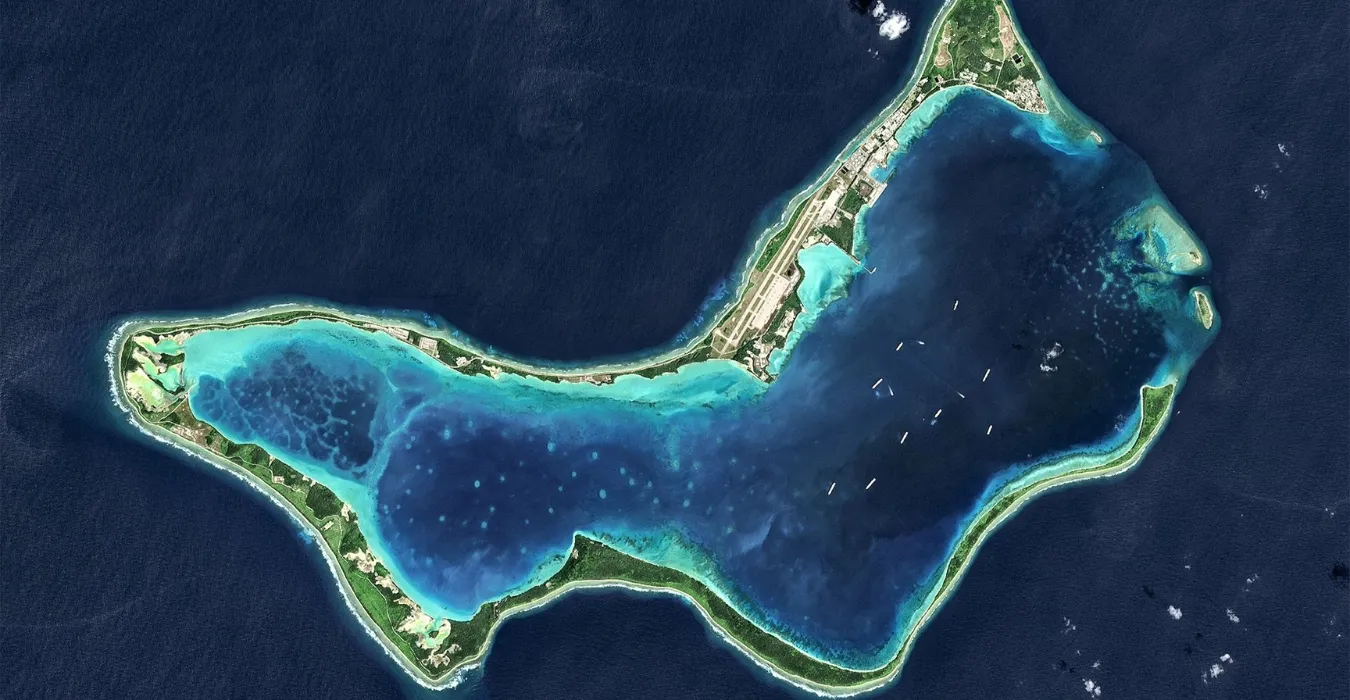
Geopolitical Significance of Diego Garcia
Strategic Location
Diego Garcia’s location—approximately 1,000 miles south of India and equidistant to the eastern coast of Africa and Southeast Asia-grants it unparalleled reach across critical maritime chokepoints such as the Strait of Hormuz, the Bab el-Mandeb, and the Malacca Strait. These routes handle a substantial proportion of global oil trade and commercial shipping, making the island essential for ensuring maritime security and freedom of navigation.
This positioning provides the United States and its allies a forward base to monitor and, if necessary, respond to any instability in the IOR, including crises in the Persian Gulf or rising Chinese influence in the region.
Historical Context: From British Colony to Military Hub
The Chagos Archipelago, including Diego Garcia, was separated from Mauritius by the United Kingdom in 1965 to form the British Indian Ocean Territory (BIOT). By the late 1960s and early 1970s, the US recognized Diego Garcia’s strategic value amidst Cold War tensions. The island was developed into a joint US-UK military facility, solidifying Western presence in the Indian Ocean.
However, this came at a human cost. Between 1968 and 1973, over 1,500 native Chagossians were forcibly removed to Mauritius and the Seychelles to make way for the military installation—a move that remains contentious in international courts and diplomatic circles.
Diego Garcia’s Military Infrastructure
Diego Garcia hosts a range of sophisticated military infrastructure that supports both naval and air operations:
- Naval Support Facility Diego Garcia: This provides anchorage for submarines, surface warships, and prepositioned supply vessels. The lagoon can accommodate a large fleet, including nuclear-powered submarines.
- Airfield: The island features two parallel runways capable of handling heavy bombers, reconnaissance aircraft, and refueling tankers. During operations in Afghanistan and Iraq, B-1B and B-52 bombers were regularly deployed from Diego Garcia.
- Logistics and Supply Hub: Diego Garcia acts as a critical logistics node, housing prepositioned supplies, fuel depots, and maintenance facilities to sustain long-range operations.
Role in Past and Present Conflicts
Diego Garcia has been instrumental in numerous US-led military operations, including:
- Gulf War (1990-91): Served as a launchpad for strategic bombers and refueling operations.
- Operation Enduring Freedom (2001): Functioned as a staging ground for strikes against Taliban and Al-Qaeda positions in Afghanistan.
- Operation Iraqi Freedom (2003): Supported air sorties and logistical supply chains for coalition forces.
The island’s ability to support extended-range operations underscores its importance as a power projection platform, ensuring rapid response capabilities without reliance on host nations in volatile regions.
Diego Garcia and the Indo-Pacific Security Landscape
With the growing strategic competition between the United States and China, Diego Garcia has gained renewed prominence in the Indo-Pacific security architecture. China’s increasing naval footprint in the Indian Ocean, including port developments in Gwadar (Pakistan) and Hambantota (Sri Lanka), highlights the importance of maintaining a robust forward-operating base like Diego Garcia to counterbalance Beijing’s influence.
Additionally, Diego Garcia complements the Quadrilateral Security Dialogue (Quad)—comprising the US, India, Japan, and Australia-by enhancing maritime domain awareness and joint operational capabilities in the region.
Legal and Diplomatic Controversies
The sovereignty of the Chagos Archipelago remains a subject of international dispute. In 2019, the International Court of Justice (ICJ) ruled that the UK’s continued administration of the territory was unlawful and called for its return to Mauritius. The United Nations General Assembly backed this ruling, intensifying diplomatic pressure on London and Washington.
While the UK and US have maintained that the island’s military utility is essential for regional security, Mauritius continues to advocate for sovereignty over the Chagos Islands, including Diego Garcia.
The Future of Diego Garcia
The strategic calculus around Diego Garcia will likely remain unchanged in the near future. The island’s role as a critical outpost for US military operations, particularly amidst increasing Chinese assertiveness and persistent regional instabilities, ensures its continued relevance.
However, the unresolved legal status of the Chagos Archipelago and the moral dimensions of the Chagossian displacement pose long-term challenges. Addressing these concerns—potentially through negotiated settlements or shared governance frameworks—could redefine the island’s role in future geopolitical equations.
Conclusion
Diego Garcia epitomizes the intersection of geopolitics, military strategy, and legal contention in the Indian Ocean. As the Indo-Pacific emerges as the fulcrum of 21st-century geopolitics, this remote atoll will continue to shape the security dynamics of the region, serving as a vital asset for safeguarding maritime routes, deterring adversaries, and supporting global military operations.
