
Strategic Importance
India’s geographical position as a peninsular power makes it a natural guardian of the IOR. Key choke points such as the Malacca Strait, Hormuz Strait and Bab el-Mandeb are integral to India’s maritime strategy. These waterways are critical for trade and energy supplies, connecting the Middle East, Africa and Southeast Asia.
Naval Modernisation
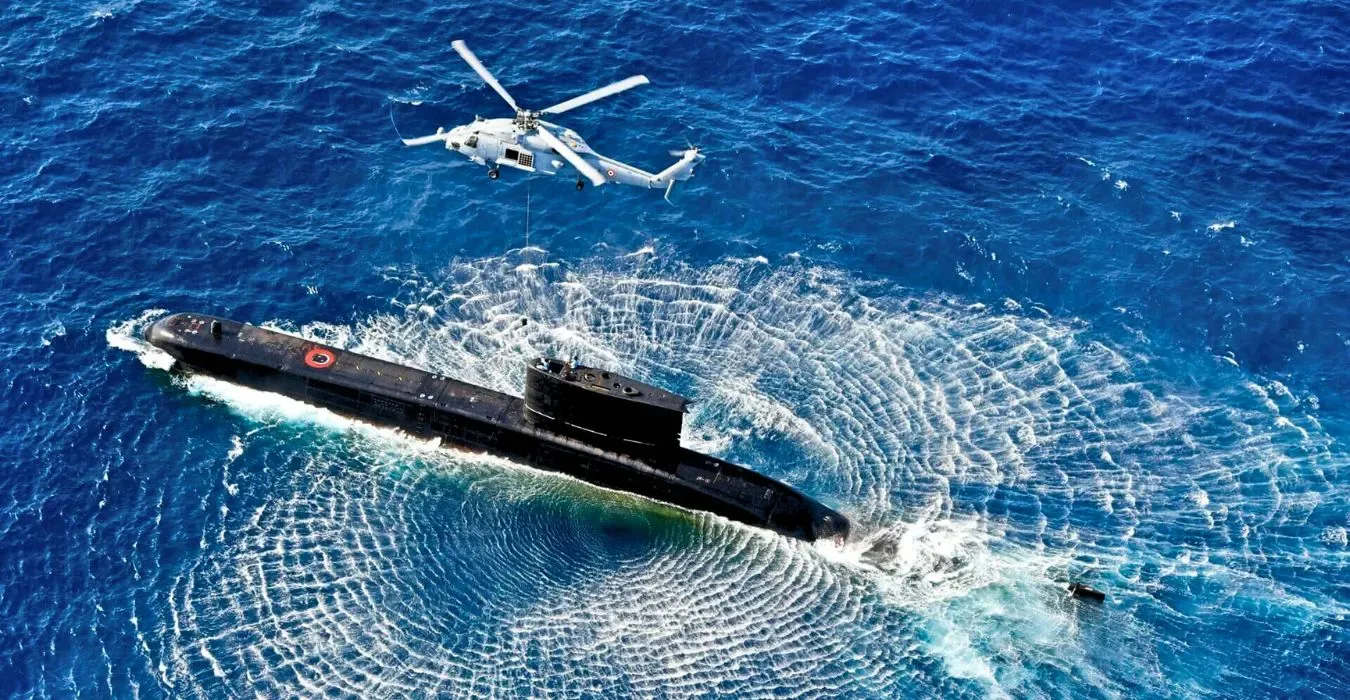
The Indian Navy has significantly enhanced its capabilities with advanced Ships, Aircraft Carriers and strategic initiatives. INS Vikrant, India’s first indigenous aircraft carrier, marks a milestone in naval shipbuilding, while the Scorpène-class submarines, including INS Kalvari and INS Khanderi, which are primarily designed for anti-ship and anti-submarine operations, bolster underwater warfare capabilities. The induction of P-8I Poseidon maritime surveillance aircraft and MH-60R Seahawk helicopters has further strengthened India’s maritime capabilities and counter threats in the Indian Ocean Region (IOR).
INS Tushil, a stealth frigate of the Talwar-class, is being developed under the collaboration between India and Russia. Equipped with advanced weaponry, sensors and stealth technology, INS Tushil will enhance the Indian Navy’s combat capabilities. As part of the follow-on order to the original Talwar-class frigates, it is designed to perform multiple roles, including anti-air, anti-surface and anti-submarine warfare.
Other initiatives, like Mission SAGAR, showcase India’s commitment to maritime diplomacy and humanitarian assistance in the Indian Ocean Region. Strategic programmes like the Maritime Theatre Command (MTC) aim to improve coordination across naval, air and land forces. Modernisation efforts also include the development of nuclear-powered submarines like INS Arihant and INS Arighaat, Project 17A frigates and advancements in unmanned systems and coastal defence. Participation in international exercises such as Malabar and the expansion of naval bases like INS Kohassa highlight India’s strategic focus on maritime security and its growing influence in the Indo-Pacific.
Partnerships and Exercises
India has been actively strengthening its strategic partnerships and regional engagement to enhance security and counterbalance China’s growing influence in the Indian Ocean Region (IOR). As a key member of the Quadrilateral Security Dialogue (Quad), alongside the United States, Japan and Australia, India promotes a free, open and inclusive Indo-Pacific. The Malabar naval exercises, initially a bilateral initiative with the U.S., now include all Quad nations, enhancing interoperability and demonstrating a unified commitment to regional security.
In 2016, India signed the Logistics Exchange Memorandum of Agreement (LEMOA) with the U.S., enabling reciprocal access to military facilities for logistics support, thus strengthening operational readiness and strategic cooperation. These partnerships play a crucial role in countering China’s “String of Pearls” strategy, which involves developing a network of ports and infrastructure in countries like Pakistan, Sri Lanka and the Maldives to secure its maritime interests and expand its influence in the IOR.
India’s leadership in the region is further underscored by its active participation in the Indian Ocean Naval Symposium (IONS) and cooperation with ASEAN nations. These engagements foster dialogue, joint exercises and collaboration, promoting maritime security and stability in the region. Collectively, these initiatives reflect India’s comprehensive approach to securing its strategic interests and addressing challenges in the Indo-Pacific.
Non-Traditional Security Challenges
Piracy, illegal fishing and climate change-induced disasters are major non-traditional security threats in the Indian Ocean Region (IOR). India’s Information Fusion Centre for the Indian Ocean Region (IFCIOR), established in 2018 in Gurugram, plays a crucial role in enhancing maritime domain awareness. By sharing information and fostering cooperation with partner nations, it ensures timely responses to maritime threats and promotes regional stability.
Conclusion
India’s proactive maritime strategy ensures the IOR remains a zone of peace and stability. Continued investments in naval capabilities and regional partnerships will fortify India’s position as a dominant maritime power, capable of addressing both traditional and non-traditional threats.
