
In March 1943, when Pusat Tenaga Rakjat (Putera), which translates to “Center of the People’s Power,” was inaugurated under the chairmanship of Indonesian freedom fighter Sukarno, an Indian revolutionary nationalist leader, Subhas Chandra Bose, was on his way to East Asia – travelling underwater from Europe in a daring journey via the Cape of Good Hope. Both Bose and Sukarno, incidentally, were engaged in channeling people’s aspirations to put up a strong resistance against Western imperialism in their respective countries, India and Indonesia.
Former Manipur Chief Minister Mohammed Alimuddin with Japanese World War II veterans in Manipur – 1974.
Bose set his foot in Sabang, a group of islands off the coast of Sumatra, from where he flew to Tokyo, touching down en route at Penang, Manila and Saigon. While Bose rejuvenated an armed unit called the Indian National Army (INA) with Japanese assistance the same year and went on to establish a government in exile in October 1943, the Indonesian volunteer defence force Sukarela Tentara Pembela Tanah Air was formed simultaneously, which would later become the core military force of the Indonesian revolution.
A year later, in March 1944, when Djawa Hokokai replaced Putera, the Bose-led INA fought its way into Manipur province in British-administered India via Burma – now Myanmar – and hoisted the national flag on April 14, 1944, in the presence of locals. All the different communities of Manipur – Meitei, Kuki and Pangal consisting of Hindu Vaishnavites, Christians and Muslims, respectively – rallied around the INA’s cause and extended not just support but active participation too. Even the Tangkhul Nagas, a Tibeto-Burmese ethnic group, chipped in with valuable contributions to the cause of India’s liberation and sided with nationalist icon Bose’s INA. The hills of Manipur were alive with Bose’s clarion call, and his INA dominated the province’s entire southern half from January to July 1944. As the Singapore-based provisional government of India headed by Bose oversaw the territory’s administration, Bose himself took the hospitality of a Kuki tribal chief briefly before retreating to Burma.
Ironically, the land where this bonhomie shaped a unique solidarity once has given way to bitter fratricidal enmity.
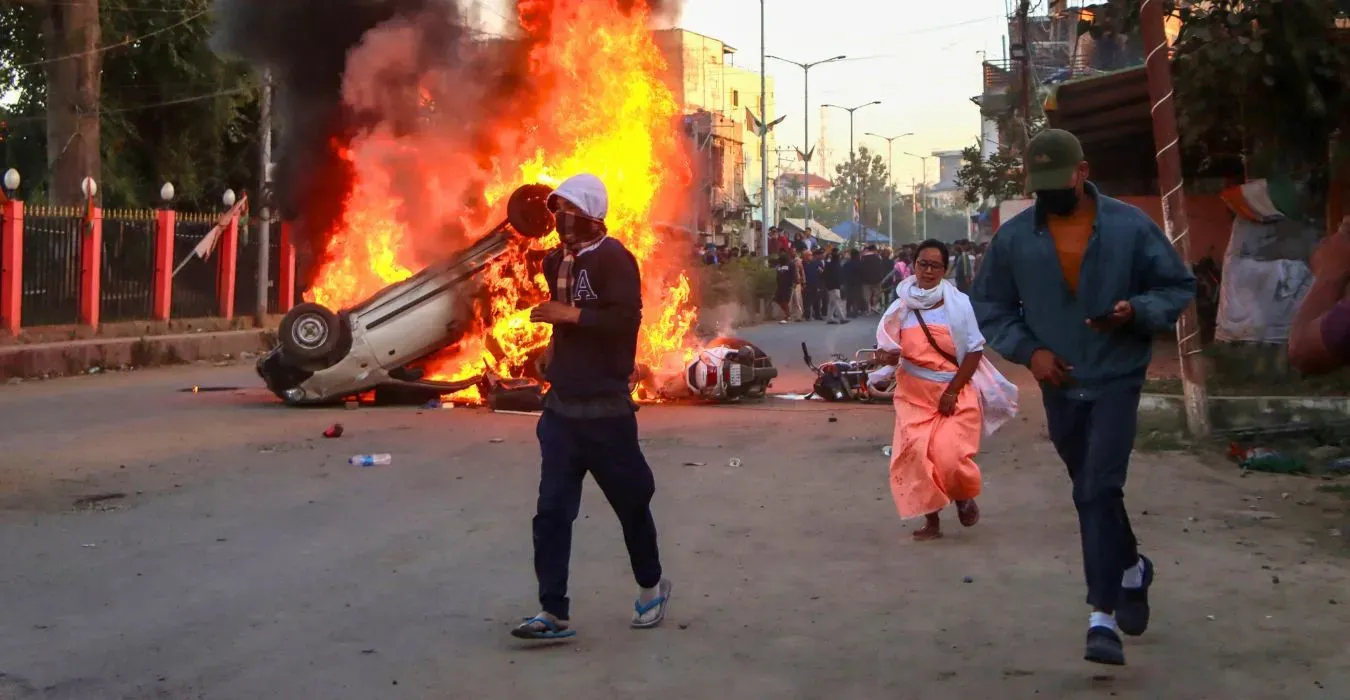
Manipur has been a seething cauldron for the last two and half years. The words of L. Nishikanta Singh, a retired Lieutenant General of the Indian Army, “I am just an ordinary Indian from Manipur living a retired life. The State is now Stateless. Life and property can be destroyed anytime by anyone, just like in Libya, Lebanon, Nigeria and Syria”, epitomised one of independent India’s most horrible ethnic strife. Insane hatred left a trail of destruction throughout the tiny province of Manipur, with thousands of houses burnt, hundreds of religious structures of all denominations vandalised and over 70,000 forcefully displaced. No doubt the psychological impact of the ethnic strife will last long and will compound India’s security scenario in the volatile Northeast, especially in the context of instability in neighbouring Burma and Bangladesh.
Add to this, proliferation of advanced weapons systems in the volatile region due to the weaponisation of the military arm of Burma’s exiled National Unity Government by the Western powers. This has enabled easy procurement and use of drones in Manipur’s ethnic clashes. It is an open secret that Manipur’s insurgency has thrived due to a combination of factors like ethnic linkages, drug smuggling, narco-terrorism and gun running – all linked to Burma. But did Manipur deserve such agony, given its inclusive polity since its inception? Manipur Legislative Assembly’s maiden Speaker TC Tiankham was a Kuki tribal, the first Education Minister of the province Bob Khating belonged to an ethnic Naga tribe and Mohammed Alimuddin, a Meitei Muslim or Pangal, was a cabinet minister in the pre-merger government of Manipur and later became provincial Chief Minister twice, in 1972 and 1974. So, what went wrong?
Many believe Manipur violence exposes India’s tribal insecurity
The situation reached such a volatile stage that tribal lawmakers even demanded a separate administrative structure for self-rule. Sadly, a tussle between two ethnic groups over Constitutional status as tribes with reservations in jobs, education and elected bodies turned communal. According to pioneering development and displacement studies scholar and North-East India domicile Dr Walter Fernandes, the conflict in Manipur is essentially tribal versus non-tribal, but some motivated forces gave it a communal colour to divert attention from the real issues. The fact is, there are victims and perpetrators on all sides. How to bridge the trust deficit is the real issue, especially when tribals elsewhere in India are not feeling secure either – as evident from their spontaneous participation in the maiden street movement, supporting peace in Manipur.
One must not forget that India’s left-wing insurgency has a tribal element. An empowered committee – consisting of eminent security experts like Prakash Singh and Ajit Doval – on development challenges in extremism-affected areas had ascertained the causes of subaltern extremism in 2008 and flagged disgruntlement due to a lack of development in remote areas. Hence, national laws like the Panchayat Extension to Scheduled Areas Act (PESA) – which is the plinth of self-governance through village assemblies – and Forest Regulation Act (FRA) provisions need to be strengthened further to prevent indiscriminate infringement. The local tribal Gram Sabhas (elected village assemblies), having authority under both these Acts to be consulted before any new development project is launched, should be encouraged to invoke vested power for recasting laws that suit tribal interests in the tribal hinterland.
Conclusion
A prolonged trust deficit has caused the rift to widen in Manipur. Mutual consensus and compromise, therefore, is the need of the hour for reconciliation and lasting peace to return in this ravaged Northeastern territory. Innovative resolution of the Manipur crisis through sustained engagement will help restore tribal confidence in the system and prevent India’s vast tribal inhabited areas from turning into a happy hunting ground for extremist elements.
