
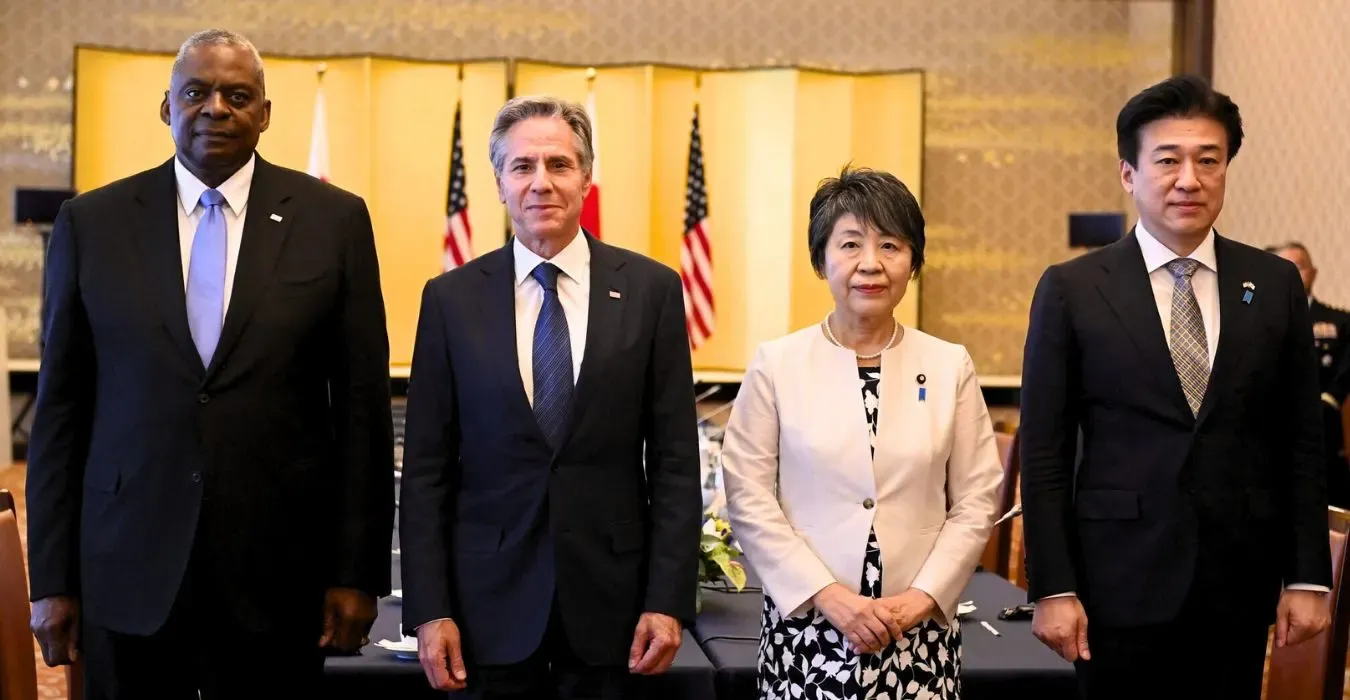
The U.S.-Japan alliance is currently at a point of unprecedented strength, bolstered by recent developments in defence and strategic cooperation. As the secretaries of defence and state held a 2+2 meeting with their Japanese counterparts in Tokyo in July 2024, the alliance is poised to take significant new steps towards deeper integration and operational coordination.
Historical Context and Transformation
The U.S.-Japan alliance, originally rooted in the security arrangements established after World War II, has undergone substantial evolution. Initially, the alliance served primarily as a security arrangement to allow U.S. basing rights in Japan, with minimal expectations of Japan as a military partner. Over the decades, however, Japan has progressively redefined its defence posture, culminating in a landmark reinterpretation of its pacifist constitution under former Prime Minister Shinzo Abe. This allowed Japan’s Self-defence Forces (SDF) to engage in collective self-defence, enabling cooperation with other nations’ militaries under specific circumstances.
Recent Developments and Future Prospects
The U.S.-Japan Security Consultative Committee meeting took place on July 28, 2024. During the meeting, the U.S. Secretary of Defense Lloyd J. Austin III, U.S. Secretary of State Antony Blinken, Japan Minister of Defense Kihara Minoru and Japan Minister for Foreign Affairs Kamikawa Yoko resolved to enhance U.S.-Japan Alliance deterrence and response capabilities to uphold the free and open rules-based international order.
The Ministers announced a historic decision to modernise the U.S. and Japanese command and control (C2) frameworks, including the reconstitution of U.S. Forces Japan (USFJ) to a Joint Force Headquarters, which will complement Japan’s establishment of the JSDF Joint Operations Command (JJOC).
The Ministers welcomed integral efforts to pursue mutually beneficial co-production opportunities to expand the production capacity of Advanced Medium-Range Air-to-Air Missiles (AMRAAMs) and Patriot PAC-3 Missile Segment Enhancement (MSE) to meet critical demands for such advanced systems and address timely procurement and readiness requirements. The two nations also reiterated their strong support for networking with allies and partners in and beyond the Indo-Pacific region, recognising the U.S.-Japan Alliance as the cornerstone of regional peace, security and prosperity.
In December 2022, Japan announced a historic defence build-up as part of its new National Security and Defence Strategies. This shift signalled a commitment to transforming the U.S.-Japan security partnership into a true defence alliance. The upcoming 2+2 meeting is expected to announce plans for a more integrated command structure, facilitating closer military cooperation between the two nations.
The Significance of the 2022 Defence Build-up
Japan’s decision to increase defence spending to 2% of its GDP and acquire counter-strike capabilities marks a significant departure from its post-war defence policies. These changes are driven by a rapidly evolving security environment, including China’s rise, North Korea’s provocations and Russia’s aggression in Ukraine. These threats have underscored the need for Japan to enhance its defence capabilities and take a more proactive role in regional security.
Evolving U.S. Perspectives on the Alliance
The U.S. approach to alliances has also evolved. The current administration emphasises the importance of capable allies and Japan’s defence reforms are seen as critical to regional stability. This has led to U.S. support for Japan’s acquisition of new capabilities and the move towards a more integrated command structure, reflecting a shared understanding that a strong Japan is essential for regional security.
Beyond the U.S.-Japan alliance, Japan is strengthening ties with other regional partners. The Quad comprising the U.S., Japan, India and Australia has emerged as a key framework for regional security cooperation. Additionally, Japan’s improving relations with South Korea and enhanced security ties with the Philippines further illustrate its growing role in regional security architecture.
Conclusion
The U.S.-Japan alliance has evolved from a post-war security arrangement into a robust defence partnership, adapting to new challenges and strategic realities. The 2+2 meeting in Tokyo marked another milestone in this historic relationship, further deepening defence cooperation and operational integration. As both nations navigate an increasingly complex security environment, the alliance will continue to play a crucial role in maintaining peace and stability in the Indo-Pacific region.
