
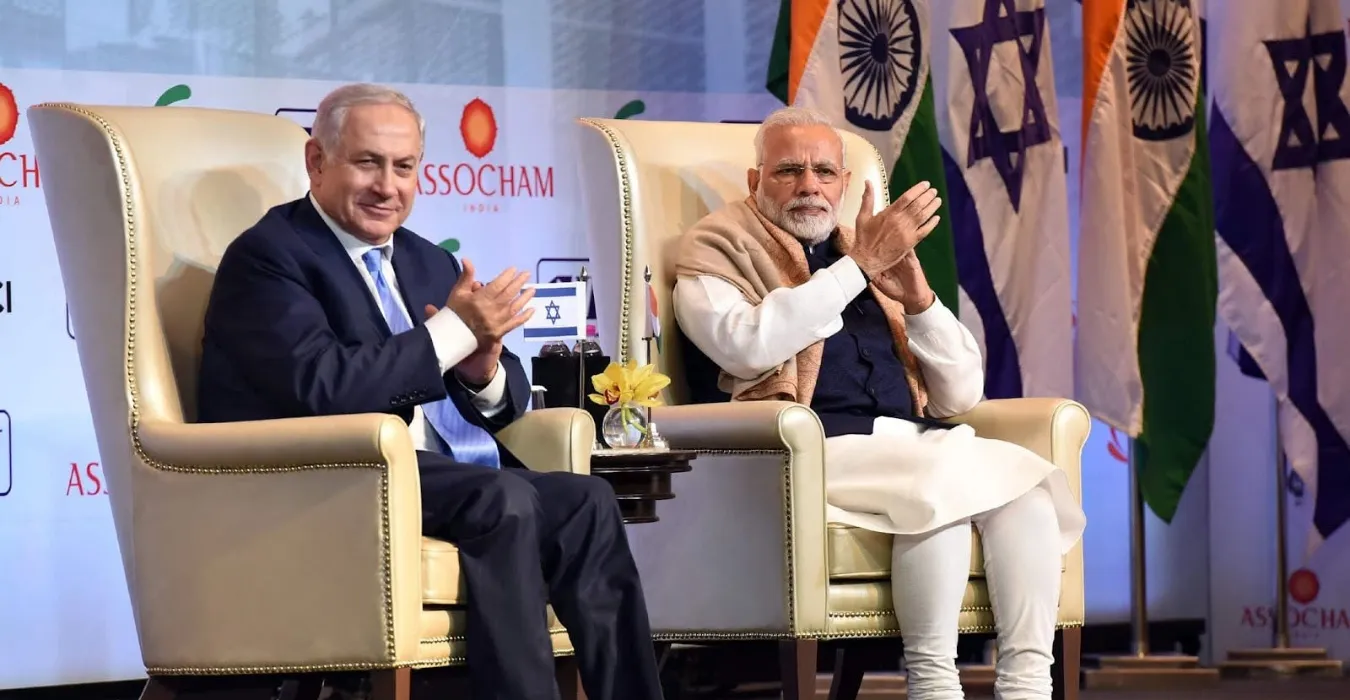
Introduction: A Strategic Axis Hardened by Terror
The Indo-Israel partnership—already one of the strongest geopolitical alignments in the 21st century-has entered a critical phase following the April 2025 Pahalgam terror attack, in which 26 civilians, mostly tourists, lost their lives. Intelligence agencies have flagged a possible use of Huawei-manufactured encrypted satellite phones by the attackers, raising suspicions of Chinese and Pakistani linkages. As India recalibrates its counter-terrorism strategy, its reliance on Israel’s cutting-edge defence and intelligence capabilities is poised to deepen.
By 2025, bilateral trade (excluding defence) has surged to $9.2 billion, while India remains Israel’s largest arms client, accounting for 43% of its arms exports. The terror attack has only reaffirmed the urgency of Indo-Israeli synergy in defence, intelligence and cybersecurity.
Historical Context: From Diplomatic Hesitation to Strategic Necessity
The trajectory from India’s post-independence pro-Palestine stance to its 1992 diplomatic recognition of Israel set the groundwork. The 1999 Kargil War was a turning point, with Israel supplying UAVs and precision munitions that helped repel Pakistani intrusions.
The Pahalgam incident echoes Kargil in strategic terms—foreign-sponsored aggression targeting civilian life and national morale. In both instances, Israeli technology and intelligence-sharing stand out as vital to India’s response capabilities.
Defence & Intelligence Cooperation: Response to Emerging Threats
Following the Pahalgam attack, security experts from Israel’s Mossad and India’s RAW have reportedly intensified joint assessments, particularly regarding encrypted communication and cyber infiltration. Israel’s Elbit Systems, whose tools were already embedded in India’s cyber defences, has offered expanded counter-terror modules.
Key defence developments include:
Barak-8 Missile Defence Systems: Jointly developed with DRDO, its interceptive capability is now being recalibrated for high-altitude threats in Jammu & Kashmir post-Pahalgam.
Heron TP Drones: Currently deployed along the Line of Control and Sino-Indian border, these UAVs have been tasked with new surveillance grids following terror movement indicators.
Spike ATGMs: Utilised for rapid mountain warfare response, their production is being accelerated with Bharat Dynamics Ltd.
Joint exercises like Blue Flag 2024 have transitioned from simulation to real-world applicability, shaping new SOPs for hybrid warfare scenarios like Pahalgam.
Technological Convergence: Cyber, Space and Counter-Terrorism
Cybersecurity collaboration has gained urgency post-Pahalgam. India suffered $10 billion in cyber losses in 2024, and Israel’s $20 billion cybersecurity sector, led by Check Point and Elbit, is now critical to India’s digital fortification.
Post-Attack Cyber Mapping: A new Indo-Israeli task force is examining cross-border digital trails using AI-based threat modeling.
Satellite Surveillance: The planned 2026 joint satellite launch has now included payloads specifically designed for terror movement monitoring across Kashmir and Ladakh.
Israel’s intelligence-backed precision has also been requested in crowd behavior analytics to aid in pilgrimage and tourist security-a direct response to the Pahalgam tragedy.
Diplomatic Realignments: Strategic Clarity Amidst Regional Chaos
India’s response to Pahalgam has included cutting diplomatic ties with Pakistan, suspending the Indus Waters Treaty, and closing the Attari border. These moves have seen silent backing from Israel, which has repeatedly faced similar cross-border hostilities.
India’s balancing act—with $75 billion in GCC trade and $120 million aid to Palestine-continues. Yet, Israel’s support in international fora, including a UN resolution condemning state-sponsored terrorism post-Pahalgam, highlights a tilt toward a more realpolitik-driven axis.
Public Sentiment and Think Tank Support
A 2024 ORF Survey showed 68% of urban Indians favour stronger ties with Israel. Post-Pahalgam, this sentiment is likely to intensify. The Moshe Dayan Center calls this alignment a “practical bulwark against extremist volatility,” while the INSS notes the growing perception of Indo-Israel as a stabilizing force in a chaotic arc from Gaza to Gilgit.
Looking Ahead: The Strategic Blueprint Post-Pahalgam
Near-Future Objectives:
$3 billion in Israeli defence exports to India by 2026
$15 billion bilateral trade goal by 2028
Indo-Israel IOR Maritime Pact to secure $5 trillion in sea trade
Integrated AI threat-detection networks in Indian cities
Long-Term Vision:
A triangular alliance (India-Israel-USA) to counterbalance Chinese influence
Development of dual-use military-civil tech parks
Formalization of a trilateral counter-terror intelligence hub in Tel Aviv or Hyderabad
Conclusion: A Resilient Axis for a Volatile Era
The Indo-Israel partnership has evolved from cautious engagement to a strategic alliance of consequence. The Pahalgam attack has made this bond more than transactional. it is now existential. The combination of Israeli precision and Indian scale offers a potent response to regional threats.
With cybersecurity, aerospace, and intelligence as the new battlegrounds, the Indo-Israel axis stands ready not just to defend, but to define the future of regional security architecture. As the world tilts toward multi-polarity, this alliance will remain a cornerstone of Asia-Middle East strategic balance, fortified by trust, innovation, and necessity.
