
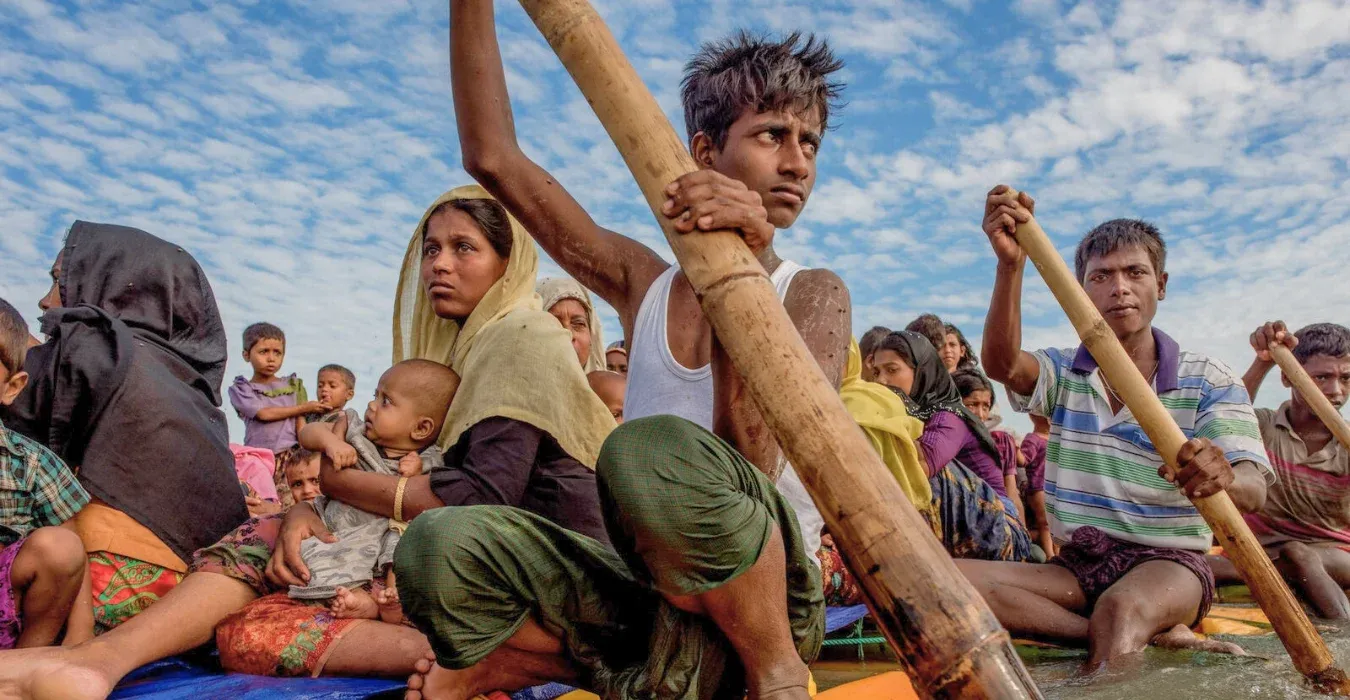
The ongoing Rohingya crisis represents one of the most profound humanitarian failures of our time, exposing the inadequacy of international response mechanisms and the dangerous tendency of global powers to abdicate their moral responsibilities. While it may be convenient to assert that primary responsibility for refugees lies with the first country of asylum, this perspective dangerously oversimplifies a crisis that demands global attention and coordinated action.
Since 2017, more than one million people have been displaced due to systematic persecution by Myanmar’s ruling authorities. The UN has designated the Rohingya as ‘the most persecuted minorities in the world yet their plight continues largely unaddressed by the international community. This mass displacement represents not merely a regional challenge, but a test of global conscience that the world appears to be failing.
Violence, Displacement & the Widening Crisis
The crisis intensified dramatically in August 2017, when clashes erupted between suspected Rohingya militants and Myanmar’s military junta in Rakhine State. What followed was a campaign of violence so severe that waves of refugees fled to neighboring Bangladesh, Thailand and India, seeking safety from systematic killing and persecution perpetrated by both the military junta and the Arakan Army. The situation has deteriorated further since Myanmar’s military coup in February 2021, which plunged the country into civil war. This internal conflict has created a cascade of humanitarian disasters: the emergence of numerous armed rebel groups, indiscriminate bombing campaigns by the military junta, and the displacement of millions more civilians beyond the Rohingya population.
According to UN estimates, the civil war has internally displaced 3.5 million people and caused 1.5 million to flee to the neighbouring countries. The conflict has claimed the lives of more than 6,473 civilians, with countless military personnel and rebel fighters killed, though many casualties remain undocumented and unaccounted for. The destruction of livelihoods has been alarming, creating a humanitarian emergency that extends far beyond any single ethnic group. The response from global powers has been characterized by negligence and an alarming tendency to distance themselves from responsibility. The capacity and capability these nations possess morally obligates them to engage with this crisis, but their indifference reveals a troubling pattern of international irresponsibility.
Global Indifference & the Failure of Collective Responsibility
The United Nations, despite its mandate to address such catastrophes, has failed colossally to bring adequate attention to Myanmar’s humanitarian crisis or to mobilize effective intervention. This failure calls into question the very foundation of international collective action. If global powers can simply shrug off such massive human suffering by claiming it is ‘not their doing,’ then the concept of global solidarity becomes nothing more than empty rhetoric. The international community’s inadequate response is starkly illustrated by the funding shortfall for humanitarian operations. The UN has managed to collect only 30 percent of the estimated $383.1 million needed to sustain aid missions for Rohingya refugees. This chronic underfunding directly translates to inadequate shelter, insufficient food supplies, limited medical care and restricted educational opportunities for displaced populations. Needless to say, UN agencies (UNHCR, WFP, UNICEF) have been active but with limited outcomes and are unable to expand their scope.
Bangladesh’s military and the interim government are at loggerheads over establishing a proposed ‘humanitarian corridor’ connecting Chittagong with Myanmar’s Rakhine State. This corridor would facilitate aid delivery, but the proposal has emerged at a particularly sensitive time, as Bangladesh’s interim government is in place in the absence of an elected government. The recent relocation to Bhasan Char, security clampdowns in camps in Bangladesh have only further aggravated the ongoing crisis. The role or failure of ASEAN, especially given Myanmar’s membership, in the crisis demonstrates helplessness. As a regional body, ASEAN’s reluctance to engage more assertively deserves attention.
Urgent Need for a Coordinated & Sustainable Response
The crisis demands sustained administrative commitment to scale up aid delivery and maintain refugee camps while long-term solutions are developed. This requires moving beyond temporary measures to establish comprehensive frameworks that address immediate needs while planning for either voluntary repatriation under safe conditions or permanent resettlement programs developed in consultation with all the stakeholders. Priority must be given to implementing time-bound aid plans that ensure security, provide access to basic education, and develop skill training programs that enable refugees to sustain themselves.
The Rohingya crisis serves as a stark reminder that humanitarian catastrophes cannot be contained by borders or dismissed as regional problems. When systematic persecution displaces over a million people, civil war destroys entire societies and the most vulnerable populations are left without protection or hope, the international community faces a fundamental choice between engagement and abandonment. The continued failure to adequately address this crisis raises disturbing questions about the effectiveness of international institutions and the commitment of global powers to the humanitarian principles they claim to uphold. If the global community cannot respond effectively to such clear-cut cases of persecution and displacement, it suggests that our collective mechanisms for protecting human rights and dignity are fundamentally broken.
The Moral Test of Our Time
The Rohingya crisis is not merely Myanmar’s problem, nor Bangladesh’s burden alone. Concrete steps such as sanctions, international tribunals, multilateral frameworks, or third-country resettlement strategies need to be used effectively. It is a test of whether the international community possesses the moral courage and practical commitment necessary to protect the Rohingyas. So far, that test is being failed and the cost is measured in human lives and suffering that continues to mount with each passing day.
