
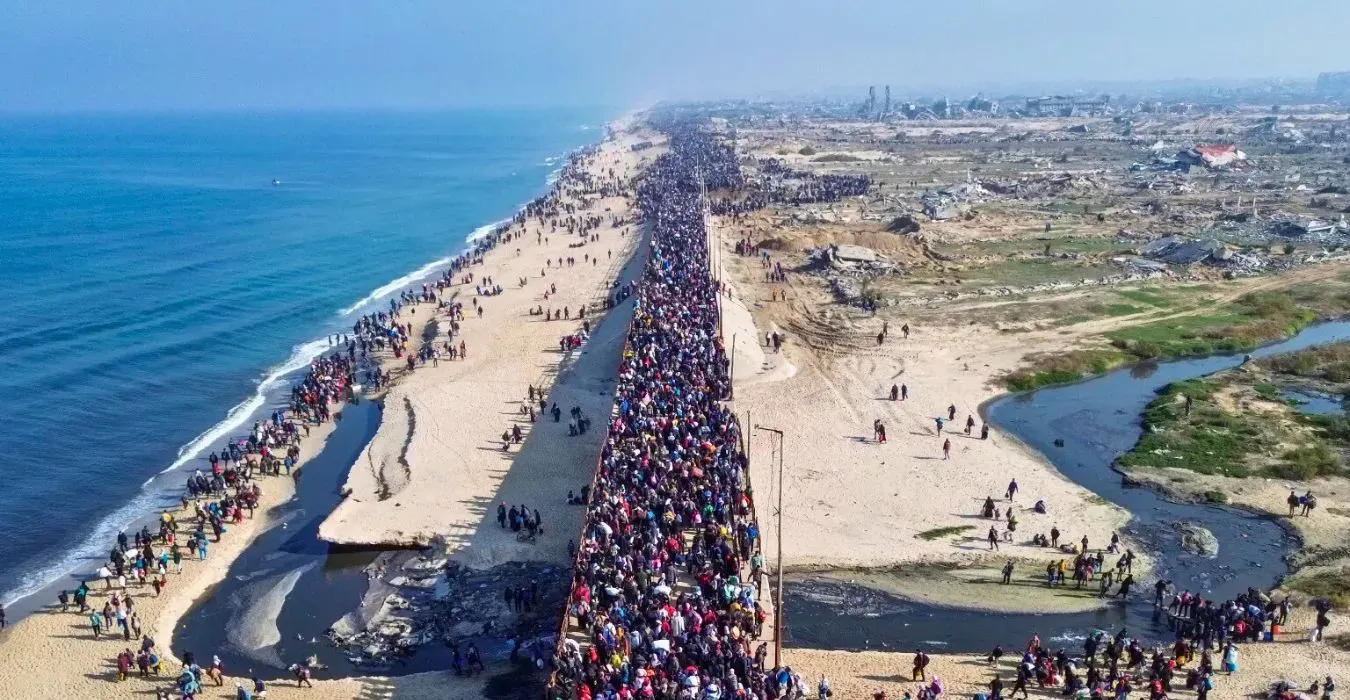
Two prominent plans have emerged: U.S. President Donald Trump’s proposal to depopulate Gaza and redevelop it and Egypt’s counterproposal focusing on reconstruction while allowing Palestinians to remain in their homeland.Trump’s Proposal: Depopulation and Redevelopment
President Trump’s plan, unveiled in late January 2025, suggested relocating Gaza’s Palestinian population to neighbouring countries, particularly Egypt and Jordan and redeveloping the territory into a new urban area. Trump described Gaza as a “demolition site” and proposed that neighbouring Arab nations absorb the displaced Palestinians. This approach was met with widespread condemnation and rejection from Arab states and the international community.
Egyptian President Abdel Fattah el-Sisi firmly opposed the displacement of Palestinians
Stating that such a move would be an “injustice” that Egypt could not support. He emphasised that the solution lies in the two-state framework, allowing Palestinians to establish their state alongside Israel. Similarly, Jordan’s Foreign Minister Ayman Safadi reiterated the country’s unwavering rejection of any plan to force Palestinians into Jordan, highlighting that such actions would violate international law and threaten regional stability.
The Arab League, representing multiple Arab nations, issued a joint statement rejecting any attempts to compromise Palestinians’ inalienable rights through displacement or land annexation. They emphasised that such actions would threaten regional stability, risk expanding the conflict and undermine prospects for peace and coexistence among the region’s peoples.
Egypt’s Counterproposal: Reconstruction and Local Governance
In response to Trump’s plan, Egypt presented a comprehensive $53 billion reconstruction proposal for Gaza, aiming to rebuild the territory by 2030 without displacing its residents. This plan was endorsed by Arab leaders at a summit in Cairo, marking a unified stance against the U.S. proposal.
Egypt’s plan includes several key components
Phased Reconstruction: The initial phase focuses on removing unexploded ordnance and clearing over 50 million tons of rubble left by Israeli bombardments. Subsequent phases involve rebuilding infrastructure, housing and essential services to restore normalcy for Gaza’s residents.
Governance Assistance Mission: The proposal suggests establishing a transitional technocratic committee of Palestinians to govern Gaza under the umbrella of the Palestinian government. This interim administration would oversee humanitarian aid and reconstruction efforts, ensuring that governance remains in Palestinian hands.
International Stabilisation Force: To ensure security and prevent further conflicts, the plan proposes deploying an international peacekeeping force led by Arab states in Gaza and the West Bank. This force would work to stabilise the region during the reconstruction period.
Economic Development: The reconstruction plan emphasises sustainable urban development, infrastructure improvements and economic opportunities for Gaza’s residents. The goal is to create a self-sustaining economy that reduces dependency on external aid.
Egypt’s approach underscores the importance of Palestinian self-determination and rejects any form of displacement. By focusing on reconstruction and local governance, the plan aims to address the humanitarian crisis while preserving the rights and identity of the Palestinian people.
International Reactions and Diplomatic Efforts
The international community’s response to these competing proposals has been mixed. While Arab nations have largely endorsed Egypt’s plan, Israel and the United States have expressed reservations. The U.S. administration, while not fully endorsing Egypt’s proposal, acknowledged it as a “good-faith first step” and emphasised the need for close cooperation in post-conflict planning for Gaza’s governance and security.
Israeli officials have criticized Egypt’s plan, arguing that it fails to address the realities of the situation, particularly concerning Hamas’ role in Gaza. Israel supports Trump’s proposal, viewing it as an opportunity for Gazans to have a fresh start elsewhere. Diplomatic efforts continue as stakeholders seek a viable solution for Gaza’s future.The United Nations has called for deploying international peacekeeping forces to ensure security during the reconstruction phase. Additionally, discussions are ongoing regarding the establishment of a trust fund, overseen by the World Bank, to finance Gaza’s reconstruction.
Challenges and Considerations
Several challenges loom over the implementation of any reconstruction plan for Gaza:
Security Concerns: Ensuring the safety of residents and preventing the resurgence of militant groups like Hamas is a primary concern. The proposed international stabilisation force would need clear mandates and robust support to be effective.
Funding and Resources: Mobilising the estimated $53 billion required for reconstruction necessitates substantial international financial commitments. Securing these funds amid global economic uncertainties poses a significant challenge.
Political Dynamics: Achieving consensus among Palestinian factions, particularly integrating Hamas into a unified governance structure, remains a complex issue. Internal political reconciliation is crucial for the success of any reconstruction effort.
Humanitarian Needs: Addressing the immediate humanitarian crisis, including providing food, medical aid and shelter to displaced populations, is an urgent priority that requires coordinated international assistance.
Conclusion
The contrasting visions for Gaza’s future—depopulation and redevelopment versus in-place reconstruction—highlight the complexities of post-conflict recovery in the region. Egypt’s plan, emphasising reconstruction without displacement, aligns with international principles of self-determination and has garnered significant support from Arab nations. However, its successful implementation hinges on addressing security, funding, political and humanitarian challenges through collaborative international efforts. As diplomatic dialogues continue, the priority remains ensuring a stable Gaza.
