
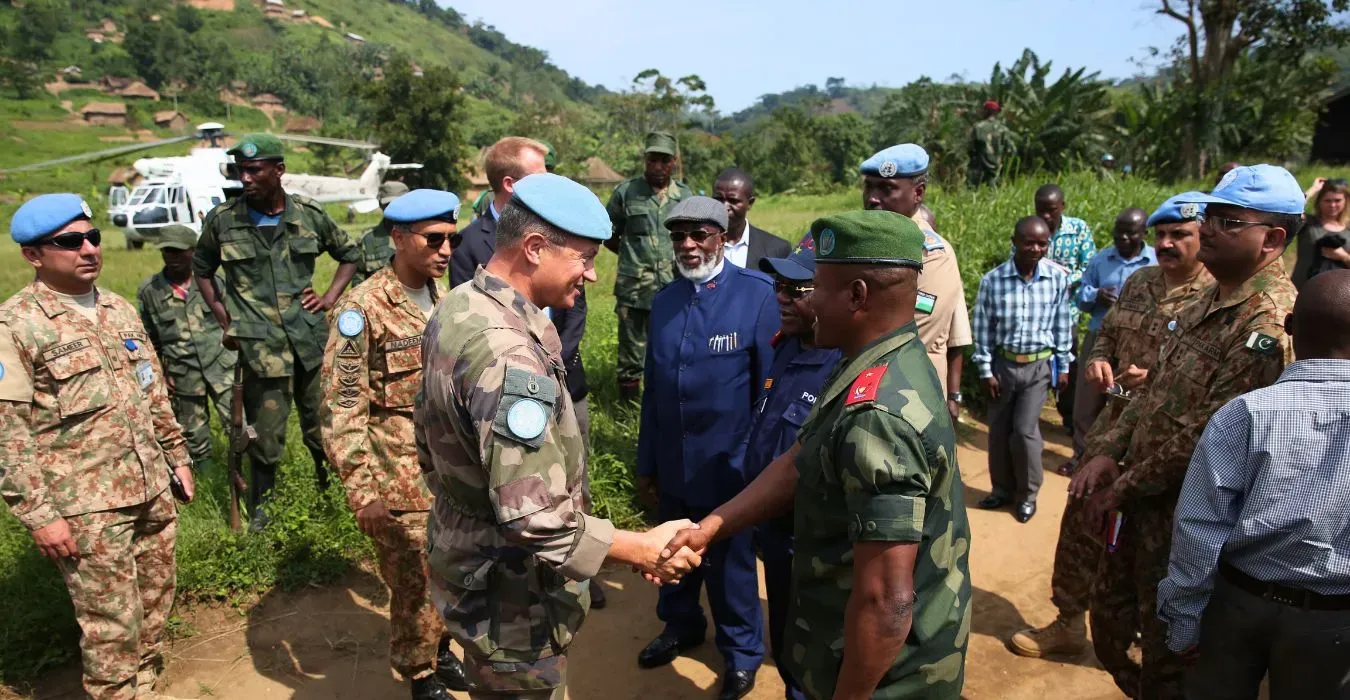
“We are closely following the developments in the Democratic Republic of Congo (DRC) and remain concerned at the deteriorating security situation”, the spokesperson of India’s Ministry of External Affairs, Randhir Jaiswal, asserted last January when the war in eastern DRC opened up old wounds. The conflict has its roots in the Rwandan genocide of 1994, which caused the subsequent Congo wars of 1996-1997 and 1998-2000.
The conflicts were stuck in nine African nations and pitted a plethora of militias against each other. Rwanda has been providing tactical support to M-23 rebels – an ethnic Congolese Tutsi militia – as it accuses the DRC government of colluding with the extremist Hutuumilitias, linked to the 1994 genocide, in targeting the country’s Tutsi community. The M-23 rebels and Rwandan forces (RDF) captured Minova on January 21, entered the key eastern city of Goma, coinciding with the emergency UN Security Council meeting on DRC. At least 7,000 people have been killed since January, according to DRC government data, and thousands more have been displaced.
Despite global pressure and sanctions, the M-23 rebels continued their offensive actions to capture the DRC’s mineral-rich eastern region. The crisis in DRC has an ethnic dimension but is also about control over mineral resources. Hours after a meeting in Doha between President Félix Tshisekedi of DRC and President Paul Kagame of Rwanda, M-23 rebels, backed by RDF, captured DRC’s largest tin oreemine, Bisie, located in Walikale territory. The mine was evacuated a few days ago by its Canadian operator, Alphamin Resources.
(Q): Qatar is mediating between Congolese and Rwandan leaders to broker a ceasefire in eastern DRC.
With M-23 boycotting the Angola peace talk, how hopeful are you about a peaceful resolution of the crisis in the Democratic Republic of Congo (DRC)?
Prof WO: The M-23 has just rejected the Qatar-led mediation talks between Presidents Felix Tshisekedi and Paul Kagame after capturing the strategic town of Walikale and inching closer to Kisangani, DR Congo’s 4th-largest city. With near control of all the four eastern DR Congo provinces, M-23 is now in a stronger negotiating position with the Kinshasa government and is incentivised to capture more territories. With easy victories over Congolese troops, M-23 is more emboldened to make tougher demands that Tshisekedi will not be in a position to meet. This will give M-23 justification to capture other provinces and finally take over power in Kinshasa.
(Q): Do you foresee regionalisation of the DRC conflict and the prospect of another Congo War?
Prof WO: The chances of a repeat of 1998-2000 are slim after the SADC (the Southern African Development Community) formally announced that it was pulling out its troops out of the Congo and remains committed to a political solution. However, with the increased involvement of Uganda in Ituri province, and if Rwanda moves into North Kivu, then there could be a risk of the two neighbours clashing again in Congo.
(Q): DRC is seeking US boots on the ground in exchange for a mineral deal.
Apart from an ethnic dimension, the DRC crisis is also about control over mineral resources, particularly columbite-tantalite or Coltan. As per the UN estimate, M-23 rebels smuggled at least 150 metric tonnes of Coltan into Rwanda in 2024. Moreover, extensive research has linked Coltan mining in the DRC to large-scale Human Rights violations and environmental degradation. Amid 7 million internal displacements in DRC due to the crisis, what impact, in your esteemed opinion, will an American intervention in DR Congo have on the ongoing conflict as well as the internal political dynamics of the African continent?
Prof WO: Based on past American involvement in such strife in the Lake Chad basin, the Sahel and Eastern Africa, there is little hope that AFRICOM (United States Africa Command) or any other direct military presence in Eastern DRC will have a significant impact on this conflict. Although President Trump has little or no interest in Africa, the rich mineral wealth, particularly coltan and cobalt, is a mouth-watering allure. With an estimated strategic mineral deposits worth $25-30 trillion, the US has an overwhelming incentive and golden opportunity to deny China access.
Conclusion
However, there are complications since China not only has signed contracts with the DRC government to extract most of these minerals, but the Europeans are also keen on protecting their historical access to Congo. Instead of intra-African confrontation in the Great Lakes region, there will most likely be fierce rivalry between Americans, Chinese and the Europeans. The irony is that the fear of Europeans fighting each other over Congo led to the Berlin Conference of 1884-5 to establish rules for colonisation and trade in Africa, thus effectively formalising the scramble for Africa. The present map of Africa is a product of this conference. Will the current conflict in Congo lead to a redrawing of African borders at a second Berlin Conference? We are watching with bated breath.
