
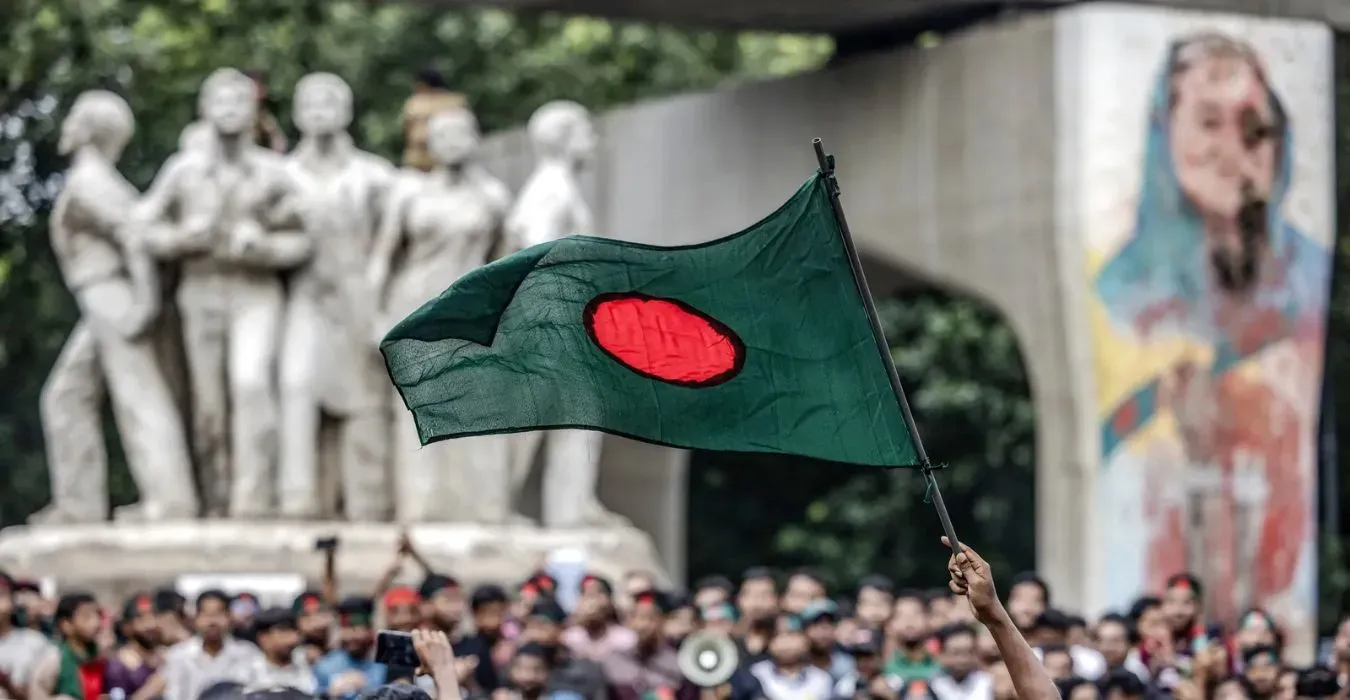
Meanwhile, a UN Human Rights Office report, released recently, found the previous Awami League and the present interim government equally guilty of transgression – in allowing large scale repression leading to human rights violations and abuses under their watch. The report prepared by a fact-finding team observed a methodical attempt to subvert the opposition political space and students’ protests during the previous regime and violence against minority Hindus, indigenous communities and even a Muslim sect under the current administration’s nose.
This Bangladesh – impatient and intolerant – has jolted the famous Bengali pride, which emanated from a sense of intense belonging to one’s cultural heritage and ethos. It is a byproduct of a pan-national collective sense of identity that has emerged in the predominantly Bengali-speaking areas of the Indian subcontinent’s Gangetic delta region over the course of history. Those inhabiting the western part of Bengal, in the Indian State of West Bengal, marvelled at the resilience of their counterparts in East Bengal, now Bangladesh. The people of Bangladesh lived and died for their language and fought valiantly to preserve Bengali culture. Student-led uprising formed the crux of their spirited struggle, driving the 1952 Language Movement, 1971 Liberation War, the 1987 anti-Ershad movement, anti-authoritarian struggles of the 1990s and the July 2023 movement that deposed Sheikh Hasina after 15 years in power.
Bangladesh’s struggle for national identity sets the nation apart from its neighbours. Born from the womb of a revolution for linguistic and cultural self-determination, the nation blossomed with secular and liberal ideals. But developments in the last few months gives an impression of Bangladesh asserting a new political narrative – one that recast the country’s fundamental identity, making it less secular and inclusive than ever before. No wonder, Bengali intellectuals are perturbed by the proliferation of a culture of hate-mongering in a land known for espousing the cause of brotherhood and harmony. “The sectarian attacks in Bangladesh distressed me greatly since I was very proud of (its) secular society and communal harmony” – says a renowned academic and former Harvard Professor from Bangladesh who has authored numerous books and articles on history, democracy, human rights and international affairs in his distinguished career.
Bimstec Can Re-Energise India-Bangladesh Ties
Religious dogmatism, an old fault line on the Indian subcontinent, has reared its ugly head in Bangladesh. The revolution, which was supposed to liberate all Bangladeshis, irrespective of faith, has instead turned the society parochial. It was absolutely imperative for those helming the civil coup to ensure that no particular group or individual was targeted for the faith they professed. By failing to do so, they ended up reinforcing the widely held belief that Sheikh Hasina was the one and only leader standing between the radical Islamist forces and a secular, moderate Bangladesh. Though India-phobia developed in Bangladesh as early as January 2024, with “India Out” campaign calling for the boycott of Indian goods gaining traction, a section of the citizenry still want a robust, constructive and productive relationship with India, not held hostage to the vicissitudes of political changes.
Despite a serious security concern in India over entrenchment of anti-India sentiment in Bangladeshi psyche, New Delhi will continue to engage Dhaka diplomatically. After all, Bangladesh has been a key component of India’s Act East Policy. Hence, the Bay of Bengal Initiative for Multi-Sectoral Technical and Economic Cooperation (BIMSTEC) Summit, scheduled to be held in Bangkok in April, can pave the way for normalization in India-Bangladesh tie because their stable bilateral relationship is considered to be a critical factor for empowering the multilateral forum. Besides, for both Bangladesh and India, BIMSTEC is a bridge to connect with the ASEAN nations. For BIMSTEC, a strong India-Bangladesh bilateral cooperation enables wider connectivity between South and Southeast Asia, bolster trade and investment as well as strategic partnership in energy, defence and international security, apart from strengthening the socio-cultural bond.
Conclusion
Bangladesh’s strategic presence as a cost-effective transit route – connecting India’s landlocked Northeast with the Bay of Bengal – for trade with Southeast Asia, invigorates India’s Act East Policy, critical to the successful cultivation of extensive economic and strategic relations with the Far East. With Prime Minister Narendra Modi and Chief Adviser Professor Yunus scheduled to attend the Bangkok BIMSTEC Summit, a brief entente in the sidelines is therefore expected to give a much-needed boost to the flagging bilateral relationship. Undoubtedly, a flourishing Indo-Bangladesh cooperation can be a game-changer for BIMSTEC. Their joint endeavour on vital issues like free trade, security, connectivity and disaster management can motivate the other members to work proactively and remain committed to achieving the hallowed goals of the forum.
