
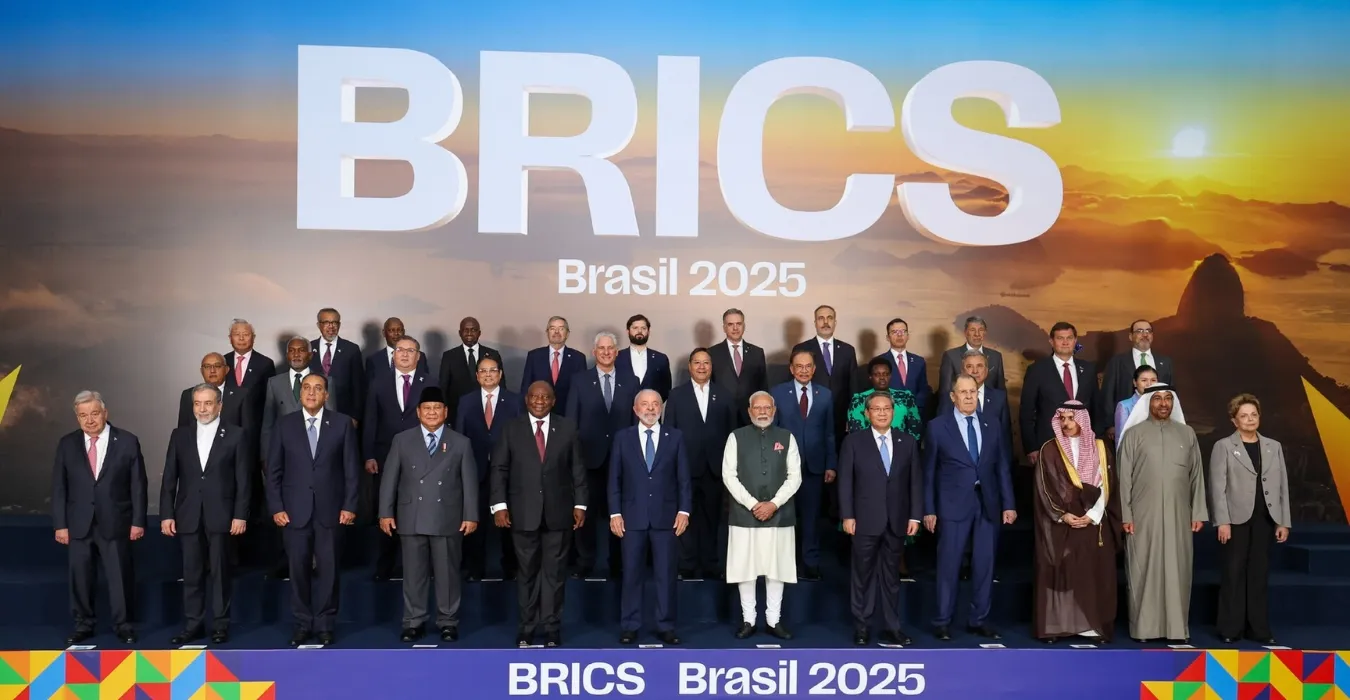
The 17th BRICS Summit held on 6-7 July in Rio de Janeiro has sent a clear message to the world — the global South is no longer willing to wait for a seat at the table; it is building its own. What began as an economic grouping of five emerging economies has now evolved into a platform pushing for a rebalanced global order, challenging the dominance of the West in institutions, finance, and international politics.
While BRICS insists it is not anti-West, its actions speak to a growing frustration with a world system still heavily shaped by Western interests. With new countries joining the group, broader cooperation on climate, trade, finance, and a push for reform in global governance, BRICS is fast becoming the voice of the multipolar world many have long envisioned.
Multipolarity over Monopoly
For decades, institutions like the United Nations, IMF and World Bank have been controlled by the wealthy nations of the West. Decision-making has been concentrated in the hands of few, while the needs and voices of the Global South have remained underrepresented. The world has entered the era of AI, but reforms remain a distant dream in global institutions.
BRICS is challenging that reality.
At the Rio Summit, leaders from Brazil, India, China, Russia, South Africa, and new members like Egypt, Ethiopia, Iran and the United Arab Emirates, joined hands to push for reforms in the global financial system and the UN Security Council. The group clearly stated that global governance must be inclusive, democratic and reflective of today’s power realities, not those of 1945.
In this sense, BRICS is not rejecting the world order — it is demanding to rebuild it on fairer terms, where countries from the Global South should be brought into a decision making role.
Frustration in Washington
This growing unity and confidence among BRICS nations has not gone unnoticed — especially by the United States. In fact, President Donald Trump has threatened to impose a 10% universal tariff on all BRICS countries in his post on the Truth Social. He also accused BRICS of “gaming the system” and creating a parallel global order that sidelines American influence.
This reaction reflects a deeper concern: BRICS is no longer just a forum for dialogue — it is building real alternatives.
- The New Development Bank (NDB) offers development loans without political strings.
- Talks around trading in local currencies are slowly reducing dependence on the U.S. dollar.
- BRICS nations now coordinate on global issues like climate finance, AI governance, and public health, offering an option to Global South countries tired of Western lectures.
As the group expands (Indonesia is the latest to join), the idea that global leadership must come from Washington, Brussels or London is being quietly — but firmly — rejected.
An Option, Not an Opponent
One important point is that BRICS does not claim to be opposed to the West. Rather, it offers an alternative. The Western nation has to understand this. If they have such concern about their interest the Global South also has the right to keep their interest above.
This alternative is based on sovereignty, mutual respect, development-oriented and consensus based decision making. For instance, in climate discussions, BRICS nations reject carbon taxes imposed by Europe as “green protectionism” and instead argue for a climate finance model that helps poorer countries transition without being punished.
In global health, they have proposed new partnerships to address diseases that disproportionately affect the developing world.
Even in finance, the goal is not to attack Western systems but to de-risk the Global South from external shocks. This includes building payment platforms, creating insurance pools, and exploring currency swaps — all of which allow these nations to act collectively, not as fragmented aid recipients.
This shift is what makes BRICS especially attractive to many mid-sized and developing countries. It is not just a club of the powerful; it is a platform of the excluded finally asserting themselves.
What the Future Holds
It is still early to say how far BRICS can go. The group faces internal challenges: political differences between members, the absence of a common currency, and a lack of military or strategic alignment.
Yet, what cannot be ignored is this: BRICS is growing — both in size and in ambition. Its recent expansion and the strong turnout at the Rio Summit show that the Global South is looking for options. In an age of geopolitical tension, debt crises, climate emergencies and digital disruption, BRICS offers not just criticism of the West, but also constructive proposals.
By offering an alternative model for cooperation — one that is more balanced and rooted in mutual benefit — BRICS is forcing the world to reimagine what global leadership can look like.
Whether Washington likes it or not, the world is no longer unipolar. The rise of BRICS is a sign of this changing situation. It is a message to the old order that the era of dominance is giving way to dialogue, diversity and diplomacy — and the Global South is no longer sitting quietly on the table.
