
 SECURITY ALERT
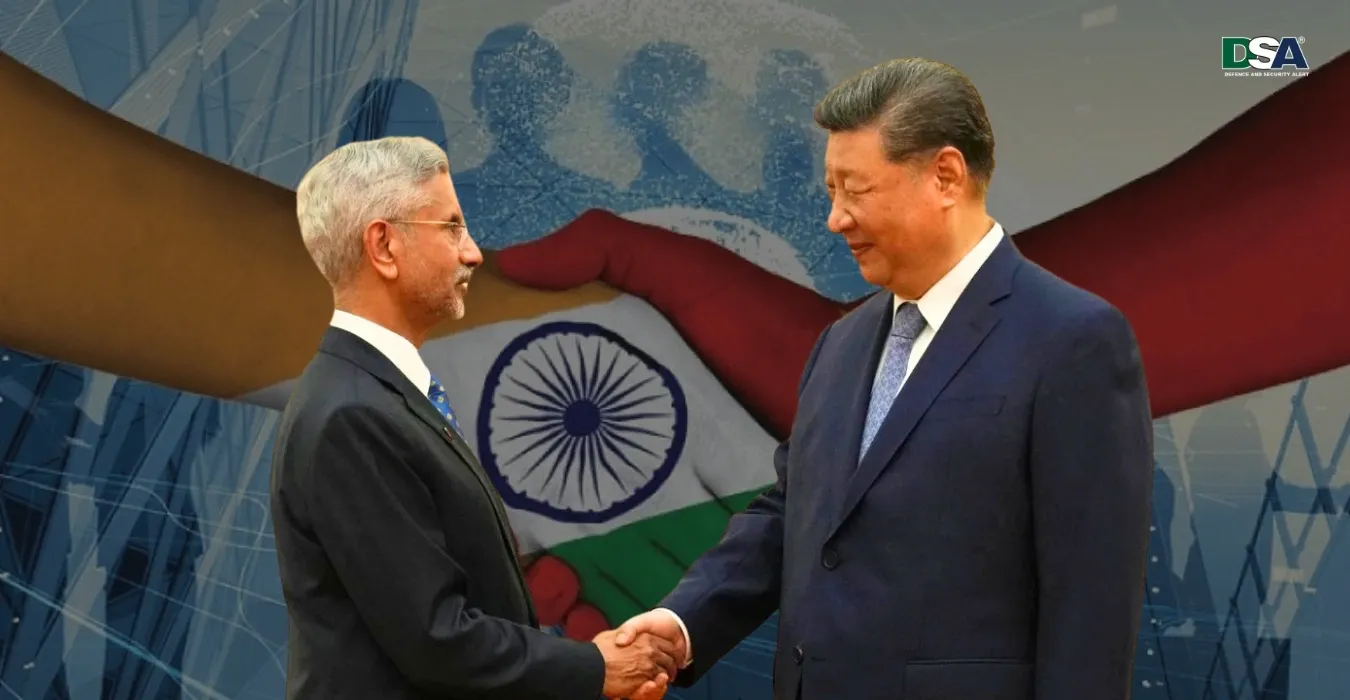
External Affairs Minister S. Jaishankar’s recent July 2025 visit to China, after a five-year hiatus, marks a significant moment in the uneasy but essential relationship between two of Asia’s largest powers. His meetings with Chinese Vice President Han Zheng and Foreign Minister Wang Yi in Beijing show that India and China are willing to talk again — a welcome shift after years of diplomatic freeze following the deadly Galwan Valley clash in 2020.
Both sides are now using softer and more pragmatic language. Jaishankar’s reference to the “continued normalization” of ties and Wang Yi’s emphasis on trust over suspicion and cooperation over rivalry, reflect this changed tone. Chinese officials even revived the metaphor of a “Dragon-Elephant Tango” — once used to describe the potential harmony between China and India.
But while the optics are encouraging, the hard reality remains: deep-rooted issues still persist. The biggest of them is the unresolved border situation along the Line of Actual Control (LAC). Though disengagement in some sectors was achieved nine months ago, full de-escalation — including withdrawal of troops and military infrastructure — remains unfulfilled. Until this happens, true normalization is wishful thinking.
Bilateral Mechanisms Return, But Trust Needs Time
A positive outcome of this visit is the gradual revival of institutional dialogue. Jaishankar’s trip follows earlier visits by NSA Ajit Doval and Defence Minister Rajnath Singh to China. The restart of the Kailash Manasarovar Yatra after five years also signals renewed confidence in people-to-people exchanges.
Furthermore, China and India have shown willingness to coordinate in multilateral platforms like the Shanghai Cooperation Organisation (SCO) and BRICS. Jaishankar is attending the SCO Foreign Ministers’ meeting in Tianjin, and Prime Minister Modi is expected to visit China for the SCO summit in September. These developments could lead to smoother coordination in tackling regional and global challenges — especially terrorism, where India continues to push for “zero tolerance,” a reference likely aimed at Pakistan’s continued role as a spoiler.
But despite these steps, deeper trust still eludes the relationship. Strategic suspicion remains strong — fuelled by unresolved border issues, China’s close ties with Pakistan and India’s growing alignment with the West. Meanwhile, China is wary of India’s increasing engagement with the U.S.-led Indo-Pacific initiatives like QUAD. Both countries are also jostling for influence in South Asia and the Indian Ocean, which adds another layer of geopolitical competition.
The Road Ahead: Building Trust Brick by Brick
The core question now is: can this thaw lead to long-term strategic stability? That depends on whether both sides can show maturity in respecting each other’s core concerns and gradually build strategic trust. The immediate step must be full de-escalation at the border, followed by the reactivation of high-level military and diplomatic communication channels.
Simultaneously, practical steps like resuming direct flights, boosting academic exchanges and encouraging think tank dialogues can help rebuild societal-level trust. These softer initiatives may not grab headlines, but they are crucial in reducing hostility and misperceptions.
Both sides must also resist external manipulation. China, in particular, emphasized that India-China relations should not be influenced by “third parties” — a thinly veiled reference to the U.S. India, on its part, must safeguard its strategic autonomy while avoiding unnecessary provocation or being drawn into binary power politics.
The global context is also shifting. With rising protectionism, trade wars and an uncertain security order in the Indo-Pacific, India and China — as major players in the Global South — have shared responsibilities. Their cooperation could add stability to the region and their rivalry could create more fault lines.
Ultimately, neither side can afford a breakdown. With massive populations, rising economies and shared borders, peaceful coexistence is not an option — it’s a necessity. Strategic trust may take years, even decades, to build. But the window for constructive dialogue has reopened. Seizing it with maturity, realism and patience will serve the best interests of both nations — and the wider region.
