
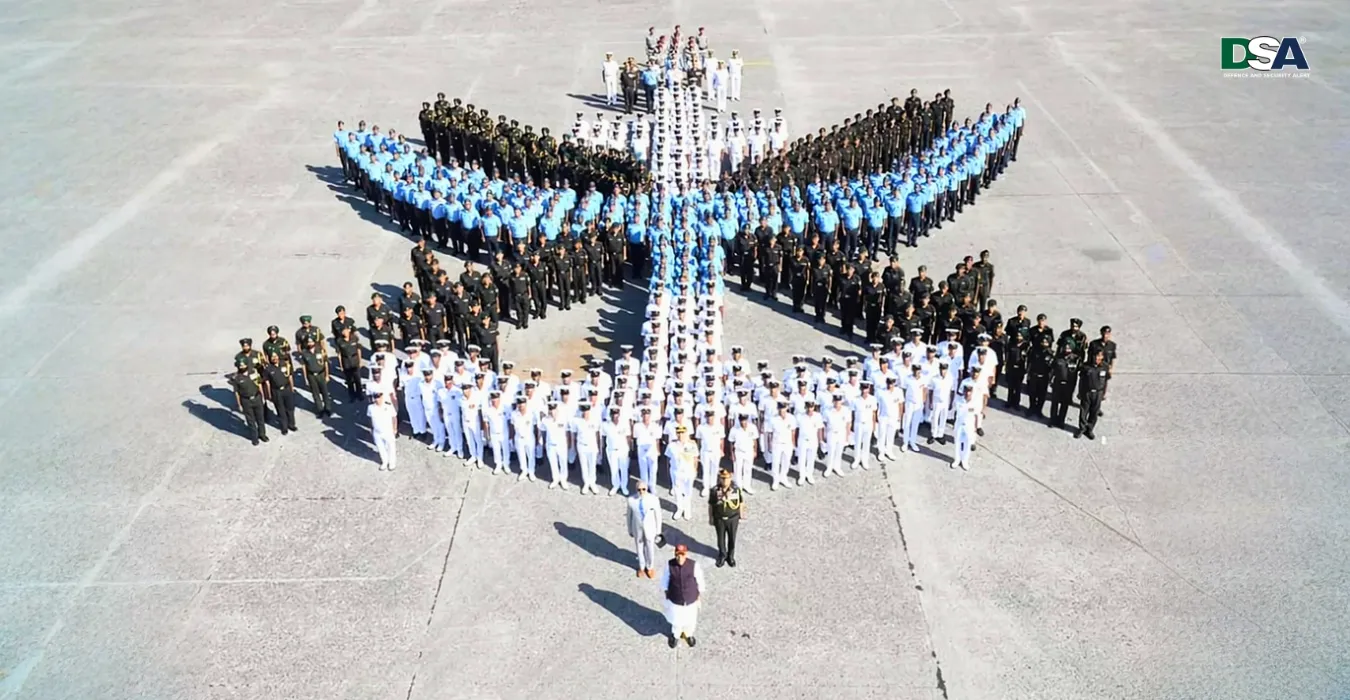
The way wars are fought has evolved a lot since the 21st century. It’s harder to tell the difference between the physical, cyber, and cognitive worlds. Weapons are no longer the only thing that matters; logistics, perception, and data are just as vital. The Indian Armed Forces are changing their doctrine and structure to include integrated theater commands. This is an effort to get the country’s many branches of the military to work together in coordinated operations.
From this perspective, Exercise Trishul, which began on October 30, 2025, was India’s biggest tri-service combat training since Operation Sindoor 2025. The Headquarters Integrated Defence Staff (HQ-IDS) and the three service commands planned and carried out Exercise Trishul. Which lasted more than two weeks and included actions on land, at sea, and in the air all at the same time. It said its purpose was to “validate the synergized use of combat power across domains to reach theater goals.”
The chosen theater, which ran from the deserts of western Rajasthan to the creek sectors of Gujarat and the neighboring sea approaches, was a realistic, complicated, and strategically vital region that was like India’s western front. The exercise tested India’s ability to deal with difficulties on land and at sea, such as hybrid, cyber, and gray-zone threats.
1. The goals and how things function
According to official and open-source reports, Trishul has four key goals:
- To make sure that all actions on land, sea, and air are part of the same operational framework.
- To make the three services work together better and make logistics work better, including working together through the Sudarshan Kshamta logistics grid.
- To test out multi-domain operations (MDO) that involve cyber-electronic warfare, ISR from space, and systems that don’t need people.
- To prove that India can create its own stuff, in keeping with the Atmanirbhar Bharat endeavour to make its own defence systems and digital command systems.
The operational architecture of Trishul was built on missions at the theater level, which brought together the three branches of the military:
- Land Segment (Army-led): live-fire artillery and armour operations, mechanized assault coordination with close-air support, and combined weapons maneuvers in the desert of Rajasthan.
- Maritime Segment (led by the Navy): amphibious operations in the Kutch-Sir Creek area, maritime interdiction maneuvers, and coordinating sea-air task groups in the northern Arabian Sea.
- Aerospace Segment (headed by the IAF): operations to gain air supremacy, battlefield air interdiction, and the utilization of UAVs and ISR assets together to collect targets in real time.
Cyber and spectrum operations were also used to see if the three services could manage the electromagnetic spectrum and make judgments over a network when things got tough.
2. Working together and the way to theater commands
The idea for Trishul came from India’s choice to set up integrated theater commands in 2020. The goal of this change was to put all the combat power of the different services under one leader. The HQ-IDS, which was set up in 2001, has been attempting to restructure India’s defence organization from one that is focused on services to one that is focused on missions.
So, Trishul wasn’t just a drill; it was a way to see how command structures would work in the future. For the first time, operational management was managed by a Joint Task Force HQ with officials from all three services and integrated logistics and communications nodes.
The drill confirmed many components of India’s new plan for working together to fight wars:
- Common Operational Picture (COP): This is when data from the Army, Navy, and Air Force networks are combined in real time so that everyone knows what’s going on.
- Joint Targeting Doctrine: Attacking diverse regions in a coordinated way to produce results based on effects.
- Theatre Logistics Nodes: A test case for logistics support that is spread out yet still linked.
This kind of testing is a huge step toward making interoperability and jointness standard. These are the two most critical aspects of current deterrent and quick-response capabilities.
3. Logistics as a source of fighting force
One element that made Trishul different was that it put a lot of focus on logistics as an important part of how successfully troops fought. The Sudarshan Kshamta module, which is a separate tri-service logistics exercise within Trishul, highlighted how logistics has moved from being a support function to being a strategic enabler.
Troops practiced advance logistical assistance, multi-modal supply lines, and medical evacuation in the desert and creek areas as if they were losing personnel. The Indian Air Force moved heavy equipment by air, and the navy made sure that amphibious forces could stay in the water. The Army then set up supply depots that could talk to each other digitally using the Joint Logistics Node (JLN) technology.
“Theatre logistics are the backbone of deterrence,“ Bharat Shakti Review noted. “They turn potential combat power into deliverable force “Trishul made the idea happen and it worked.
4. Technology and working together across fields
Data fusion, automation, and electronic superiority are all significant components of modern warfare. The Indian Armed Forces’ biggest test of multi-domain operations (MDO) so far has been Trishul.
a. Self-working systems: The drill used drones, loitering munitions, and counter-UAS systems produced by the DRDO and private businesses such Nagastra-I, SkyStriker, and ADITYA MPV. These systems worked with people on the ground to do ISR, detect targets, and look at the battlefield in real time.
b. Cyber and Spectrum Operations: Troops in Electronic Warfare (EW) pretended to jam and spoof enemy communications and radar systems. Cyber teams made sure that all three services’ networks had working intrusion detection and resilience systems.
c. Software and network suites for C4ISR Made in the United States: The Joint Command used India’s own network-centric warfare infrastructure, which includes the Navy’s NCW Grid, the IAF’s AFNet, and the Army’s ACCCS. These were all linked together by the Defence Communication Network (DCN). The end result was a live Common Operational Picture (COP) that let operations in various areas work together.
This kind of interoperability suggests that India has reached the age of algorithmic deterrence, where speed of decision-making, control of perception, and data integrity are just as crucial as physical strength.
5. Sir Creek signals: India’s silent message across the continental maritime frontier
The choice of Sir Creek was no coincidence. This disputed marshland along the India–Pakistan maritime boundary has long been a flashpoint a grey-zone frontier marked by infiltration, smuggling, and contested maritime claims. By selecting this sensitive theater for a joint amphibious exercise, India conveyed a deliberate message: its armed forces are capable of swift, coordinated action across both land and sea in their most volatile coastal sector.
In response, the Civil Aviation Authority of Pakistan put up airspace restrictions (NOTAMs) over Karachi and the areas around it. This was a quiet way of saying how significant and essential the exercise was. The message from the area was clear that India is ready to immediately coordinate activities between its three services throughout the continental maritime continuum.
Trishul is also in line with India’s Indo-Pacific agenda because it indicates that the government is determined to protect its interests not just on land but also at sea and in important shipping lanes. why the strategy aligns with India’s principle of “joint preparedness for extended deterrence.”
6. Indigenous Defence and Atmanirbhar in Action
Trishul was not only a tactical tool, but it was also a live showcase of India’s Atmanirbhar Bharat initiative in defence production. The US provided more than 60% of the equipment utilised in the exercise, such as radars, UAVs, network routers, and amphibious vehicles.
The exercise’s operational architecture included Bharat Dynamics’ precision-strike weapons, BEL’s battlefield sensors, and DRDO’s AI enabled decision-support systems. The focus on indigenous systems was both practical and symbolic. It showed that India’s goal of becoming self-sufficient had gone from a policy statement to something that can be done in battle.
These kinds of exercises show that the Government of India’s Defence Acquisition Procedure (DAP 2020) works since they test, refine, and upgrade indigenous equipment in real life.
7. Lessons learnt in operations and strategic problems
Exercise Trishul is a big step in the right direction, however there are still a lot of problems with the structure that need to be fixed:
- Cultural integration amongst agencies: Over time, procedures have become uneven because each agency has its own ideals. For real jointness to happen, everyone needs to speak the same language, have the same training, and follow the same career paths.
- Data Interoperability: A lot of progress has been made, but full network fusion between the three branches of the military’s communication systems still needs more standardisation and greater cyber security.
- Sustainment under Attrition: The exercise tested logistics, but operations that last a long time and lose a lot of people in real conflict will test resilience much more.
- Changing Doctrine into Policy: For Trishul to be successful, it must change government policy, procurement, and funding in order to close the gap between demonstration and institutionalisation.
- Risks of Strategic Signalling: Big drills along disputed boundaries could lead to misunderstandings amongst enemies. At the same time, crisis communication frameworks need to change.
But each of these problems is also a potential for India to make unity a part of its military strategy and way of thinking.
8. What this means for India’s defence plans for the future
Work out Trishul teaches India five critical things it should do to enhance its strategic position:
- Operational Readiness: The Armed Forces have now made plans for how to dispatch all three branches of the military to the west and along the coast.
- Doctrinal Maturity: The simulation makes a stronger case for putting up the Western and Maritime Theatre Commands as soon as possible.
- Integration of Technology: Indigenous AI, ISR, and communication technologies have been tested in the field, which has helped with algorithmic sovereignty.
- Strategic Deterrence: Showing that the three services can work well together builds both trust and dread, showing stability viaability.
- Keeping policies the same: Trishul shows how political vision (Atmanirbhar Bharat), institutional change (theatreisation), and operational practice (joint war-fighting) are all connected.
Conclusion
People will remember Exercise Trishul because it was so big, but it also transformed how India thinks about its defence. It made the idea of working together true, which means that India’s tri-services (Army, Navy and Air force) may now be able to function together as a single tool of state authority.
By Combining air, land, and sea operations into a single theatre design that covers cyberspace domains and using technology developed in India. India has taken a big step towards developing a self-sufficient, future-ready force that can work in many places. The shift towards this type of integration means that national security will no longer depend only on the number of assets. It will also depend on how well those assets can communicate, collaborate together, and act together under one vision.
Exercise Trishul is a test run for the ideas, technology, and ways of thinking that will shape India’s defence posture for the next ten years as the country progresses towards official theatre commands.
In the end, it demonstrates a deeper truth: sovereignty is not just preserved at borders. It is also protected in data, logistics, and how people work together. Exercise Trishul is the process of turning that synergy into steel.
