
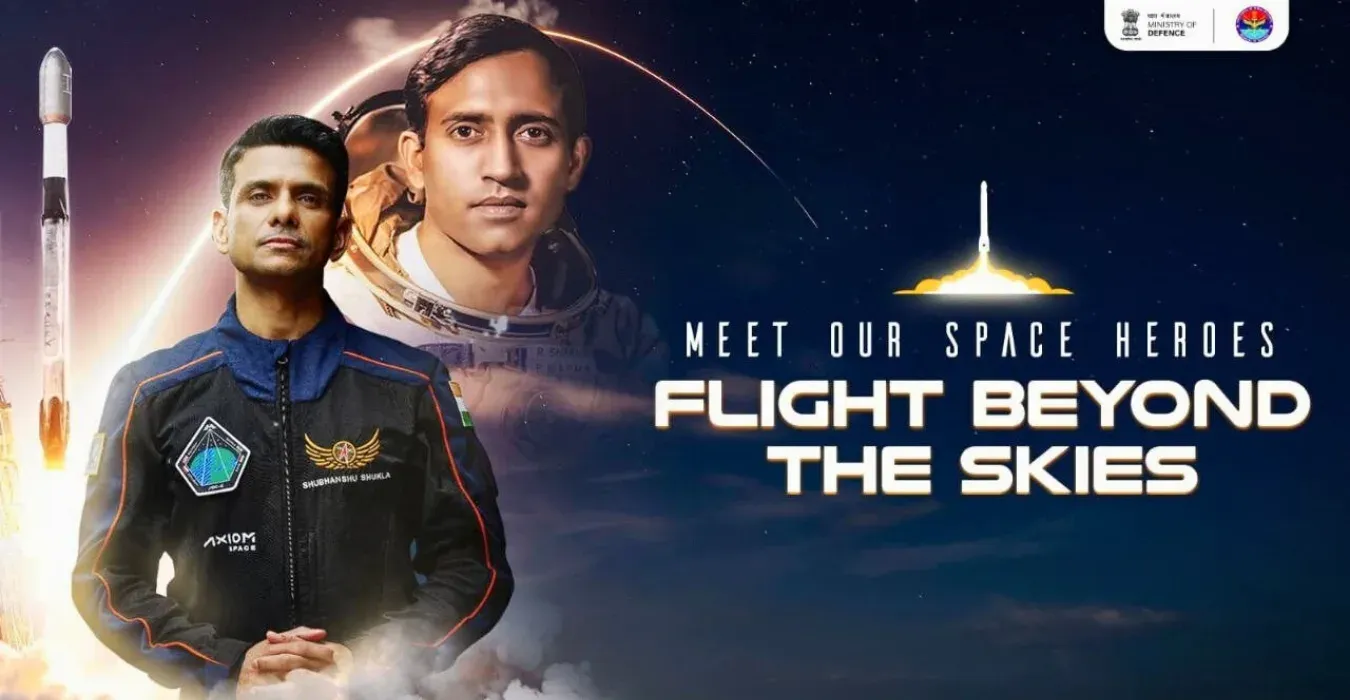
When Group Captain Shubhanshu Shukla safely returned to Earth after 18 days aboard the International Space Station (ISS), it was not just a personal milestone. It was a moment of national pride. Shukla, a second-generation Indian astronaut and a serving officer in the Indian Air Force, has become a symbol of India’s growing strength in space exploration. His journey as part of the Axiom Mission-4 (Ax-4) with SpaceX and NASA has sent a powerful message to the world: India is ready for the space age—not just with ambition, but with capability.
This mission has proved that India’s human spaceflight dream is not far from reality. While Shukla may have flown aboard an international mission, his contributions were deeply rooted in India’s scientific and strategic interests. Through over 10 critical experiments for ISRO and other Indian institutions, he laid the foundation for future Indian missions, including the much-awaited Gaganyaan program.
A Role Model for Students, A Push for STEM in India
Ask any child in India who went to space first, and they will say Rakesh Sharma. For this generation, Shubhanshu Shukla is now the face of space dreams. His mission is not just about science; it is about inspiration. The sight of an Indian Air Force officer floating in space, conducting experiments, and communicating with scientists back home is enough to spark curiosity among millions of young minds.
India has always faced a challenge in drawing students into science, technology, engineering, and mathematics (STEM). Group Captain Shukla’s mission is a game-changer. The impact of seeing someone who speaks your language, comes from your country and wears your uniform floating among the stars is priceless. It humanises space exploration and brings it within reach of Indian youth, especially those from smaller towns and rural areas.
Moreover, the group captain himself has acknowledged Rakesh Sharma as his role model. That very cycle of inspiration and success continues—only now, it is larger, stronger, and backed by far greater technology and resources.
Strengthening India’s Scientific Muscles
The group captain did not just float around and enjoy the view. His mission included more than 10 experiments for Indian institutions, each crucial for the success of India’s upcoming Gaganyaan mission.
For instance, the Microalgae experiment studied how algae could be used as a food and oxygen source for long space trips. Another, the Myogenesis study, focused on how muscles behave in space and how to reduce muscle loss—a key issue for astronauts during long missions.

He also worked on sprouting seeds in space, testing radiation dosimeters, and even tardigrade survival-those microscopic creatures famous for surviving extreme conditions. These are not small side projects. These are core building blocks for future deep-space missions, moon bases, and even Mars travel.
Let’s not forget the Cerebral Blood Flow and Photon Grav experiments, which focused on the brain’s response to space conditions. This is not only important for astronauts but also offers valuable insight for healthcare research back on Earth.
This data will feed directly into Gaganyaan, India’s first crewed space mission, and will help ISRO make spacecraft that are safer, smarter, and more comfortable. These are the silent but powerful steps toward India’s self-reliance in space exploration.
Boost to India’s Space Economy and Global Standing
India’s space industry is no longer just about launching satellites. It is about space tourism, human spaceflight, space habitats, and commercial research in microgravity. The global space economy is expected to touch $1 trillion by 2040. Shukla’s mission connects India directly with this booming future.
Axiom-4 was not just about science; it was a private, commercial space mission. Shukla’s participation in such a high-profile international collaboration signals to the world that India has talent, training, and trust. It strengthens India’s image as a serious and reliable player in the global space market.
Moreover, it opens up doors for international partnerships, commercial contracts, and foreign investments in India’s space startups and tech companies. It sends a clear message—India is not just buying tickets to space. It is preparing to sell them too.
This mission also strengthens civil-military collaboration, as an Air Force officer led science experiments in space. This aligns perfectly with India’s push for dual-use technology, where military and civilian sectors both benefit from shared infrastructure and research.
Group Captain Shubhanshu Shukla’s successful Axiom-4 mission is much more than a spaceflight. It’s a symbol of Indian capability, a spark for young minds, and a strong step towards scientific excellence.
India is now at a point where we do not just dream of space—we participate in it, contribute to it, and soon, we will lead in it. With each orbit Group Captain Shukla completed, he carried not just India’s flag—but also its hopes, ambitions, and scientific determination.
His return marks not the end of a mission, but the beginning of a movement. One that will see Indian astronauts, Indian spacecraft, and Indian experiments making headlines, not as exceptions, but as the norm.
Let’s welcome him home not just with applause, but with a firm resolve: India’s space story has only just begun.
