
BRICS Reimagined
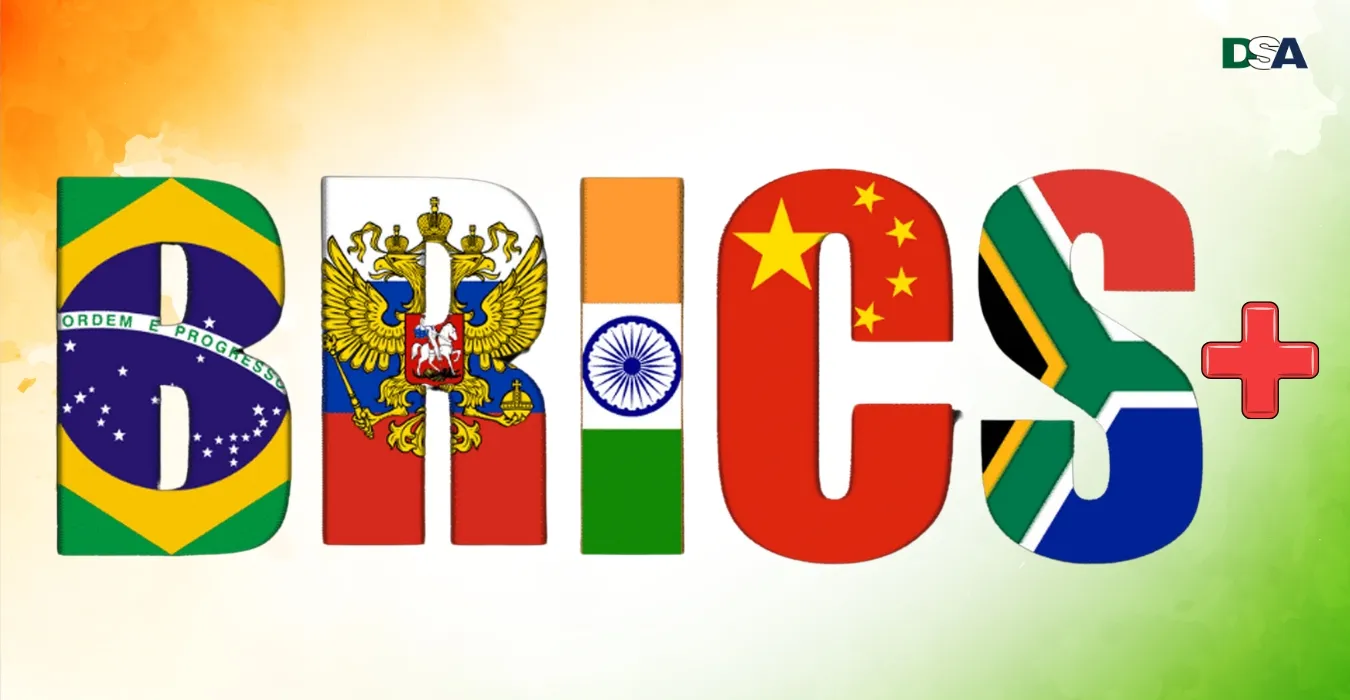
The 2023 BRICS expansion was a changing moment in the bloc’s identity.The founding members being Brazil, Russia, India, China, and South Africa, BRICS extended its membership to Egypt, Ethiopia, Iran, and UAE earlier this year to create “BRICS+” (Earle, 2025).
BRICS’s growing geopolitical ambitions were reflected in the expansion, as it is now home to about 30% of the world’s population and almost a quarter of the global GDP (Suri, 2024).
At a time when India is recalibrating its foreign policy, this evolution is happening for India.
As a recent ascendant G20 presidency, New Delhi views BRICS+ as a route to gaining further global standing without diluting its strategic autonomy (Pant and Jayaprakash, 2024). This shift was especially highlighted by Prime Minister Modi’s prominent role at the Kazan Summit on the 24th of August 2024 as the head of the BRICS summit.
India welcomed the new members carefully, choosing to support entrants such as the UAE that support its economic and diplomatic objectives, but making clear that the expansion needed to comply with definitive criteria (Rao, 2024), BRICS as a platform for Southern voices to be heard but opposes any drift in the organisation moving towards an anti-west coalition.
BRICS is not only expanding in membership but evolving in purpose-and India is positioning itself not just as a participant but as a norm-shaping force within it.
Whether this momentum can be sustained will hinge on New Delhi’s ability to navigate tensions between its global aspirations and geopolitical challenges.
The Diplomatic Balancing Act
India’s doctrine of ‘strategic autonomy’ is coming under increased strain with growing global rivalries. Being a founding member of the Non–Aligned Movement, India has traditionally stayed away from rigid alliances.
Today, we see this in its two-pronged engagement with the U.S.-led Quad and G20 on the one hand and BRICS and Shanghai Cooperation Organisation (SCO) on the other (Donald, 2024). However, with the geopolitical rivalries heating up, especially with the worsening of US China tensions, India’s margin of manoeuvre in playing the grey card might get thinner.
Negotiations for partnership are, hence, the order of the day for New Delhi with Washington and Beijing together.
India is, to use an old description appropriate within BRICS, a bridge between the worlds: It belongs to the Global South and yet has strong ties with Western democracies (Suri, 2024). This calibrated approach is reflected in PM Modi’s alternating attendance at BRICS and QUAD summits (Rao, 2024).
The Ukraine conflict reinforced India’s importance to Moscow, Simultaneously, India’s role in the U.S. Indo-Pacific strategy has grown.
Yet it remains reluctant to formalise any anti-China alignment, preferring a cooperative yet independent stance. This frustrates some in the West, but it is essential to India’s vision of global engagement (Ibid).
While Beijing and Moscow support de-dollarisation, India is cautious in favour of incremental diversification.
While there is no serious proposal for an anti-dollar currency (Pant and Jayaprakash, 2024), India’s tightrope diplomacy rests on maintaining flexibility. China and Russia expect solidarity in weakening Western influence; the West hopes India will moderate BRICS from within. India’s challenge is to amplify its voice without becoming a proxy for either camp.
As BRICS+ gains prominence, this balancing act becomes even more precarious-testing whether India’s strategic autonomy can endure in a divided world.
What India Brings to the Table
Through its normative leadership, India has become a subtle but influential agenda-setter in BRICS. Instead of a quixotic bid to defeat China’s economic strength, India has driven the bloc via ideas of inclusive development, technology, and respect for sovereignty (Pant and Jayaprakash, 2024).
This “leadership by design” – a choice for persuasion over power – allows India to mould the group’s orientation to resonate with its democratic and developmental priorities.
At the 2024 Kazan Summit, India successfully pushed for BRICS to adopt Digital Public Goods as a shared objective, resulting in support for a BRICS Digital Health Network (Rao, 2024; Sabu, 2024). This positions India not only a leader in innovation
India has also shaped the BRICS discourse on counter-terrorism
India has taken strong action against cross-border terrorism and has got bloc-side backing on the Comprehensive Convention on International Terrorism (CCIT) and explicit references to sovereignty and territorial integrity in summit declarations (Rao, 2024; Sabu, 2024). These inclusions signal India’s success in inserting global norms it values into BRICS without alienating partners.
When India pushes for multilateral reform, it is keen to be a universalist in espousing such. Its advocacy for changes in the UN Security Council, IMF, and World Bank complements its broader positioning as a voice for the Global South (Suri, 2024).
This cumulative effect on digital norms, terrorism, development, and sovereignty proves leadership for India based on values.
Friction and Fragility: Can India Lead a Bloc This Divided?
India’s growing ambition within BRICS+ faces some challenges. BRICS is characterised by internal contradictions arising out of the bloc’s internal difference consisting of ten different economies in terms of political system and geography along with , China’s economy is all 3.5 times that of the rest of the original BRICS together, meaning that Chinese diplomats have a disproportionate say over the Contingent Reserve Arrangement and the New Development Bank (Kamalakar, 2024).
These developments are negative BRICS global credibility. Indian analysts advice that unless powers such as India, Brazil and South Africa appear together to cushion for balance, as BRICS could become a vehicle for Chinese geopolitical interests (Ahmed, 2024).
Economic asymmetries exacerbate these tensions. China’s manufacturing-led growth contrasts with India’s service-driven economy, Russia and Brazil’s commodity exports, and South Africa’s smaller mixed model.
Political mistrust lingers
The unresolved border conflict between India and China—heightened by the 2020 Ladakh standoff-limits the potential for deep cooperation, even as leaders engage diplomatically at summits (Rao, 2024).
India’s ability to lead depends less on economic weight and more on its capacity to mediate, build coalitions, and keep the bloc development-focused. Leadership in BRICS, for India, will be less about dominance and more about diplomatic dexterity—advancing its agenda inch by inch in a fragmented and fluid geopolitical landscape.
Conclusion
India’s BRICS+ engagement has moved from a cautious participant to a strategic agenda setter.
India’s growing influence in the recent summits, most recently in Kazan 2024, where India played a role in the outcome of development finance, digital public infrastructure, and counter-terrorism.
Prime Minister Modi’s assertive diplomacy puts India at the centre of things as a consensual interlocutor rather than a domineering one.
However, India’s leadership remains constrained. China doesn’t have the economic command over BRICS and must contend with divergent interests among BRICS and seek to preserve ties with the West. Though avoiding BRICS reserve currency, its strategy helped reformist initiatives compatible with its global vision, keeping away from overtly anti-western measures like this (India Today, 2025).
By moderating radical proposals, India subtly reinforces its identity as a trusted bridge between power centres. This balancing act is not merely tactical—it is foundational to India’s foreign policy. Strategic autonomy remains the precondition for shaping BRICS without becoming a proxy for either Beijing or Washington.
The success of Indian influence in BRICS depends on maintaining a neutral position between Western and Eastern spheres as an autono ous player.
The success of BRICS+ as a platform for its intended goals depends on India’s ability to preserve geopolitical autonomy.
References
Ahmed, S.Z. (2024). India Can Do A Lot With BRICS – If It Doesn’t Let China Run The Show. [online] www.ndtv.com. Available at: https://www.ndtv.com/opinion/why-india-shouldnt-let-russia-and-china-control-brics-agenda-6767416.
Donald, D. (2024). India Between Superpowers: Strategic Autonomy in the Shadow of a Pacific Conflict. [online] Council on Foreign Relations. Available at: https://www.cfr.org/blog/india-between-superpowers-strategic-autonomy-shadow-pacific-conflict.
Earle, P.C. (2025). BRICS 2025: Expansion, De-Dollarization, and the Shift Toward a Multipolar World | The Daily Economy. [online] Thedailyeconomy.org. Available at: https://thedailyeconomy.org/article/brics-2025-expansion-de-dollarization-and-the-shift-toward-a-multipolar-world/.
India Today (2025). Trump claims BRICS ‘broke up’ after tariff threat: Haven’t heard from them lately. [online] India Today. Available at: https://www.indiatoday.in/world/story/trump-claims-brics-india-china-broke-up-threatened-150-tariffs-undermining-dollar-2683205-2025-02-21.
Kamalakar, G. (2024). India’s strategic influence in BRICS: Balancing power with diplomacy. World Journal of Advanced Research and Reviews, [online] 24(2), pp.269–274. doi:https://doi.org/10.30574/wjarr.2024.24.2.3221.
NDTV (2025). Is BRICS ‘Disintegrating’ After Trump’s Tariff Threat? S Jaishankar Says… [online] www.ndtv.com. Available at: https://www.ndtv.com/india-news/committed-to-multi-polarity-s-jaishankar-on-us-tariff-threat-to-brics-7981942.
Pant, H.V. and Jayaprakash, R.S. (2024). The BRICS imperative for India. orfonline.org. [online] doi:https://doi.org/1025135826.jpg?1732259279.
Rao, A. (2024). Why BRICS Matters and India’s Strategic Role in the Grouping. [online] India Briefing News. Available at: https://www.india-briefing.com/news/why-brics-matters-indias-strategic-role-in-the-multilateral-grouping-34949.html/.
Sabu, A.T. (2024). India and the 16th BRICS Summit: Interests and Agendas – Centre for Public Policy Research (CPPR). [online] Centre for Public Policy Research (CPPR). Available at: https://www.cppr.in/articles/india-and-the-16th-brics-summit-interests-and-agendas.
Suri, R. (2024). BRICS and India’s pivotal role in shaping a multipolar world. [online] Global Order. Available at: https://www.globalorder.live/post/brics-and-india-s-pivotal-role-in-shaping-a-multipolar-world.
