
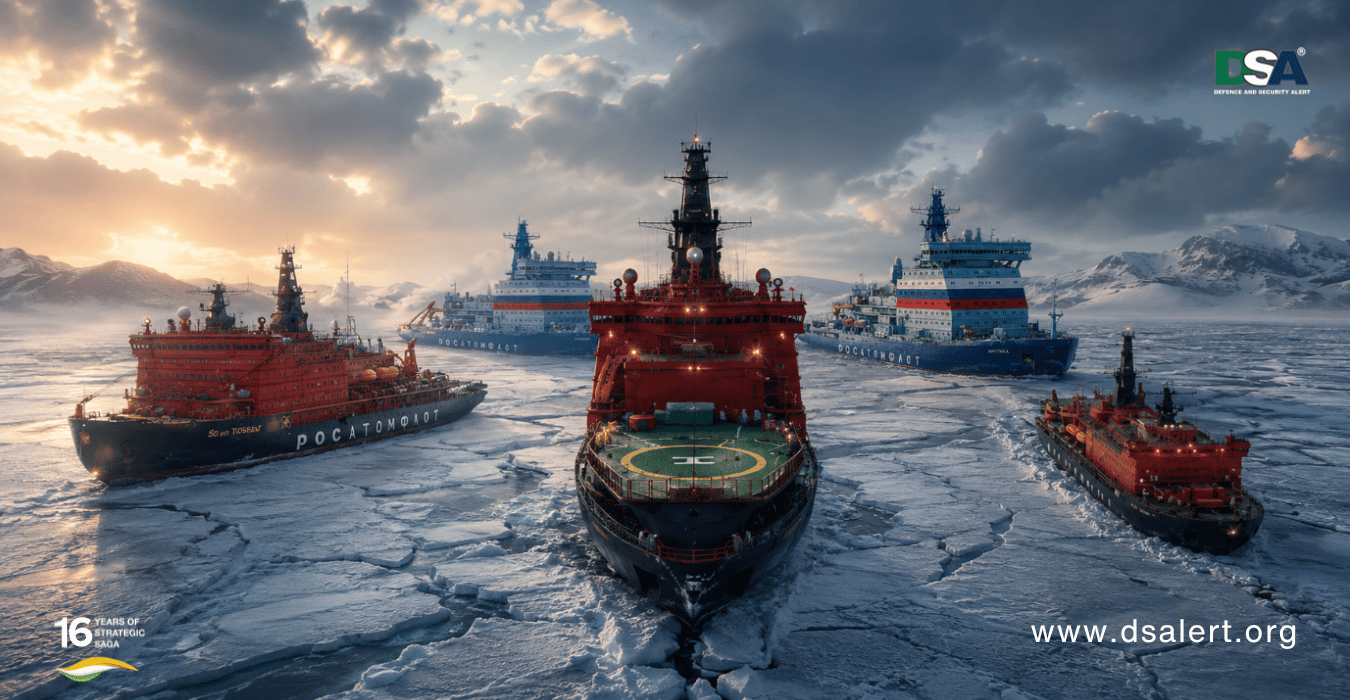
The Arctic is rapidly emerging as one of the most consequential geopolitical theatres in the 21st century. Accelerating climate change, melting sea ice, evolving maritime trade corridors and intensifying great-power competition have collectively transformed the region from a peripheral strategic space into a central arena for global power politics. Within this changing geopolitical environment, Russia holds a position of unique dominance. Russia is the only Arctic state that owns and operates a fleet of nuclear-powered icebreakers, affording Moscow unparalleled operational capability across the Arctic Ocean. According to recent Russian fleet data, Russia currently possesses about 34 diesel-powered icebreakers and 8 nuclear-powered ones, making it the world’s largest and most capable icebreaking force. Russia’s Arctic fleet is more than just a technological accomplishment or a logistical requirement. It acts as a strategic tool to advance Russia’s economic interests, military stance, energy security and geopolitical influence in the High North. In many respects, the icebreaker fleet has become central to Russia’s long-term Arctic doctrine and its wider vision of Eurasian connectivity. As Arctic competition intensifies between Russia, NATO and increasingly China, the strategic significance of Moscow’s icebreaking capabilities continues to expand.
Implications for India
For India, developments in the Arctic have a growing strategic relevance. The Arctic influences global energy markets, maritime trade routes and Eurasian connectivity patterns. India’s growing engagement with Russia in energy cooperation and connectivity initiatives makes Arctic developments strategically significant for New Delhi.
Future Arctic trade routes may reshape aspects of Europe-Asia commerce and alter global maritime calculations, potentially leading to shifts in trade balances, supply chain logistics, and economic partnerships between nations.
Moreover, evolving Arctic competition between Russia, NATO and China could influence broader geopolitical dynamics extending into Eurasia and the Indo-Pacific, potentially impacting trade, security alliances and regional power balances. India’s Arctic policy and scientific engagement therefore require careful alignment with long-term geopolitical and economic trends emerging in the region, such as the increasing competition for resources and shipping routes, as well as the strategic manoeuvres of major powers like Russia, NATO and China.
The Arctic and Emerging Geopolitical Competition
The geopolitical relevance of the Arctic has increased significantly over the last two decades. The Arctic region, once viewed as a remote and largely inaccessible part of the world, now connects increasingly to global trade, energy markets and strategic competition. The economic importance of the region has grown with estimates of significant hydrocarbon reserves, including deposits of natural gas and oil under Arctic waters. Simultaneously, climate-induced ice reduction has enhanced the feasibility of Arctic maritime routes, particularly the Northern Sea Route (NSR), which runs along Russia’s Arctic coastline.
The Northern Sea Route has emerged as a major component of Russia’s Arctic strategy. Compared to traditional maritime corridors connecting Europe and Asia through the Suez Canal, the NSR significantly reduces shipping distance and transit time. Moscow therefore views the route not merely as a commercial opportunity but also as a strategic corridor capable of strengthening Russia’s role in Eurasian trade and global logistics.
However, despite climate change, Arctic navigation remains operationally difficult. Ice conditions, severe weather, seasonal variability and limited infrastructure continue to restrict maritime activity. Thus, icebreakers are still essential for long-term Arctic operations. Seen in this way, Russia’s combination of conventional and nuclear-powered icebreakers provides it a distinct strategic advantage over other Arctic states.
Russia’s Icebreaker Fleet: Composition and Strategic Utility
Russia’s icebreaker fleet currently consists of approximately 34 diesel-powered and eight nuclear-powered vessels. While diesel-electric icebreakers perform coastal escort duties, port operations and regional logistics support, the nuclear-powered fleet forms the core of Russia’s Arctic operational capability. The nuclear fleet includes vessels such as Yamal, 50 Let Pobedy, Taymyr, Vaygach, Arktika, Sibir, Ural and Yakutia. Additional vessels, including Chukotka, Leningrad and Stalingrad, are under construction as part of the Project 22220 programme. These icebreakers are among the most technologically advanced polar vessels ever developed.
The Project 22220 class, in particular, reflects Russia’s effort to modernise Arctic infrastructure and strengthen year-round navigation capability. Equipped with dual RITM-200 nuclear reactors, these vessels can reportedly operate for several years without refuelling while breaking through thick Arctic ice layers exceeding two to three metres. They have high propulsion power and can operate for long periods of time, making them perfect for Arctic escort operations and long missions.
The strategic utility of these vessels goes beyond navigation support. They facilitate energy exports, ensure access to remote Arctic infrastructure and support Russia’s military logistics in Polar Regions. In effect, icebreakers function as enablers of continuous Russian presence across the Arctic theatre.
Nuclear Propulsion and Arctic Operational Superiority
The operational significance of nuclear propulsion in Arctic environments is substantial. Diesel-powered icebreakers need regular refuelling and logistical support, which can be challenging to maintain in isolated Arctic conditions. Nuclear propulsion removes many of these limitations by providing long-duration operational capability with minimal refuelling.
This allows Russian nuclear icebreakers to sustain an uninterrupted presence in the Arctic even during the harsh winter conditions that make maritime operations especially difficult. Strategically, this endurance translates directly into operational superiority.
The ability to escort commercial convoys, keep navigation channels open and support military logistics year-round gives Russia a major boost in its influence in the Arctic. Importantly, no other country currently operates a comparable nuclear-powered icebreaker fleet. While several Arctic and non-Arctic states are expanding their polar capabilities, Russia remains the only country possessing mature operational experience in nuclear Arctic navigation.
Soviet Legacy and Continuity in Arctic Strategy Russia’s Arctic supremacy is deeply rooted in Soviet strategic planning. During the Cold War, the Soviet Union viewed the Arctic as critical for both national security and economic development. In 1959, the launch of Lenin, the world’s first nuclear-powered surface vessel, marked the beginning of Soviet nuclear icebreaker operations. Subsequently, Moscow invested heavily in Arctic infrastructure, including ports, scientific stations, military facilities and polar logistics networks. Unlike many Western states that reduced Arctic investments after the Cold War, Russia maintained long-term institutional continuity in Arctic development. This continuity is particularly important in understanding Russia’s current strategic posture. The present icebreaker fleet is not an isolated technological program but rather part of a decades-long effort to establish sustainable operational dominance in the Arctic.
Arctic Energy Security and Economic Interests
Russia’s Arctic territories contain some of the world’s largest untapped reserves of hydrocarbons and strategic minerals. Arctic LNG projects, offshore oil fields and mineral extraction zones have become increasingly important to Russia’s economic strategy, particularly in the context of evolving global energy markets. Icebreakers are vital for the continuity of these activities. Maritime logistics must be able to function without interruption to export Arctic energy, especially during winter when conventional navigation is difficult. Nuclear-powered icebreakers are thus economic security assets because they provide year-round access to energy infrastructure and export terminals.
The Northern Sea Route adds another economic dimension. Moscow hopes to develop the route into a commercially viable Eurasian trade corridor that could reduce dependence on traditional maritime chokepoints like the Suez Canal and the Strait of Malacca. Consequently, Russia’s icebreaker fleet directly supports broader ambitions related to Arctic economic integration and Eurasian connectivity.
Military Dimensions of Russia’s Arctic Posture
In recent years, the Arctic has also become increasingly militarised. Russia has reopened Soviet-era Arctic military bases, expanded radar systems and strengthened submarine operations across northern waters. Military capability and strategic deterrence closely connect to Arctic mobility. Icebreakers provide logistical support, resupply operations, and sustained military access throughout remote Arctic areas, supporting these goals.
The ability of icebreakers to facilitate troop movement, infrastructure support and strategic mobility improves Russia’s capability to maintain a continuous presence in the High North.
This is particularly relevant given the growing interest from NATO in Arctic security. As Western countries increase their Arctic exercises and surveillance activities, Russia’s superior icebreaking capability provides Moscow with considerable operational flexibility and regional advantage.
The Western Capability Gap
A major feature of contemporary Arctic geopolitics is the widening capability gap between Russia and Western powers in polar navigation. Russia possesses the world’s largest icebreaker fleet and remains the only state operating nuclear-powered icebreakers. By contrast, the United States maintains a comparatively limited heavy icebreaker capability and lacks nuclear-powered Arctic vessels entirely.
This imbalance has important strategic implications. Arctic operations require not only naval capability, but also sustained logistical endurance, specialised infrastructure and year-round mobility. Russia currently possesses all three at scale. Consequently, despite the growing Western focus on Arctic security, Moscow continues to maintain clear operational superiority across large portions of the Arctic maritime domain.
China and the Emerging Polar Silk Route
China’s growing Arctic engagement adds another layer of complexity to regional geopolitics. China is not a geographically Arctic state, but Beijing is increasingly seeing the Arctic as strategically relevant in the context of the Belt and Road Initiative. The concept of the “Polar Silk Route” reflects China’s interest in Arctic shipping routes as alternatives to vulnerable Indo-Pacific maritime chokepoints.
This has led to increased Russia-China cooperation on Arctic infrastructure, shipping and energy projects. For Russia, Chinese investment offers economic support for Arctic development. For China, Arctic access adds to trade diversification and long-term strategic flexibility, allowing it to secure new shipping routes and resources that are vital for its economic growth and energy security. This developing partnership may be a key influence in future Eurasian geopolitical alignments.
Russia, for all its Arctic dominance, faces several significant challenges. Nuclear icebreakers are technologically complex and financially costly assets requiring advanced shipbuilding capability, specialised maintenance infrastructure and highly trained personnel. Western sanctions post-Ukraine conflict have also complicated access to some technologies and industrial supply chains. Economic pressures and project delays may influence the pace of future Arctic expansion, potentially leading to reduced investment in necessary technologies and infrastructure that support Arctic operations. In addition, Arctic operations will always be difficult due to severe weather conditions, environmental risks and geographical isolation. Sustaining long-term dominance in the Arctic will demand continuous financial and institutional commitment.
Conclusion
Russia’s nuclear-powered icebreaker fleet has become one of the most significant strategic assets in modern Arctic geopolitics. Beyond navigation, it enables Moscow to secure energy infrastructure, dominate the Northern Sea Route, sustain military mobility and strengthen its geopolitical influence across the High North. As climate change opens new Arctic trade corridors and intensifies great-power competition, Russia’s unmatched icebreaking capability provides it with a major long-term strategic advantage.
For India, the Arctic is increasingly linked to energy security, maritime trade and Eurasian connectivity. Emerging Arctic routes and Russia’s expanding Arctic energy projects could reshape global commerce and strategic calculations in the Indo-Pacific. Therefore, India must view the Arctic not merely as a scientific domain, but as an evolving geopolitical space with growing implications for its economic and strategic interests. Ultimately, Russia’s icebreaker supremacy reflects how the Arctic is rapidly emerging as a central theatre of twenty-first century global competition.
At the broader strategic level, the Arctic’s transformation demonstrates how future geopolitical influence will depend not only on military strength, but also on control over critical infrastructure, logistics and emerging trade corridors. In this context, Russia’s Arctic strategy highlights the growing importance of technological capability, maritime dominance and long-term geopolitical planning in shaping the balance of power in the evolving international order.
Referral
- Government of India, Ministry of Earth Sciences. India’s Arctic Policy: Building a Partnership for Sustainable Development. New Delhi: Government of India, 2022. https://library.arcticportal.org/2015/1/Indias_Actic_Policy.pdf
- Abhishek Mishra. India’s Arctic Policy and Strategic Implications. Issue Brief. New Delhi: Manohar Parrikar Institute for Defence Studies and Analyses (MP-IDSA), 2022.
https://idsa.in/system/files/issuebrief/ib-india-arctic-policy-abisen-170322.pdf - United States Geological Survey. Circum-Arctic Resource Appraisal: Estimates of Undiscovered Oil and Gas North of the Arctic Circle. USGS Fact Sheet 2008–3049. Reston, VA: USGS, 2008. https://pubs.usgs.gov/fs/2008/3049/
- Arctic Portal. “Northern Sea Route / Northeast Passage.” Accessed May 6, 2026. https://arcticportal.org/shipping-portlet/shipping-routes/northeast-passage
- Rosatom. “Rosatom Manufactured Nuclear Fuel for the Chukotka Icebreaker Currently under Construction.” Accessed May 6, 2026. https://rosatom.ru/en/press-centre/news/rosatom-manufactured-nuclear-fuel-for-the-chukotka-icebreaker-currently-under-construction-/
- Wikipedia Contributors. “Project 22220 Icebreaker.” Wikipedia, The Free Encyclopedia. Accessed May 6, 2026. https://en.wikipedia.org/wiki/Project_22220_icebreaker
- International Atomic Energy Agency (IAEA). “Nuclear Marine Propulsion to Innovative Small Modular Reactors and Deployment Models.” Accessed May 6, 2026. https://www.iaea.org/resources/member-states-side-eventsom-nuclear-marine-propulsion-to-innovative-small-modular-reactors-and-deployment-models
- Rosatom Energy. “Rosatom Finished the First RITM-200 Reactor for the Yakutia Icebreaker.” Accessed May 6, 2026. https://rosatom-energy.ru/en/media/rosatom-news/rosatom-finished-the-first-ritm-200-reactor-for-the-yakutia-icebreaker/
- Wikipedia Contributors. “Arctic Policy of Russia.” Wikipedia, The Free Encyclopedia. Accessed May 6, 2026.
https://en.wikipedia.org/wiki/Arctic_policy_of_Russia - Wikipedia Contributors. “Northern Sea Route.” Wikipedia, The Free Encyclopedia. Accessed May 6, 2026.
https://en.wikipedia.org/wiki/Northern_Sea_Route - Reuters. “Lavrov Vows Russia Will Defend Its Arctic Interests.” September 19, 2024.
https://www.reuters.com/world/europe/lavrov-vows-russia-defend-its-arctic-interests-2024-09-19/ - United States Coast Guard. “US Coast Guard Announces Homeporting of the First Two Arctic Security Cutters.” April 2026.
https://www.news.uscg.mil/Press-Releases/Article/4461752/us-coast-guard-announces-homeporting-of-the-first-two-arctic-security-cutters-i/ - United States Coast Guard. “Polar Security Cutter Program.” Accessed May 6, 2026.
https://www.dcms.uscg.mil/Our-Organization/Assistant-Commandant-for-Acquisitions-CG-9/Programs/Surface-Programs/Polar-Icebreaker/ - State Council Information Office of the People’s Republic of China. China’s Arctic Policy. Beijing: State Council of China, 2018. https://english.www.gov.cn/archive/white_paper/2018/01/26/content_281476026660336.htm
