
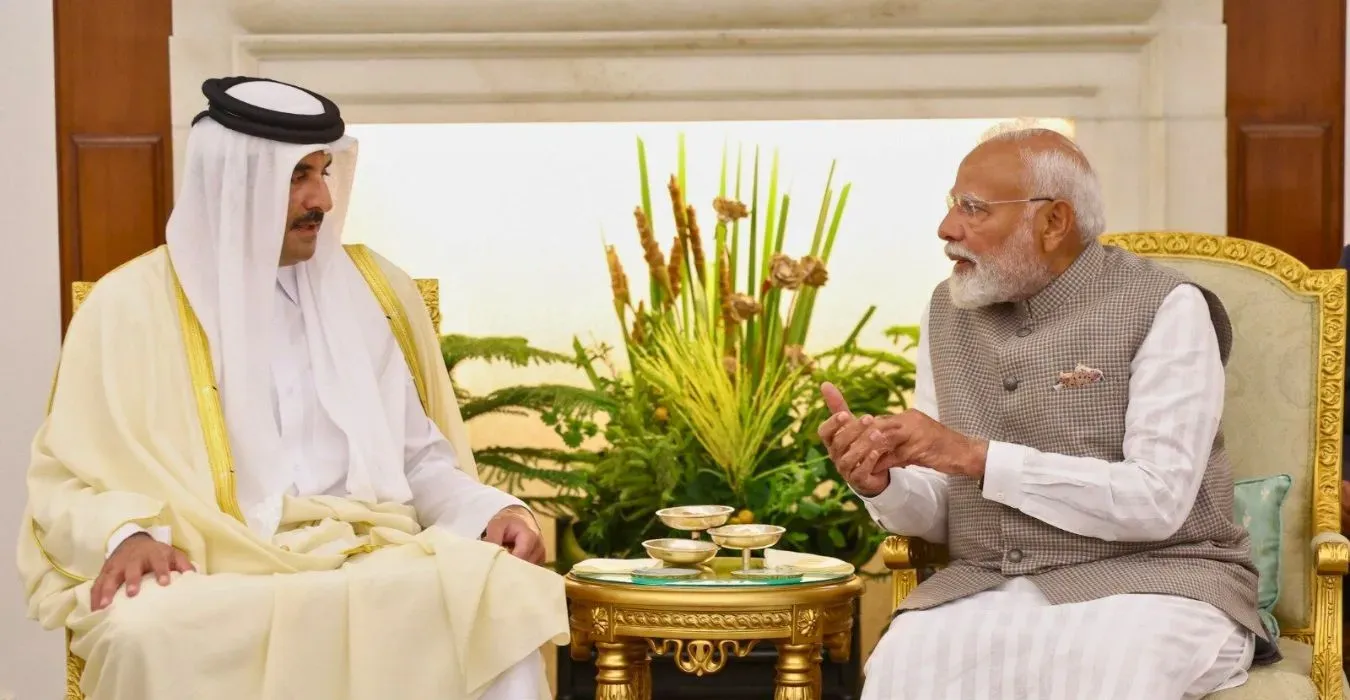
“My visit to Qatar has added new vigour to the India-Qatar friendship. India looks forward to scaling up cooperation in key sectors relating to trade, investment, technology and culture. I thank the Government and people of Qatar for their hospitality.”—Prime Minister Narendra Modi wrapped up his Qatar visit in 2024 with these words. Bilateral ties were significantly strengthened as both sides agreed to elevate the relationship to a strategic level as the Emir of Qatar Sheikh Tamim Bin Hamad Al-Thani met Prime Minister Modi in New Delhi for wide-ranging talks, with an aim to boost economic and strategic cooperation. While Qatar pledged an additional $10 billion investment in India, supplementing the existing $1.5 billion held by the Qatar Investment Authority, as both nations seek to double trade by 2030 and further bolster financial and tech ties, the leaders recalled the historic trade linkages, deep-rooted people-to-people contact and robust bilateral relations. They expressed the desire for further expanding and deepening the multifaceted relationship between both countries – according to a Ministry of External Affairs read-out on the joint statement. Qatar’s Emir and the Indian Prime Minister discussed ways to enhance cooperation in trade, investment and energy. Trade between India and Qatar stood at US $14 billion in the fiscal year 2023-2024, down from $18.77 billion in 2022-2023. Qatar is also a major investor in India with the Sovereign Wealth Fund and Qatar Investment Authority, currently holding about $1.5 billion in foreign direct investment across sectors like retail, power, IT, education, healthcare and affordable housing. A number of areas were identified where the Qatar Investment Authority can increase investments – in infrastructure, ports, shipbuilding, and energy especially renewable energy, smart cities, food parks, start-ups and new technologies like artificial intelligence, robotics and machine learning.
Qatar-India partnership
Dr. Abdulfatah Mohamed, Professor of Global Affairs at Qatar’s Hamad Bin Khalifa University and former Senior Adviser to the Qatari Foreign Ministry is upbeat about the outcome of Emir Al-Thani’s visit to India. “This historic visit marks a new chapter in Qatar-India partnership forged in a changing world order,” says Dr. Mohamed, as he highlighted the shared interest in regional as well as global peace and the influence of the Indian diaspora in Qatar’s economy. They are not just a cog in the machine but a powerful economic engine shaping Qatar’s growth. With their robust presence across various sectors – from high-skilled professions to vital blue-collar roles – the Indian population in Qatar is not only a significant contributor to the local economy, but also acts as a cultural bridge to foster a unique relationship. “Apart from fiscal impact, their remittances contribute to economic and social development back home” reminds Dr. Mohamed. He also flagged energy as a key partnership segment. Though India’s 30 percent stake in Mozambique’s Cabo Delgado gas field – through a consortium of Indian State-owned companies including ONGC Videsh (OVL), Oil India (OIL) and Bharat Petro Resources (BPRL) – will likely reduce future dependency on Qatar for liquefied natural gas, Dr. Mohamed is, however, confident that energy security will remain the backbone of India-Qatar relations for years to come due to the growing energy demands driven by rapid industrialization and urbanization. Apart from this Dr. Mohamed cited the Indian expatriate community’s contribution in strengthening the Qatari healthcare system, which is an important pillar of bilateral ties. Moreover, both India and Qatar decided to re-energize the Joint Working Group on Health as India wants to enhance export of pharmaceutical products and medical devices to Qatar. Since Qatar’s agricultural sector has expanded in recent years due to the country’s increased food demands caused by a rapid population growth and economic development, Dr. Mohamed envisaged India’s participation in ensuring food security and protection of supply chains.

Conclusion
Despite its small geographic size, a wealthy Qatar is a linchpin in peace-making. In fact, its strategic significance and indispensability in West Asia can be gauged from the fact that it hosts strange contradictions. Qatar concurrently hosts America’s largest military base in the Middle East, Palestinian resistance group Hamas and Afghan Taliban offices. The US moved its Combat Air Operations Centre from Prince Sultan Airbase in Saudi Arabia to Qatar’s Al Udeid air base near Doha in 2003. Al Udeid, with over 10,000 US troops, serves as the logistics and command base for the US Central Command (CENTCOM) overseeing US military operations in the region. The Taliban maintained a political office in Doha from 2013 till the 2020 peace deal which paved the way for the final pull-out of international troops from Afghanistan. Hamas has run a political office in the Qatari capital too since 2012 as Qatar provided hundreds of millions of dollars in aid to residents of Hamas-controlled Gaza since 2014. It is an undeniable fact that Qatar has been at the forefront of mediating peace between Israel and Hezbollah in Lebanon and Hamas in Gaza, apart from securing a US-Iran prisoner swap deal. This shows Qatar’s acceptability in opposing camps and ideologies, and as Dr. Mohamed asserts, “Qatar will not shy away from playing a productive role in restoring peace if asked by the conflict stakeholders.” While India does not have the diplomatic resources or ambition to play a standalone role in the Middle-East peace process, the huge diaspora, according to Dr. Mohamed, is an important factor that allows New Delhi to seek peace.
