
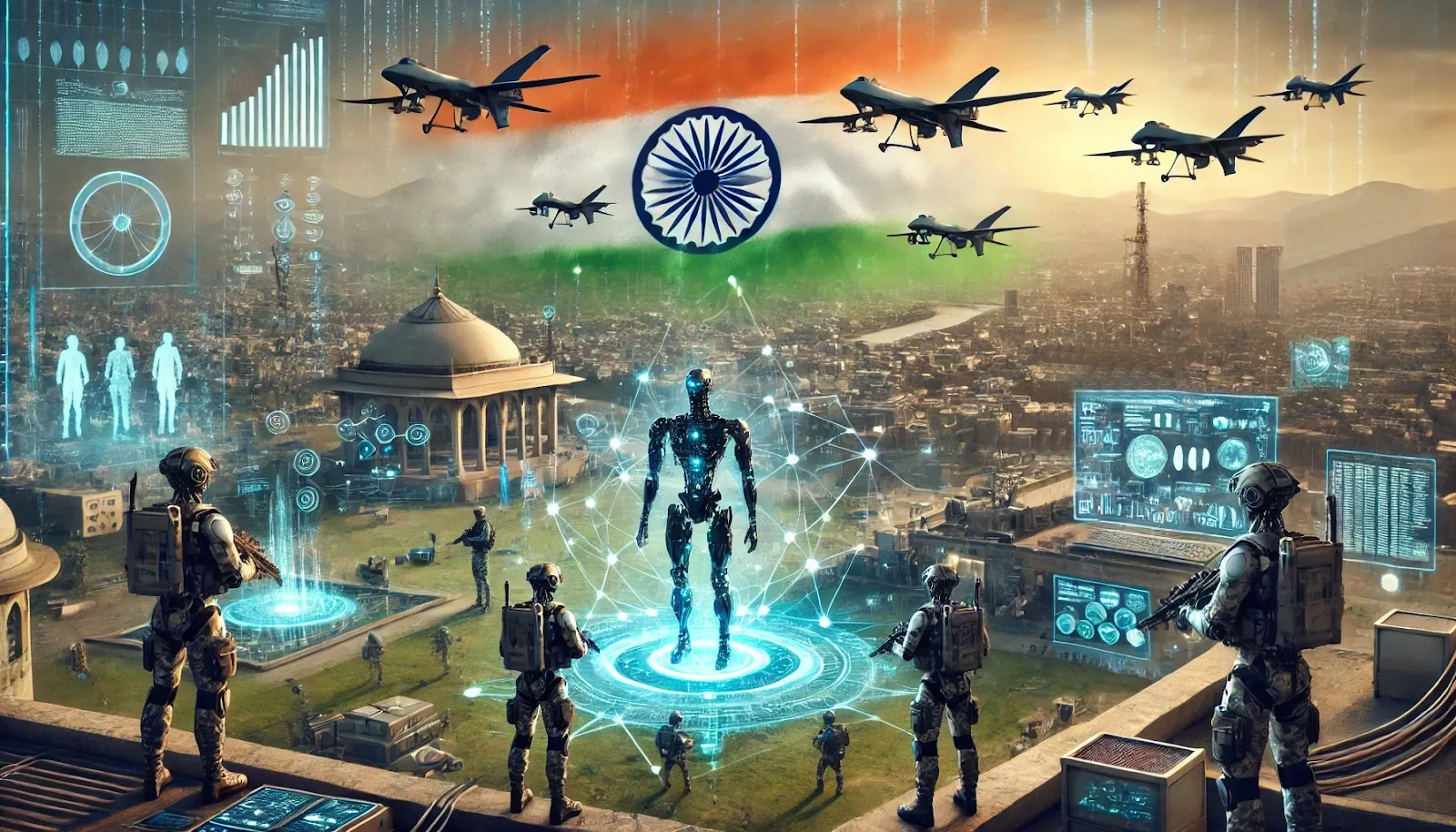
The country faces significant regional threats from adversaries like China and Pakistan, with China advancing in AI-driven military capabilities such as unmanned systems and predictive analytics. Additionally, terrorist organisations are increasingly leveraging AI-driven mechanisms for cyberattacks, propaganda and reconnaissance, further complicating the security landscape. AI offers India the means to enhance operational efficiency, strengthen cybersecurity, deploy advanced autonomous systems and effectively safeguard its national interests in an increasingly complex environment.
Current Initiatives
India is making significant strides in integrating Artificial Intelligence (AI) into its defence sector through a range of initiatives aimed at modernising its capabilities and addressing emerging threats. The Defence AI Council (DAIC) and Defence AI Project Agency (DAIPA), established in 2019, oversee the integration of AI in areas such as autonomous weapon systems, predictive maintenance and intelligence analysis. The Centre for Artificial Intelligence and Robotics (CAIR), a premier DRDO laboratory, is engaged in research on AI and robotics, developing tools like multipurpose robots and AI-based video analytics for enhanced intelligence. To foster innovation, the DRDO Young Scientist Laboratories (DYSLs) focus on advanced technologies, including AI, quantum computing and cognitive systems. Additionally, the Innovations for Defence Excellence (IDEX) initiative encourages startups to develop AI-driven solutions for applications such as satellite image analysis and spectrum management.
India is also investing in AI-powered systems like the Integrated Command and Control System (ICCS), which integrates data from multiple sources to enhance operational efficiency and decision-making. The HAL Combat Air Teaming System (CATS), developed by Hindustan Aeronautics Limited, includes the CATS Warrior, a stealth drone designed to operate alongside fighter jets. DRDO is promoting the development of AI-powered swarm drones capable of functioning as early warning systems to monitor aerial threats, while also advancing AI-driven cybersecurity tools to counter sophisticated cyberattacks. Collaborations with academic institutions, such as IITs, further strengthen research in AI-driven surveillance, electronic warfare and radar systems. These initiatives underscore India’s commitment to leveraging AI for modernising its defence capabilities, addressing regional challenges and maintaining its strategic edge in a rapidly evolving security environment.
Benefits of AI Integration
Artificial Intelligence (AI) is revolutionising modern warfare and for India, its integration into military operations is a strategic necessity to address regional threats and enhance operational efficiency. AI enhances operational efficiency across various domains, including surveillance and logistics. For instance, during the 2021 Dakshin Shakti military exercise, the Indian Army showcased an AI-enabled swarm of 75 aerial drones for intelligence, surveillance and reconnaissance (ISR) missions, demonstrating AI’s potential in real-time data collection and situational awareness.
Autonomous drones and unmanned vehicles reduce human risk while increasing precision. The HAL Combat Air Teaming System (CATS), developed by Hindustan Aeronautics Limited, includes the CATS Warrior-a stealth drone designed to operate alongside manned fighter jets, enhancing combat capabilities and mission success rates.
Predictive algorithms can anticipate enemy movements, providing India with a strategic edge. AI-driven predictive analytics assist commanders in anticipating adversary actions, enabling proactive and informed decision-making. In logistics, AI optimises supply chains, ensuring timely delivery of resources. AI applications in logistics streamline supply chain management, ensuring efficient resource allocation and timely delivery of essential supplies to frontline units.
AI-driven simulations improve training and readiness, enabling soldiers to adapt to diverse scenarios. The Indian military employs AI-powered simulations to create realistic training environments, allowing personnel to practice and adapt to various combat scenarios without the risks associated with live exercises. A notable initiative is the development of WARDEC, an AI-powered wargame simulation centre. This facility utilises AI and virtual reality to create metaverse-enabled gameplay, allowing soldiers to engage in virtual reality wargames that closely mimic real-time battlefield conditions. Such simulations enable personnel to experience diverse combat situations, improving their decision-making and tactical skills in a safe, controlled setting.
Furthermore, the Indian Armed Forces have been utilising flight simulators and other AI-enabled systems to support training across various military domains. These simulators help reduce the expenditure on ammunition and logistics while providing effective training tools that can replicate different terrains and combat scenarios. These AI-driven simulation initiatives underscore the Indian military’s commitment to leveraging advanced technologies to enhance training effectiveness, ensuring that personnel are well-prepared to face the dynamic challenges of modern combat environments.
Challenges
India’s pursuit of integrating Artificial Intelligence (AI) into its defence sector faces several critical challenges. One significant hurdle is the limited funding for research and development (R&D), with India allocating only about 0.8% of its GDP to R&D and an even smaller fraction directed toward defence-specific AI projects. This financial constraint impedes the growth of indigenous AI capabilities. Additionally, India’s dependency on foreign technology for critical defence systems, including AI-driven solutions, limits self-reliance and introduces potential security vulnerabilities. Ethical concerns surrounding AI weaponisation further complicate progress, particularly regarding decision-making in autonomous weapon systems and adherence to international humanitarian laws.
To overcome these obstacles, building a robust AI ecosystem is imperative. This requires collaborative efforts between defence organisations, private industry and academic institutions. Such partnerships can drive innovation, optimise resource utilisation and establish ethical Frameworks for AI integration in defence. Addressing these challenges strategically will be key to ensuring India’s AI capabilities align with its national security goals.
Conclusion
India’s adoption of AI in defence is a work in progress, requiring sustained investments and policy focus. A robust AI strategy will be indispensable for maintaining strategic superiority in future conflicts.
