
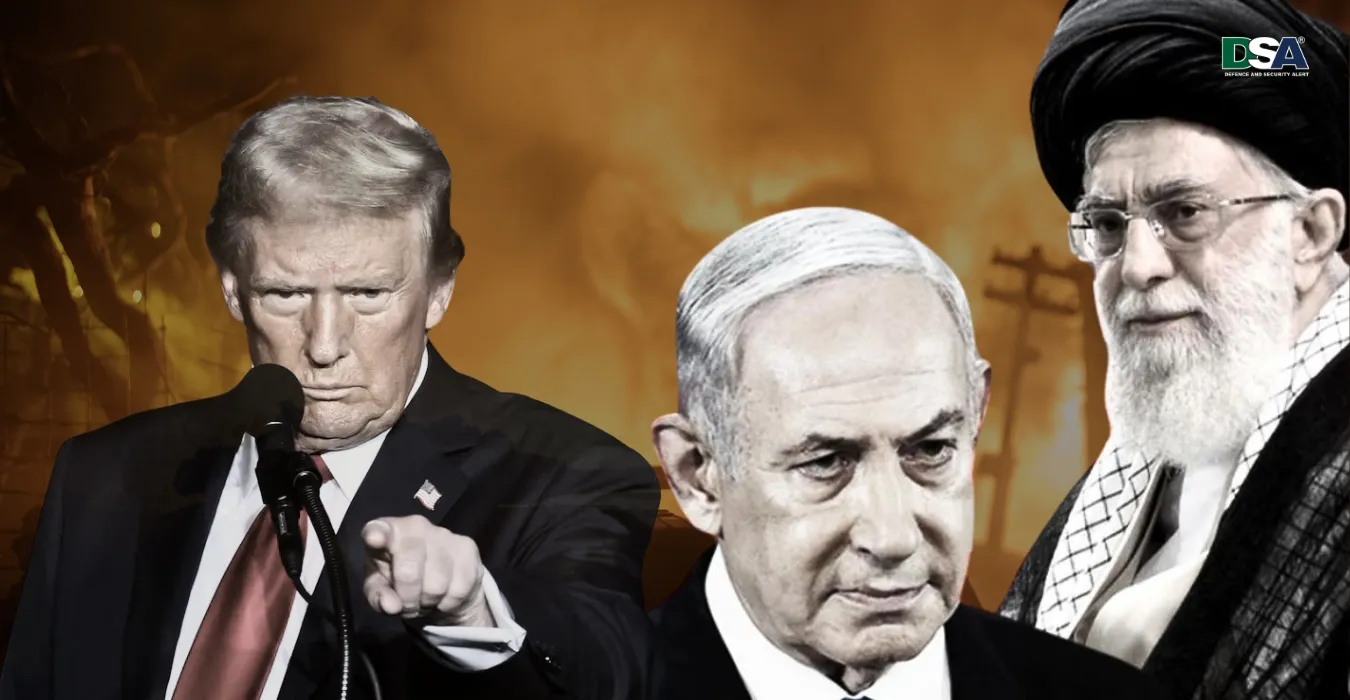
President Trump’s sudden announcement that he could take up to two weeks to decide whether to go to war with Israel against Iran or not. The White House repeatedly said that the U.S. is giving more chances for diplomacy to work.
The “Two Weeks” Trumpism
“Within the next two weeks.”
That is when President Trump now says he will be ready to make his decision about bombing Iran or not. This new timeline was offered by White House press secretary Karoline Leavitt during her Thursday afternoon briefing. However, as she read the president’s statement aloud, many could not help but feel that this new time frame sounded a little familiar. As almost everyone in Washington is aware, “two weeks” is one of Trump’s favourite units of time. Asked eight weeks ago if he could trust Vladimir V. Putin of Russia, President Trump replied, “I will let you know in about two weeks.” Tax plans, health care policies, evidence of conspiracy theories he claimed were true, the fight against ISIS, the opening of some coal mines, infrastructure plans — all were, at one point or another, riddles he promised to solve in about two weeks. “Two weeks” for Mr. Trump can mean something or nothing at all. It is both a yes and a no. It is delayed while at the same time scheduling. It is not an objective unit but a subjective unit of time. It simply means later. However, later can also mean never sometimes.
Uncertainty Around the Strike
Is the United States going to bomb Iran? We do not know. Will we actually find out the answer to that question within two weeks? We do not know that either. One reporter tried to drag Trump’s timeline into reality: “President Trump has said previously, in regard to Russia, he has used the phrase ‘about two weeks’ several times… How can we be sure he is going to stick to this one on deciding on Iran?” Ms Leavitt’s response essentially boiled down to one situation cannot be compared with another. However, in truth, this was less a matter of politics and more a matter of metaphysics.
Strategic Calculations Behind the Delay
Trump’s delay, however ambiguous, opens a host of new military and covert options. Assuming he makes full use of it, Trump now has time to assess whether six days of relentless bombing and killing by Israeli forces — which has already taken out one of Iran’s two biggest uranium enrichment centres, much of its missile fleet and some of its top nuclear scientists — has changed minds in Tehran. Meanwhile, the president is openly considering dropping the world’s heaviest conventional weapon on the second enrichment site. This may either compel Iran to back off or harden its resolve. Some experts even suggest that Trump’s two-week announcement may be a psychological tactic — a deliberate delay meant to deceive Iran into lowering its defences.
Two Weeks to Reinforce the Battlefield
Even if there is no deception, offering one more diplomatic off-ramp strengthens Trump’s military hand. Two weeks allow:
- A second U.S. aircraft carrier to reach the region,
- More time to position U.S. forces to counter Iranian retaliation,
- Moreover, crucially, it is time for Israel to destroy air defences around Fordo and other key nuclear targets, reducing risks to American troops in the event of a strike.
In my opinion, these two weeks could be seen as a time to prepare — but it may also frustrate Israeli leadership, who seem increasingly desperate to dismantle Iran’s nuclear infrastructure now.
American Hesitation: War Fatigue and Congress Check
Trump fears sending U.S. troops into the Middle East for someone else’s war. America’s deep scars from Iraq and Afghanistan are etched into both public memory and government psyche. Any offensive military action will require notifying Congress within 72 hours. However, that is not all — it must also be justified in a way that wins over a sceptical American public. Let us not forget that the U.S. invaded Iraq, citing weapons of mass destruction — a claim that collapsed in the years that followed. This time, people may not so easily trust what they’re told. Moreover, if the United States does strike Iran directly, it could mark the final collapse of the post-World War II “Liberal World Order” and its ideals of international law — ironically, values that the West, especially the U.S., has long claimed to champion.
Why Israel Must Go Solo
If Israel is truly determined to destroy Iran’s nuclear program, it should do so alone. Here is why:
- Credibility of Power: If Israel independently disables Iranian nuclear infrastructure, it will cement its position as a dominant regional power — no easy feat, considering Iran’s substantial capabilities in the Middle East.
- Preserve U.S. Standing: By going solo, Israel keeps the U.S. out of blame. Otherwise, critics will say that a great power got manipulated into pursuing the agenda of a smaller ally. Morgenthau — the classical realist in international relations — would definitely advise against that.
- Air Superiority Claim: Israel has repeatedly claimed to have unmatched air dominance. A solo mission that succeeds would validate those claims more convincingly than any joint operation ever could.
Division Within Trump’s Circle
President Trump’s contemplation of war is also creating visible fractures within his own political base. Vice President JD Vance recently posted a lengthy note assuring Americans that Trump has not abandoned his America First principle and has no interest in foreign entanglements that do not align with the American people’s goals. However, others are far less convinced. Figures like Representative Marjorie Tayl or Greene, media personality Tucker Carlson, and strategist Steve Bannon have sharply criticized any talk of U.S. involvement. “Anyone slobbering for the U.S. to become fully involved in the Israel/Iran war is not America First/MAGA,” Ms Greene posted. Meanwhile, on the other side of the Republican aisle, hawks like Senators Lindsey Graham and Tom Cotton are urging Trump to go full throttle. They want direct and aggressive action against Iran.
Deliberate Delay or Deadly Drift?
The next two weeks may be filled with backchannel negotiations, covert operations, and strategic positioning. However, they also carry the burden of uncertainty.
Will diplomacy get another breath of life? Or will these two weeks — like many before it — turn into a vague postponement that buys time not for peace but for preparation?
The stakes are no longer regional. It has become global. Moreover, for President Trump, the question is no longer just about Iran or Israel. It is about legacy, restraint, and the burden of power.
