
 SECURITY ALERT

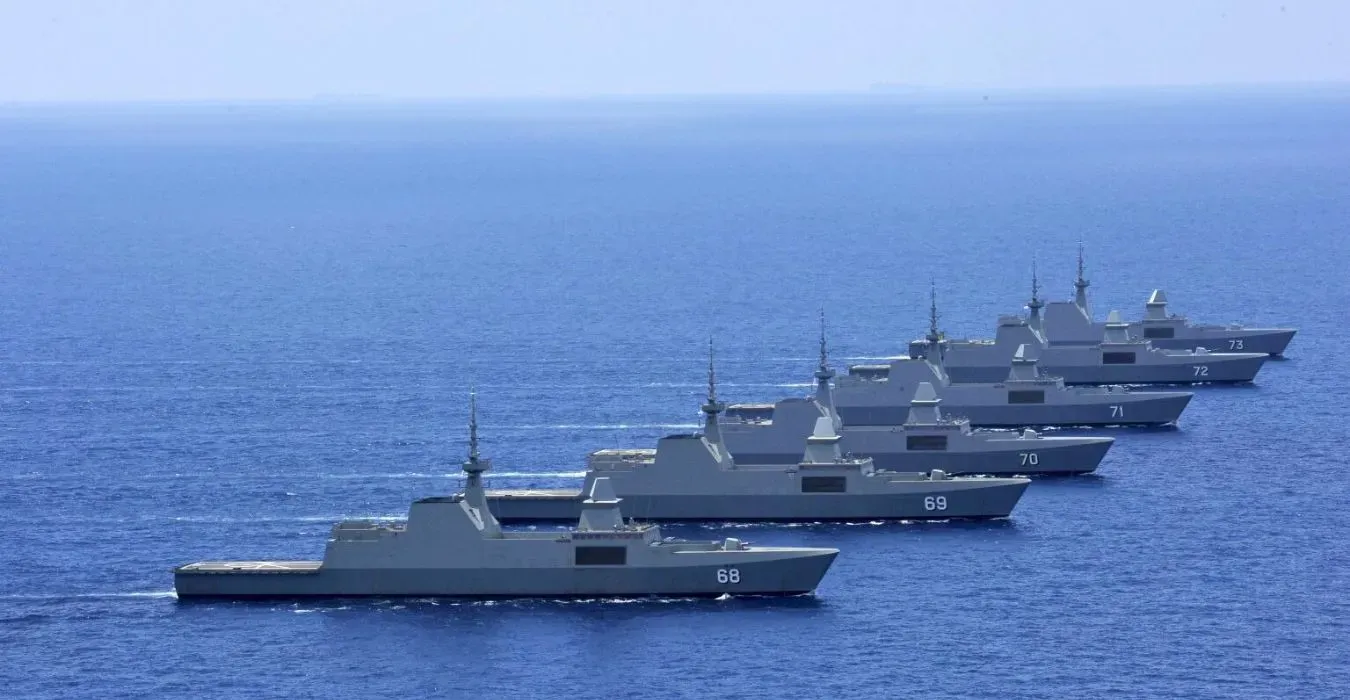
From the South China Sea to the Indian Ocean and the broader Indo-Pacific, countries like China, India, Japan, South Korea and Southeast Asian states are expanding their fleets, integrating advanced technologies and redefining their maritime strategies. This surge in naval development raises a critical question: Is Asia witnessing a race for maritime supremacy, or are these efforts driven by a mix of defensive and prestige-oriented motives?
China’s Maritime Ambitions
At the heart of Asia’s naval transformation is China’s People’s Liberation Army Navy (PLAN). Over the past two decades, China has evolved from a coastal defence force into a blue-water navy capable of projecting power far beyond its shores. The PLAN’s rapid expansion includes the construction of aircraft carriers, destroyers and nuclear-powered submarines, supported by a robust shipbuilding industry.
For instance, the launch of China’s third aircraft carrier, Fujian in June 2022 is noteworthy as the vessel is the first fully indigenous carrier design of Beijing and it represents a major step in the transformation of the PLAN’s overall capabilities and aspirations.
Xi Jinping’s vision of China as a “great maritime power” by 2050 underscores this shift, with investments in anti-access/area-denial (A2/AD) capabilities aimed at countering U.S. naval dominance in the Western Pacific. China’s assertiveness in the South China Sea, marked by the “nine-dash line” claim, claims vast territories and has heightened tensions and spurred regional responses from neighboring countries, including the Philippines, Vietnam and Malaysia. Working in tandem with an aggressive coast guard, the militarised fishing boats (Chinese vessels) assert their presence more than 1,000 miles from the Chinese mainland.
India’s Balancing Act
India, an emerging naval power, is modernising its fleet to assert influence in the Indian Ocean Region (IOR) and beyond. With two operational aircraft carriers and plans for a third, alongside a growing submarine fleet, India seeks to counter China’s expanding presence while safeguarding vital sea lines of communication (SLOCs). Initiatives like the Indigenous Aircraft Carrier program and partnerships with the U.S., Japan and Australia through the Quadrilateral Security Dialogue (Quad) reflect India’s dual focus on self-reliance and strategic alignment. Yet, its naval buildup is as much about regional stability as it is about matching China’s maritime reach.
India has shifted from being a “buyer’s navy” to a “builder’s navy,” emphasising indigenous design and construction. INS Vikrant is the first indigenously built aircraft carrier, commissioned in 2022. INS Nilgiri (a stealth frigate of the Project 17A class), INS Surat (a Visakhapatnam-class destroyer) and INS Vagsheer (a Scorpene-class submarine), commissioned on January 15, 2025, showcasing India’s growing domestic manufacturing capabilities. The Navy is modernising its underwater fleet to address capability gaps and enhance deterrence. Its plans include: Arihant-class nuclear-powered ballistic missile submarines (SSBNs): Two are operational, with more under construction; Project 75 and 75I: Six Scorpene-class submarines are being built, with INS Vagsheer as the latest addition. Project 75I aims to acquire six more advanced conventional submarines with air-independent propulsion (AIP) and Project 75 Alpha: Clearance was granted in 2024 for nuclear-powered attack submarines (SSNs) to counter regional threats.
Japan and South Korea: Quiet Modernisers
Japan and South Korea, constrained by historical and constitutional factors, have pursued more measured yet sophisticated naval modernisation. Japan’s Maritime Self-Defence Force (JMSDF) boasts advanced destroyers equipped with Aegis systems and has converted helicopter carriers into platforms capable of supporting F-35B jets, signaling a shift toward power projection. Japan has a history of revolutionising shipbuilding technology and is an experienced and capable producer of hull machinery equipment for naval vessels. Japan’s investment has enabled it to become a leading producer of highly automated commercial vessels.
South Korea, meanwhile, has developed a formidable navy with domestically built submarines, destroyers and the light aircraft carrier program, driven by both North Korean threats and the need to protect its maritime trade routes. Both nations align closely with the U.S., reinforcing a collective stance against China’s rise.
Southeast Asia: Smaller Players, Big Stakes
Southeast Asian nations like Vietnam, Indonesia and the Philippines are also modernising their navies, albeit on a smaller scale. Vietnam’s acquisition of Russian Kilo-class submarines and Indonesia’s plans for a “green-water” navy reflect efforts to deter aggression in disputed waters, particularly in the South China Sea. The Philippines, bolstered by U.S. support, is upgrading its fleet with frigates and missile systems. These states are not aiming for supremacy but rather a credible deterrence against larger powers encroaching on their maritime rights.
The U.S. Factor
The United States remains the elephant in the room, with its Pacific Fleet serving as the guarantor of a rules-based maritime order. The U.S. Navy’s forward presence, coupled with its pivot to Asia under successive administrations, has intensified competition. The heavily armed warships of the U.S. can travel thousands of miles in a matter of days and linger at locations without imposing on another country’s sovereignty. The power of the blue-water navy operating across the open ocean lies in its forward presence, power projection and deterrence. Concepts like Air Sea Battle and investments in unmanned systems aim to maintain supremacy, but China’s growing capabilities challenge this dominance, prompting allies and partners to bolster their own navies.
A Race or a Response?
Is this a race for maritime supremacy? The answer depends on perspective. China’s trajectory suggests an ambition to rival the U.S. as a global naval power, potentially reshaping the Indo-Pacific balance. India’s efforts, while significant, prioritise regional influence over outright dominance. Japan and South Korea enhance capabilities within an alliance framework, not as independent contenders. Southeast Asian states, meanwhile, focus on survival rather than supremacy. Historical parallels to pre-World War I naval arms races exist—rising powers, technological leaps and contested waters—but today’s dynamics are tempered by economic interdependence and multilateral diplomacy.
Implications
The consequences of Asia’s naval modernisation are profound. Escalating capabilities could destabilise the region, particularly if miscalculations in flashpoints like the South China Sea or Taiwan Strait trigger conflict. Yet, cooperation remains possible—joint exercises, maritime dialogues and confidence-building measures hint at a desire to avoid outright confrontation. The race, if it is one, is not solely about supremacy but about securing national interests in an era of shifting power. The war in Ukraine has caused a profound security shock in the Euro-Atlantic area. While the conflict is broadly perceived as a land war on Europe’s doorstep, its maritime aspects are significant. The naval and maritime lessons include the underscoring of the interconnectedness of the global trading system, its reliance on sea lines of communication and the continuing relevance and effectiveness of naval blockade, as witnessed by the swirl of international concern around the blocking of Ukrainian grain exports. Asia-Pacific is more than just a monolithic region, it is a true maritime domain in terms of high-end naval capability, grey-zone operations and maritime power competition.
In conclusion
Asia’s naval modernisation reflects a complex interplay of ambition, insecurity and pragmatism. Whether it culminates in maritime supremacy for one nation or a balanced multipolar order will depend on how these powers navigate their rivalries and alliances in the years ahead.
