
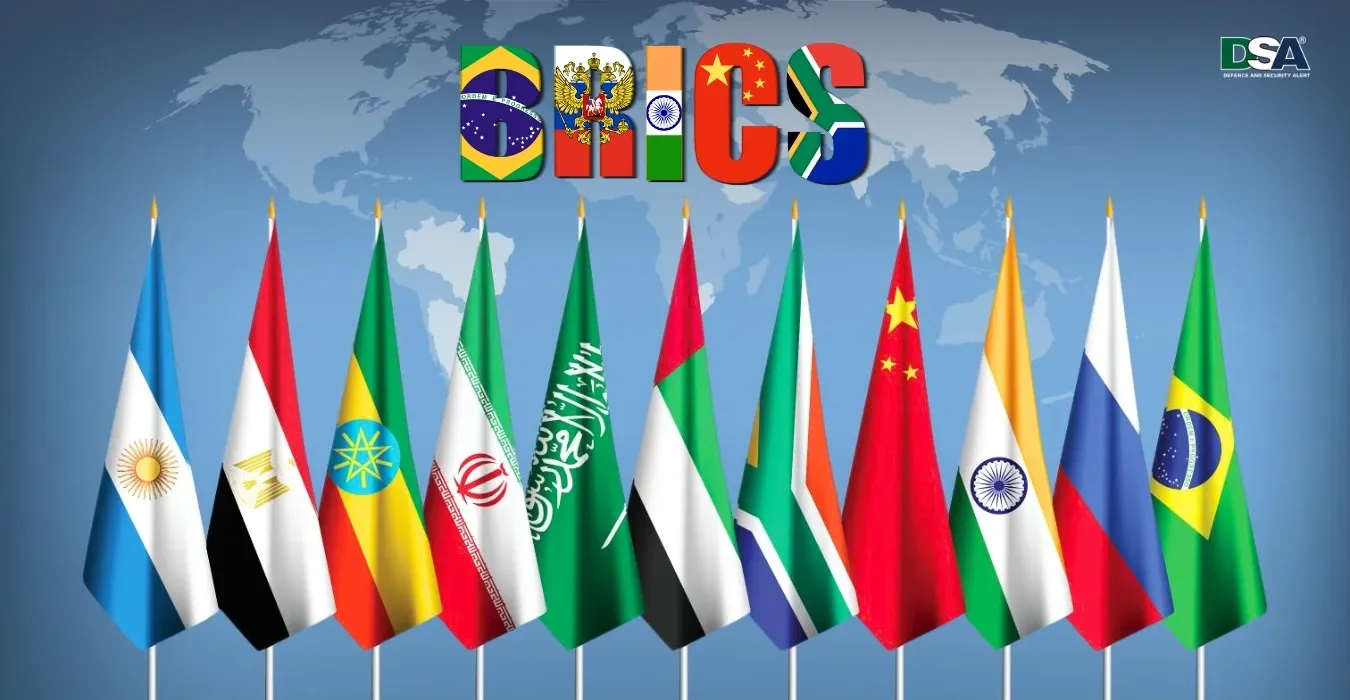
Originally a term coined by British economist Jim O’Neill in 2001, BRICS referred to the group of emerging markets consisting of Brazil, Russia, India and China. South Africa joined in 2010, transforming BRICS from a primarily economic grouping of rising middle powers into a platform for the Global South and an alternative to Western-dominated institutions. As a founding member of this multilateral institution, India has played a critical role in shaping the BRICS agenda and outcomes, often aligning them with its national priorities. BRICS has served as a vital platform for emerging countries like India to advance their interests while retaining strategic autonomy.
Why BRICS Matters in a Polarised World
Recent geopolitical crises, such as the COVID-19 pandemic, the Russia-Ukraine conflict, the Israel-Gaza war and the Iran-Israel confrontation—have made the world more unstable and increasingly polarised between the Global North (primarily the United States and its European allies) and the Global South. Furthermore, the erratic and isolationist policies of the U.S. administration under Donald Trump accelerated the transformation of BRICS into a non-Western economic and political coalition. This shift offers Global South countries a space to engage as equals and chart independent courses.
In 2024, BRICS expanded to include Egypt, Ethiopia, Iran and the UAE, followed by the inclusion of Indonesia in 2025. As of 2024, BRICS countries accounted for 24% of global trade, 36% of global land area, 72% of rare earth mineral reserves, 43.6% of global oil production, 36% of natural gas production and approximately 42% of the world’s population.
BRICS today provides alternative financial mechanisms such as the Contingent Reserve Arrangement (CRA) and the New Development Bank (NDB), which offer loans for infrastructure and sustainable development—unlike the IMF and World Bank, these come without conditionalities. The grouping promotes collaboration among Global South countries in areas like non-traditional security (e.g., terrorism, cybersecurity), finance, trade, education, health, sustainable development, science and technology and human and social development. It also serves as a collective voice pushing for reforms in global governance institutions such as the WTO, the UN Security Council, the World Bank and the IMF.
India’s Strategic Role in BRICS
BRICS provides India with a valuable platform to pursue development-oriented diplomacy that supports its key priorities-ensuring energy security, combating terrorism and securing financing for climate change initiatives. It allows India to raise concerns about unfair international mechanisms such as the EU’s Carbon Border Adjustment Mechanism, unilateral sanctions and economic concentration by developed nations.
India can also work with like-minded countries on issues like securing supply chains, critical mineral access, energy diversification, public health, green technology, AI and cybersecurity innovation. Additionally, India’s BRICS membership opens opportunities to build strategic partnerships with new member states, such as Iran.
Importantly, BRICS membership allows India to maintain strategic autonomy, even as it strengthens its ties with the West through platforms like the QUAD and bilateral relations with the U.S. and its allies. India acts as a balancing force in forums like BRICS and the Shanghai Cooperation Organisation (SCO), where its presence helps prevent the formation of overtly anti-Western blocs led by China and Russia.
Challenges Within BRICS for India
Despite the benefits, India’s BRICS membership also presents several challenges. The grouping lacks internal cohesion, with member states often having divergent priorities and even bilateral tensions. Since the Ukraine crisis, China and Russia have increasingly tried to pivot BRICS from a neutral, non-Western forum to an anti-Western platform.
China and Russia’s push for de-dollarisation—aiming to reduce reliance on the U.S. dollar-has been met with skepticism from India, which fears the potential rise of the Chinese Yuan as the default alternative and the possible retaliatory actions by the United States. Moreover, China’s ambition to dominate platforms like BRICS and SCO could reduce India’s influence in these multilateral institutions.
India is also wary of the rapid expansion of BRICS. This expansion risks diluting the group’s original focus—cooperation among emerging markets—and may lead to a lack of consensus among a more diverse membership. The growing economic and political clout of China within BRICS further compounds India’s concerns about being overshadowed.
A Critical Time for Indian Diplomacy
BRICS remains an important multilateral platform that allows India to raise its voice, influence global governance reforms, and assert leadership within the Global South. However, increasing geopolitical instability and China’s assertive rise mean that India must play a more proactive role in shaping the BRICS agenda.
To protect its strategic interests, India must ensure that BRICS remains a platform for equitable cooperation among emerging nations-not a tool for great power rivalry or ideological confrontation.
References
- Maiorano, D., & amp; Kaur, K. (2024, November 13). India’s role in the BRICS: Navigating the balance in a changing world. Institute of South Asian Studies, National University of Singapore. Retrieved July 25, 2025, from https://www.isas.nus.edu.sg/papers/indias-role-in-the-brics-navigating-the-balance-in-a-changing-world/
- BRICS Brasil. (2025, February 5). Areas of cooperation. In About the BRICS. Retrieved July 25, 2025, from https://brics.br/en/about-the-brics/areas-of-cooperation
- Maiorano, D., & Kaur, K. (2024, November 13). India’s role in the BRICS: Navigating the balance in a changing world. Institute of South Asian Studies, National University of Singapore. Retrieved July 25, 2025, from https://www.isas.nus.edu.sg/papers/indias-role-in-the-brics-navigating-the-balance-in-a-changing-world/
