
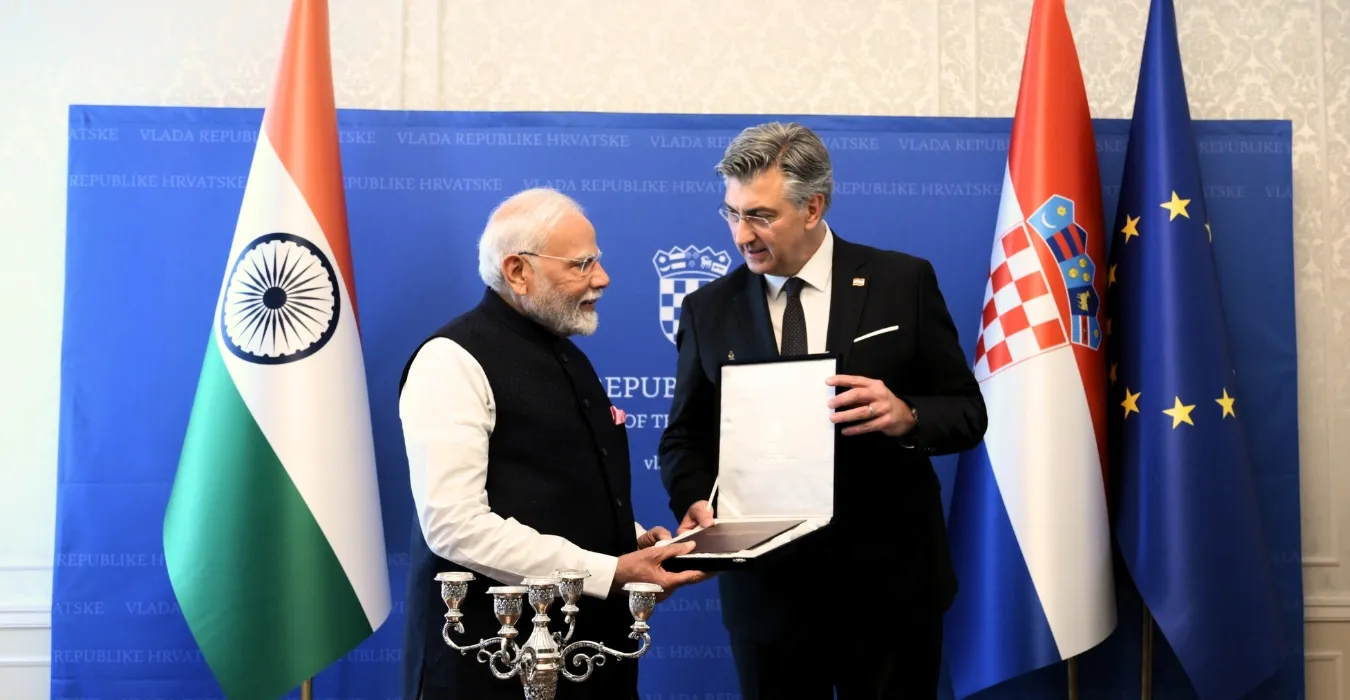
On 18 June 2025, PM Narendra Modi visited Croatia as a part of his ongoing three-country tour, which previously included a meeting with Cyprus president Nikos Crystodoulides and attending the G-7 meeting in Canada as an observer country.India’s foreign policy historically has always prioritised Canada and Cyprus over Croatia, especially in the areas of counterterrorism, economic cooperation, and national security. High-level trips to Croatia have been infrequent despite India’s consistent engagement with Cyprus, which includes PM Modi’s 2019 meeting with President Christodoulides, President Kovind’s 2018 visit, and EAM Jaishankar’s 2022 trip. The same can be said even for India’s Canadian engagement, historically, which is trying to be back on track after the massive diplomatic fallout during the tenure of Justin Trudeau. In fact, Narendra Modi’s recent visit was the first by an Indian prime minister since Croatia gained its independence in 1992, while President Kovind’s visit in 2019 was the last major one between the countries.
About Croatia
For starters, Croatia was formed during the brutal Yugoslav wars from 1990-2001, which has been described as one of the deadliest conflicts in Europe post the conclusion of the Second World War. Croatia was formed in 1991 and became the first country to become independent from the former communist republic of Yugoslavia. India immediately recognised Croatian existence in 1992 and in July 1992, a mission was also set up between the two. Croatia immediately joined NATO in 2009. Croatia is also an EU member state, which it joined in 2013, apart from being a member of various international organisations like OSCE, WTO and the United Nations. Croatia and India both have a parliamentary system of democracy, but they differ in the way in which it is followed. Croatia has a proportional voting system, and India has an FPTP system.
Croatia is an Eastern European country, which makes it even more crucial in global supply chains in today’s day and time, where geopolitical conflicts have taken a hit on the European economies. Croatia is at the crossroads of Central and Southeast Europe. Croatia’s northwestern neighbour is Slovenia, its northern neighbour is Hungary, its northeastern neighbour is Serbia, with which Croatia has had troubled relations, and its eastern neighbour is Bosnia and Herzegovina. Croatia also has a sealine named the Adriatic Sea, which is the northernmost arm of the Mediterranean Sea and quite literally separates the Italian (Western Europe) and Balkan peninsula (Eastern Europe).
Croatian Economy Basics
The Croatian economy is a peculiar case study. Croatia’s GDP is around 8500 US$, according to World Bank estimates. The per capita income of Croatia is around 46,600 US$, which makes it a firmly developed country. Its GDP growth rate is 3.3% over the past fiscal year, which is significantly higher than its other European Union counterparts like – France (0.9%), Italy (0.7%), Belgium (1.3%), Netherlands (0.3%) and Sweden (-0.3%) in the same time frame. In fact, a broader trend that has been observed in the Balkan countries which were chided for being under-developed for decades has recorded a stronger growth rate in the past 2 years, with countries like Serbia (3.8%), Slovenia (1.7%), Slovakia (1.4%), Bosnia and Herzegovina (2.2%), which is quite antithetical to what the rest of Europe has been experiencing after the Russia – Ukraine war. The reasons for the sustained Balkan growth rates, as given by experts, are the sustained strong domestic demand along with other industries like a quickly rising IT sector, Renewables, Construction sector, Automotive parts, Minerals sector and Tourism sector, which have formed the bulk of the growth rates of these countries. India must take steps to improve its trade with the Balkan states as well.
The Free Trade Factor
This visit by PM Modi is also seen by experts as a follow-up to the long-delayed India-EU FTA, whose talks began way back in 2007 and are nearing completion. Visiting Croatia—one of the EU’s fastest-growing economies—at a time when energy supply chains are strained by geopolitical tensions like the Russia–Ukraine war gives India added leverage in the ongoing FTA negotiations. The recent declarations of MoUs regarding collaboration in industries including semiconductors, IT, renewable energy, medicines, and agriculture bear similarities to the components of a preferential trade agreement. This can be a crucial step in helping India comprehend the diversity of the European market. This was also reiterated by Envoy Goel in an interview with the Tribune. The value of India –Croatia trade balance’s value as of the year 2024 stands at 248,223 US$, as per the ITC website, which is a massive increase in the past few years. The Indian exports to Croatia is modest at 298 million, in which petroleum is the top product with a value of 81.4 million dollars as per the OEC. On the other hand, Croatian exports are around 50.6 million dollars, with the highest value being for Scrap vessels at 5.64 million dollars.The Economic Complexity score for India is 0.76 and Croatia is at 0.69. As per trade statistics, the net trade balance value in the product segments of –Ships and boats, Nuclear reactors, Pharmaceuticals, and Wood Articles have the highest trade value. The services trade between the two isalmost negligible. The MoUs, therefore, in the above-mentioned sector can actually end up boosting bilateral trade between India and Croatia. The digital economy sector can be a sunrise sector for cooperation between India and Croatia, as the growth rates for bothcountries in the overall economy have been impressive over the years; this has the potential to improve services trade between thetwo.
The Egyptian Factor
Though many experts link the visit to the IMEC project, this may be only partly true. The Israel–Iran conflict poses serious risks to Israeli port security, deterring traders. Additionally, strained Saudi–Israel ties make IMEC projections seem overly optimistic. However, the alternative trade route involving India – Egypt – Croatia may become a reality in implementing the EFTA. India and Egypt have stepped up their engagements in the past 3 years, with the Egyptian president Abdel Fatah Al Sisi as the chief guest in India’s Republic Day parade in 2023, along with Egypt joining the BRICS recently, showing that Egypt is a valued partner in India in the field of economic cooperation. For the time being, this alternate trade route may be a game-changer because Egypt and Croatia both have crucial positions in Mediterranean affairs and have stayed relatively stable (politically and economically) in comparison to other nations in the region. The overall bilateral trade between Egypt and Croatia as of today stands at around 165 million$ as per OEC. Also, the cordial ties between Egypt and Croatia may provide India with partners in this newer trade route, which may prove to be a game-changer in the upcomingyears. In addition, the three nations have a common heritage in the Non-Aligned Movement, which was spearheaded by Tito (Croatia), Nasser (Egypt), and Nehru (India). This could facilitate economic negotiations and build trust before the India–EU Free Economic Agreement and IMEC are finalised.
Deepening Cooperation Imperative to Success
However, these predictions will hold true only if cooperation among the three countries deepens, with India playing a central role. Key sectors like banking, pharmaceuticals, digital economy, labour mobility, education, and medical tourism should be targeted for bilateral or even trilateral partnerships. This approach can significantly boost India’s soft power in the Balkans and the Red Sea region—both of which have the potential to become major growth engines for their respective continents in the coming years. At the same time, India must keep making frequent high-level visits by crucial ministers in those countries of Europe, which have been overlooked for years but may play a crucial role in the evolving dynamics of IMEC and India –EFTA. Therefore, the recent visit by PM Narendra Modi can play a crucial role in forging a new trade route and possibly shifting the dynamics in one of the global geoeconomic hotspots.
