
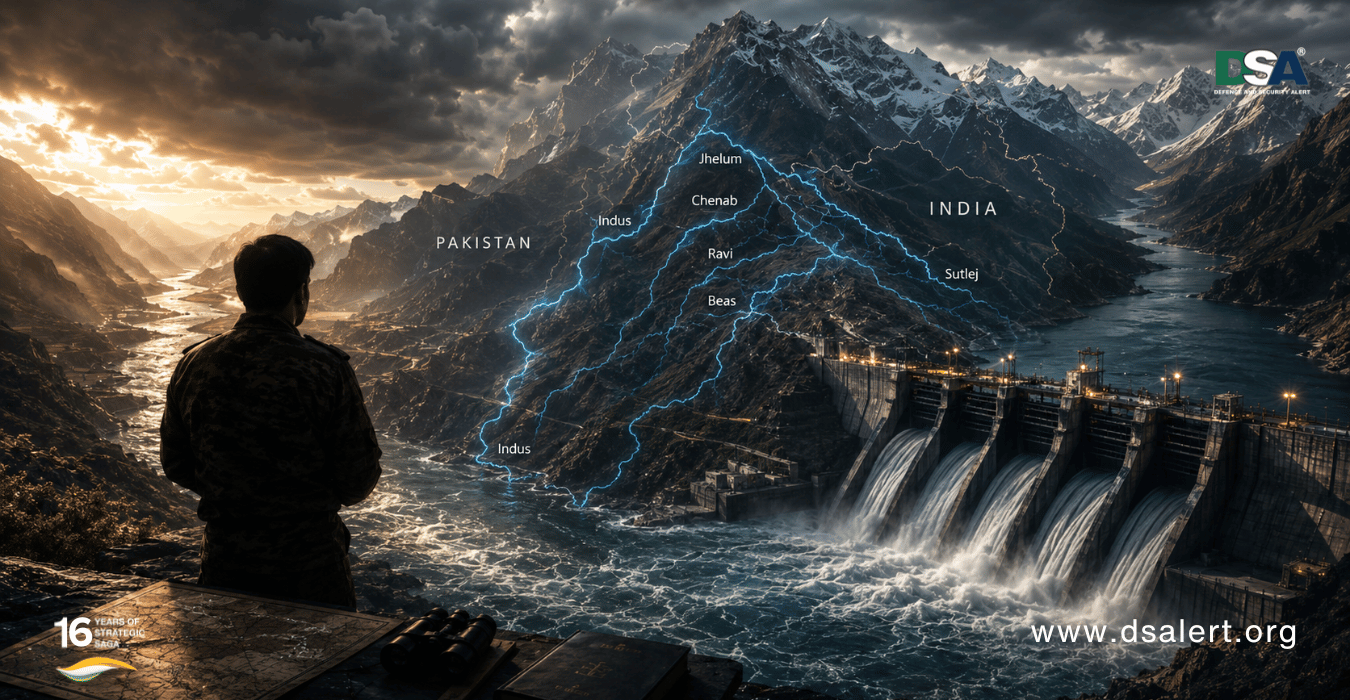
The Indus Waters Treaty has long stood as one of the most resilient water-sharing arrangements in the world. Signed in 1960 between India and Pakistan with the World Bank’s facilitation, the treaty survived wars, diplomatic breakdowns, terror attacks and repeated crises between two nuclear-armed neighbours. For more than six decades, it was often cited as proof that even hostile states could preserve limited cooperation when vital resources were at stake. Yet the strategic environment in which the treaty operates has changed significantly. Water is no longer viewed only through the lens of irrigation, agriculture and engineering. It has increasingly become part of national security, climate resilience, territorial sovereignty and strategic leverage.
India’s decision after the Pahalgam terror attack of 22 April 2025 to keep the treaty “in abeyance” marked a decisive shift in New Delhi’s approach. The Cabinet Committee on Security stated that the treaty would remain in abeyance until Pakistan credibly and irrevocably ended its support for cross-border terrorism. The attack killed 25 Indian nationals and one Nepali citizen, according to India’s official statement. This decision indicated that India was no longer willing to treat water cooperation as completely insulated from security concerns. The central question now is whether a treaty negotiated in the political and hydrological realities of the 1950s can remain adequate in an era marked by terrorism, climate change, demographic stress, infrastructure competition and hardening strategic postures.
Historical Context: Partition and the Water Question
The origins of the Indus Waters Treaty lie in the unfinished consequences of Partition. In 1947, the division of British India created two sovereign states but also divided an integrated river and canal system. The rivers of the Indus Basin flowed across new political boundaries, while key headworks and control structures remained on the Indian side. At the same time, large agricultural areas dependent on these waters became part of Pakistan. This created an immediate upper-riparian and lower-riparian tension.
Pakistan feared that India, by virtue of geography, could control the timing and availability of water flows. The crisis became visible in April 1948 when water supplies to some canals flowing into Pakistan were stopped after temporary arrangements expired. The Inter-Dominion Agreement of May 1948 restored supplies, but it did not resolve the deeper dispute. What followed was nearly a decade of negotiations facilitated by the World Bank. The outcome was the Indus Waters Treaty, signed on 19 September 1960 by Prime Minister Jawaharlal Nehru and President Ayub Khan. The World Bank notes that the treaty was concluded after nine years of negotiations and remains a signatory for specified purposes.
Core Architecture of the Treaty
The treaty adopted a practical but unusual model: instead of creating a fully joint river-management regime, it divided the six rivers of the Indus Basin between the two countries. The eastern rivers Ravi, Beas and Sutlej were allocated to India for unrestricted use. The western rivers Indus, Jhelum and Chenab were allocated primarily to Pakistan, while India retained limited rights for domestic use, non-consumptive use, agricultural use and run-of-the-river hydropower projects under defined technical conditions.
This structure reflected Pakistan’s high dependence on the western rivers for irrigation and agriculture. It also reflected India’s willingness, at that time, to accept restrictions on the western rivers in exchange for a stable legal framework. The treaty also created the Permanent Indus Commission as the main bilateral institutional mechanism. The commission was designed to exchange information, discuss technical issues, inspect projects and prevent disputes from escalating. Where issues could not be resolved bilaterally, the treaty provided for graded dispute-resolution mechanisms, including a Neutral Expert and a Court of Arbitration. The World Bank describes its current remaining responsibilities under the treaty as linked mainly to the appointment of Neutral Experts and arbitration-related processes.
Strategic Geography of the Indus Basin
The Indus Basin is not merely a hydrological system; it is a strategic geography. The main Indus River originates near the Tibetan Plateau and flows through the Himalayan region before entering Pakistan. Its tributaries, including the Jhelum, Chenab, Ravi, Beas and Sutlej, make the basin one of the most important river systems in South Asia. India’s position as an upper-riparian state gives it geographical significance, while Pakistan’s lower-riparian position creates structural vulnerability.
For Pakistan, the Indus system is not just a source of water. It is the foundation of food security, rural employment, hydropower generation and political stability. Pakistan’s Punjab and Sindh provinces depend heavily on Indus waters for crops such as wheat, rice, cotton and sugarcane. The Indus Basin Irrigation System is widely described as the world’s largest contiguous irrigation system, supporting food production and water distribution across vast agricultural areas. This dependence explains why Pakistan views any change in India’s water posture as a matter of existential concern.
For India, the basin is equally important, though in a different way. The rivers pass through Jammu & Kashmir, Ladakh, Himachal Pradesh and Punjab regions that require water for hydropower, irrigation, flood control, livelihoods and development. India’s long-term concern has been that the treaty restricts its ability to fully utilise waters flowing through its own territory, especially when Pakistan continues to pursue an adversarial security posture.
From Water Diplomacy to Water Security
For decades, the treaty was treated as an example of functional cooperation. It survived the wars of 1965 and 1971, the Kargil conflict of 1999 and several periods of intense diplomatic hostility. However, the political meaning of the treaty has changed. In India, a growing view has emerged that the treaty gave Pakistan significant water security while India continued to suffer from Pakistan-backed cross-border terrorism.
The Pahalgam attack became the immediate trigger for a shift. India’s decision to hold the treaty in abeyance did not mean that river flows could be stopped overnight. The Indus system is vast and India does not currently possess the infrastructure required to completely block or divert the western rivers. However, the decision carried strategic significance. It signalled that India was willing to link water cooperation with national security behaviour. External Affairs Minister S. Jaishankar later stated that the treaty would remain in abeyance until Pakistan stopped cross-border terrorism in a credible and permanent manner.
This marks a major change in India’s diplomatic language. Earlier, the treaty was treated as a separate technical arrangement. Now, India has placed it within the broader framework of deterrence, reciprocity and strategic conditionality.
Can India Suspend the Treaty?
The legal question is complex. The Indus Waters Treaty does not contain a simple unilateral suspension clause. Pakistan argues that India cannot suspend or withdraw from the treaty unilaterally. India’s position is shaped by the argument that fundamental circumstances have changed, especially due to continued cross-border terrorism and the transformed strategic environment.
Some legal analysts have referred to Article 62 of the Vienna Convention on the Law of Treaties, which concerns a “fundamental change of circumstances”. However, whether this principle can be applied to the Indus Waters Treaty remains contested. The treaty was designed to be durable and international legal forums may not easily accept unilateral suspension. At the same time, law does not operate in isolation from politics. India’s move is therefore best understood not simply as a legal act, but as a strategic signal: treaty-based cooperation cannot be unconditional when one party enables hostile activity against the other.
India’s Real Leverage: Infrastructure, Data and Project Execution
So India’s most practical leverage does not lie in dramatic claims of “stopping water”. Such claims are technically misleading and strategically counterproductive. India’s real leverage lies in three areas: infrastructure development, full utilisation of treaty-permitted rights and control over hydrological information.
First, India can accelerate projects on the eastern rivers, where it has unrestricted rights. Better utilisation of Ravi, Beas and Sutlej waters can support agriculture, drinking water, groundwater recharge and regional development in Indian states. Second, India can speed up legally defensible hydropower and storage-related projects on the western rivers within the limits of technical design and national policy. Third, India can reassess the sharing of certain hydrological data, especially when normal treaty-based cooperation is politically suspended.
Data is a strategic asset. Flood warnings, river-flow information and water-level data are crucial for disaster preparedness and irrigation planning. If such information becomes irregular, Pakistan’s uncertainty increases. However, India must use this tool carefully. Humanitarian flood warnings should not be abandoned, as that would damage India’s responsible international image. Indeed, reports in 2025 indicated that India issued a flood warning to Pakistan through diplomatic channels as a humanitarian gesture, despite treaty-related tensions.
Pakistan’s Vulnerability
Pakistan’s vulnerability comes from overdependence, inefficient water management and weak climate resilience. The country’s agriculture is heavily tied to the Indus system. Any long-term reduction in flows, uncertainty in timing, or perceived upstream control can affect crop cycles, irrigation planning and food security. Hydropower generation from major reservoirs such as Tarbela and Mangla may also be affected by changes in water availability.
Pakistan also faces serious domestic water-management challenges, including groundwater depletion, salinity, inefficient irrigation practices and unequal distribution. These problems cannot be blamed entirely on India. Even if the treaty remained fully functional, Pakistan would still need internal reform. Its water security requires modern irrigation, crop diversification, reservoir maintenance, groundwater regulation and better provincial coordination.
This is where Pakistan’s strategic dilemma lies. It seeks treaty protection from India, but its own internal water governance remains weak. It treats the Indus Waters Treaty as a shield, but a treaty alone cannot solve structural water stress.
Climate Change and the Treaty’s Future
The Indus Waters Treaty was negotiated in a different climatic era. It did not fully account for the scale of climate change now affecting South Asia. Glacier melt, irregular snowfall, changing monsoon patterns, extreme floods and prolonged droughts are altering the hydrological behaviour of Himalayan river systems. Population growth and urbanisation have further increased demand for water.
This means that even without terrorism and political hostility, the treaty would require modernisation. It lacks strong provisions for climate adaptation, environmental flows, basin-wide ecological management, groundwater stress, disaster-risk reduction and joint climate forecasting. The treaty was designed mainly to divide waters, not to jointly manage a changing basin under climate stress.
For India, this creates both responsibility and opportunity. A future Indian position can argue not only from the standpoint of security, but also from the standpoint of treaty modernisation. India can state that a 1960 framework cannot remain frozen when strategic, demographic and environmental conditions have changed fundamentally.
Dispute Resolution and Institutional Stress
The treaty’s dispute-resolution system has also come under pressure. Differences over Indian hydropower projects on the western rivers have repeatedly gone to Neutral Experts and arbitration forums. In 2022, the World Bank appointed a Neutral Expert in proceedings involving India and Pakistan under the treaty’s mechanisms. Parallel legal processes have contributed to institutional friction, with India objecting to certain arbitration tracks and emphasising treaty-consistent procedures.
This institutional stress shows that the treaty is no longer operating smoothly. The problem is not only political mistrust; it is also procedural complexity. When technical disagreements become legal battles and legal battles become diplomatic disputes, the treaty’s cooperative spirit weakens.
India’s Strategic Policy Options
India’s approach should be firm, lawful and long-term. First, India should avoid exaggerated public rhetoric about instantly stopping water. Such claims are technically unrealistic and may weaken India’s credibility. Second, India should accelerate infrastructure projects that strengthen its own water security. Third, India should expand hydrological monitoring, satellite mapping, glacier studies and basin-level planning. Fourth, India should ensure that treaty-related concessions are linked with Pakistan’s behaviour on terrorism. Fifth, India should frame its position internationally as one of responsible revision, not reckless weaponisation.
India must also invest in water diplomacy with other neighbours. Its Indus policy will be watched by Bangladesh, Nepal, Bhutan and China. Therefore, India’s conduct should demonstrate that it is a responsible upper-riparian power, but not a passive one. The message should be clear: cooperation is possible, but strategic irresponsibility will carry costs.
Conclusion
The Indus Waters Treaty once represented the possibility of cooperation despite conflict. It was born from the trauma of Partition, shaped by World Bank mediation and sustained through decades of India-Pakistan hostility. However, its future is now uncertain because the strategic context has changed. Terrorism, climate change, population growth, water scarcity and infrastructure competition have transformed the meaning of river-sharing.
For Pakistan, the treaty remains a lifeline. For India, it has become a test of whether cooperative arrangements can continue without security reciprocity. The Pahalgam attack and India’s decision to keep the treaty in abeyance have made one thing clear: water can no longer be treated as separate from national security.
India’s strategic water calculus should not be based on emotional reaction, but on infrastructure, law, technology and statecraft. The objective should not be irresponsible water weaponisation. It should be to ensure that India’s generosity is not mistaken for strategic weakness. The Indus Basin will continue to flow across borders, but the political future of the treaty will depend on choices made by both states. If Pakistan continues to treat terrorism as an instrument of policy, India is likely to treat water cooperation as conditional. In the twenty-first century, the Indus Waters Treaty will survive only if it evolves from a frozen legal arrangement into a realistic framework that reflects security, climate and strategic realities.
References
- World Bank. “Fact Sheet: The Indus Waters Treaty 1960 and the Role of the World Bank.” World Bank, 11 June 2018; last updated 21 June 2023. Accessed 16 June 2026.
- Mukherjee, Vasudha. “Indus Waters Treaty in Abeyance after Pahalgam Attack: What Does This Mean?” Business Standard, 24 April 2025. Accessed 16 June 2026.
- Zehra, Ishaal. “The Indus Treaty Verdict: When Water Outlasts War.” The Interpreter, Lowy Institute, 4 July 2025. Accessed 16 June 2026.
- Moneycontrol News. “One Year after Operation Sindoor: What Is India’s Stand on Indus Water Treaty?” Moneycontrol, 7 May 2026. Accessed 16 June 2026.
- Barry, Sinéad, and Emma Whitaker. “The Indus Water Treaty Suspension: A Wake-Up Call for Asia–Pacific Unity?” Climate-Diplomacy, 9 May 2025. Accessed 16 June 2026.
- Von Lossow, Tobias. “Indus Water Treaty 2025: A Pause of Cooperation, Not an End.” Climate-Diplomacy, 15 October 2025. Accessed 16 June 2026.
