
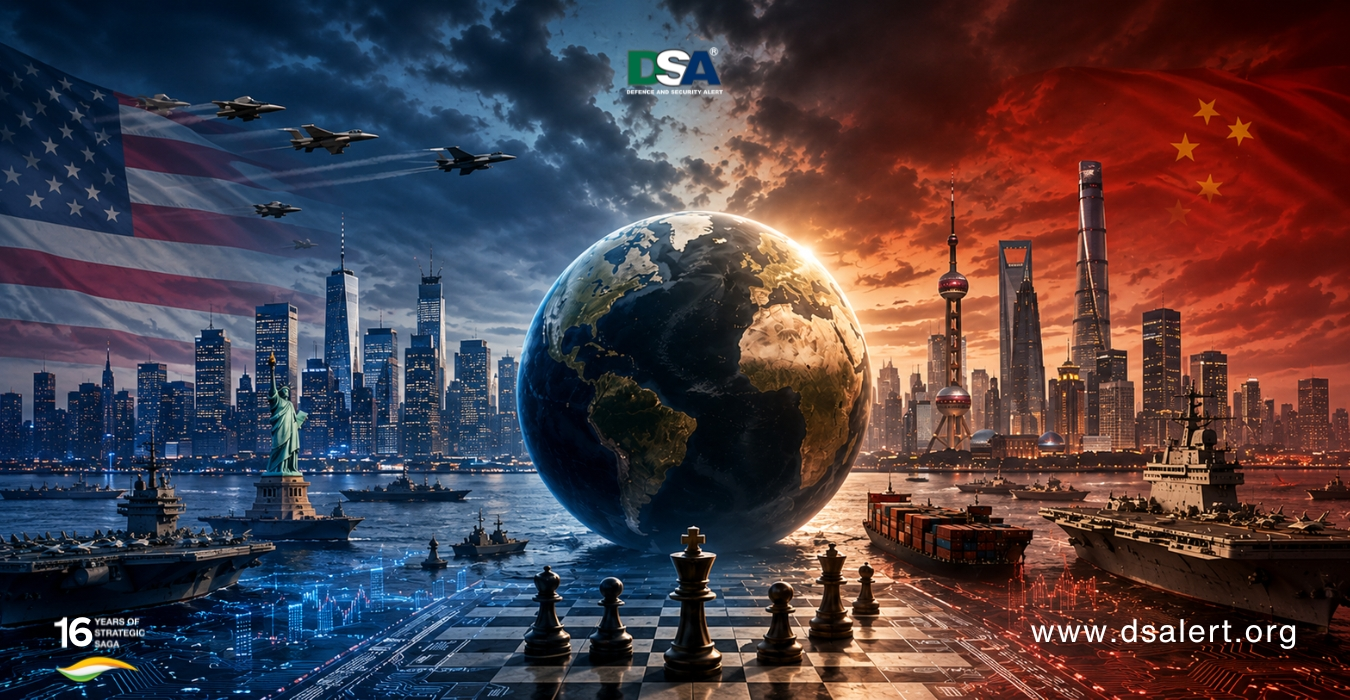
Since the end of the Second World War, the United States has occupied the position of the world’s leading superpower, supported by unparalleled economic, military and technological strength. Following the collapse of the Soviet Union in 1991, the international system entered an era of unipolarity in which Washington appeared to be the only power capable of shaping the global order.
However, China’s rapid rise over the past three decades has brought a fundamental question to the forefront of strategic debate: Can China surpass the United States in the same way that America overtook the British Empire during the twentieth century?
From Britain to America: A Lesson from History
At the beginning of the twentieth century, Britain presided over the largest empire in modern history. It controlled major global trade routes and possessed the world’s most powerful navy. Yet the economic and industrial rise of the United States, combined with Britain’s exhaustion during the two World Wars, gradually shifted the centre of global power from London to Washington.
This historical transition has led many scholars to ask whether China is now following a similar path and whether the United States could eventually experience a decline comparable to that of Britain.
However, historical comparisons must be approached with caution. Britain’s relative decline coincided with the rise of a culturally and politically aligned power. By contrast, the competition between China and the United States involves two states with sharply different political systems, strategic priorities and visions of the international order.
China: The Greatest Rise in Modern History
Since launching economic reforms in the late 1970s, China has undergone one of the most remarkable transformations in modern history. It has evolved from a largely developing economy into the world’s second-largest economic power.
China has also emerged as the world’s leading manufacturing centre, the largest exporter of goods and a major trading partner for countries across Asia, Africa, Europe and Latin America. Its vast industrial base has made it a central pillar of global supply chains.
Beijing’s rise extends far beyond economics. China has made significant advances in artificial intelligence, telecommunications, renewable energy, electric vehicles and space exploration, advanced manufacturing and military technology.
Through initiatives such as the Belt and Road Initiative, China has financed and constructed ports, railways, highways, energy facilities and digital infrastructure across multiple regions. These investments have expanded Beijing’s diplomatic and economic influence and positioned it as a serious competitor to the United States for global leadership.
The Enduring Strengths of the United States
Despite China’s rise, the United States continues to possess sources of power that will be difficult to surpass in the foreseeable future.
The United States remains home to many of the world’s leading universities, research institutions and technology companies. It continues to play a dominant role in fields such as artificial intelligence, semiconductors, biotechnology, aerospace, software and advanced defence technologies.
The global position of the US dollar provides Washington with another major strategic advantage. As the world’s principal reserve and transaction currency, the dollar gives the United States extraordinary influence over international finance, sanctions, investment and global capital flows.
Militarily, the United States maintains unmatched power-projection capabilities. Its global network of military bases, security partnerships and formal alliances stretches across Europe, the Middle East and the Indo-Pacific.
Institutions such as NATO, together with American alliances with Japan, South Korea, Australia and the Philippines, provide Washington with a strategic network that China has not yet been able to replicate.
The United States also benefits from considerable soft power. American universities, media, entertainment, innovation and political ideals continue to shape global culture and public opinion.
The Challenges Facing China
China’s rise is impressive, but it is not without serious limitations. One of the most significant challenges is demographic decline. A shrinking workforce and rapidly ageing population could place long-term pressure on economic productivity, social welfare and domestic consumption.
The Chinese economy is also confronting structural difficulties, including high levels of local government debt, weakness in the property sector, declining investor confidence and slower economic growth than in previous decades.
China’s development model has depended heavily on manufacturing, exports and infrastructure investment. Transitioning towards a more consumption-driven and innovation-led economy will require difficult economic and political reforms.
Beijing also lacks a global alliance network comparable to that of the United States. Although China has developed strategic partnerships with countries such as Russia, Pakistan and Iran, these relationships do not provide the same degree of institutional integration, military interoperability or political coordination found within the US-led alliance system.
Similarly, the Chinese yuan has not emerged as a genuine alternative to the US dollar. Capital controls, limited financial transparency and concerns over political intervention continue to restrict its wider international use.
China’s growing influence has also generated resistance. Concerns over economic dependency, territorial disputes, military expansion and political pressure have encouraged several countries to deepen their strategic cooperation with the United States and other regional powers.
Technology as the Central Battlefield
The competition between China and the United States will not be determined by economic size alone. Technology is increasingly becoming the principal battlefield of twenty-first-century power.
Artificial intelligence, quantum computing, semiconductors, robotics, biotechnology, space systems and next-generation communications will shape future military capabilities, industrial productivity and geopolitical influence.
The United States currently holds major advantages in research, advanced chip design, software and global innovation networks. China, however, possesses enormous manufacturing capacity, a large domestic market and the ability to mobilise state resources behind strategic industries.
The outcome of this technological rivalry may determine which country is better positioned to define global standards, control critical supply chains and dominate the industries of the future.
Towards a Bipolar or Multipolar World?
An increasing number of scholars argue that the central question is no longer whether one country will completely dominate the other, but how power will be distributed between them.
Rather than witnessing a total transfer of global leadership from Washington to Beijing, the world may be moving towards a bipolar or multipolar order in which influence is shared among the United States, China and other rising powers.
India, the European Union, Russia, Japan and influential regional powers are likely to play increasingly important roles in shaping the emerging international system.
In such an order, the United States may retain its leadership in military power, advanced technology, global finance and alliances, while China consolidates its position as the world’s leading industrial and commercial power.
This would produce a global balance fundamentally different from the overwhelming American dominance that characterised the post-Cold War era.
Conclusion
Current indicators do not suggest that the United States is heading towards a sudden collapse comparable to that of traditional empires. Nor do they indicate that China is capable of assuming complete global leadership in the near future.
China possesses the economic scale, industrial capacity and strategic ambition required to challenge American influence. Yet it continues to face major demographic, financial, political and diplomatic constraints.
The United States, meanwhile, is experiencing relative decline in certain areas, but it retains substantial advantages in technology, finance, military reach, alliances, education and global influence.
What is increasingly clear is that the era of uncontested American unipolarity is fading. The international system is undergoing a historic transformation marked by renewed great-power competition and the emergence of multiple centres of influence.
The twenty-first century is therefore unlikely to be exclusively American or exclusively Chinese. Instead, it is shaping up to be an era of prolonged strategic competition in which Washington and Beijing will compete not only for military and economic power, but also for technological leadership, diplomatic influence and the authority to define the future international order.
