
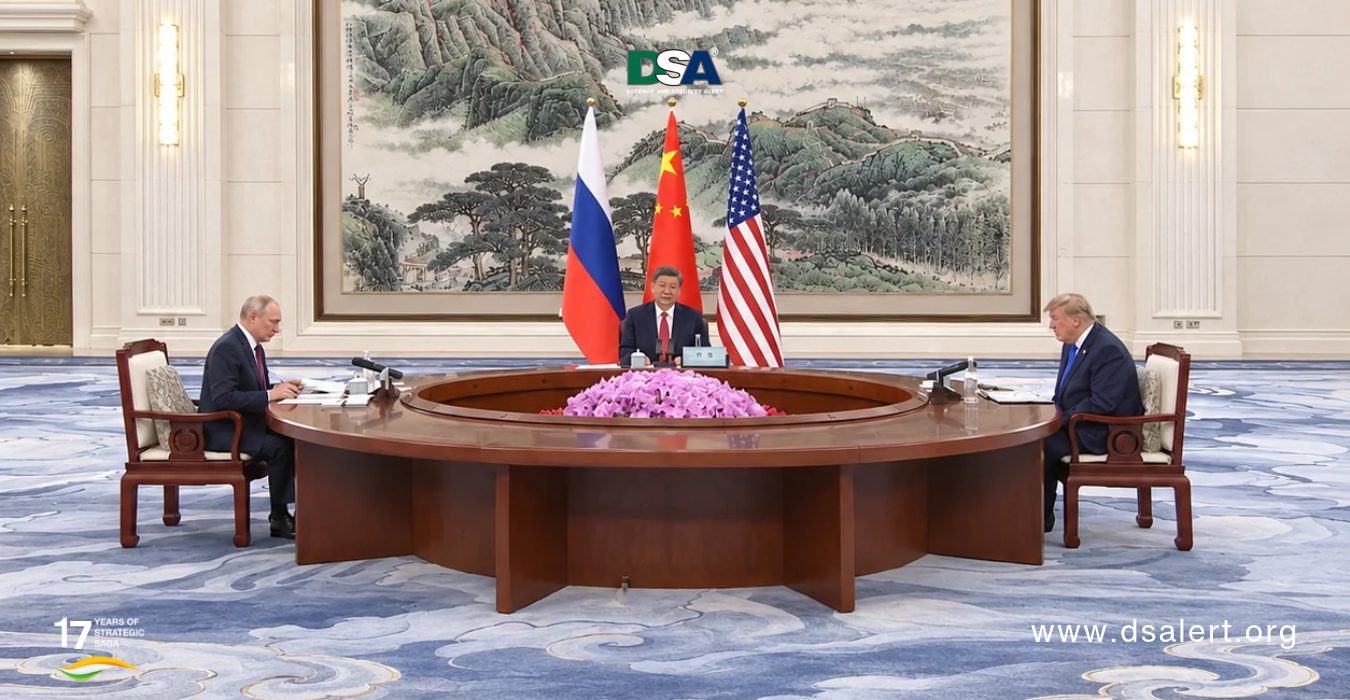
The Shenzhen summit marks an important moment in global diplomacy, but its significance extends beyond Washington, Beijing and Moscow. For India, the central challenge is to preserve strategic autonomy while securing a greater role in shaping the emerging international order.
Introduction
The unprecedented trilateral summit involving US President Donald Trump, Chinese President Xi Jinping and Russian President Vladimir Putin in Shenzhen on 19 November 2026 represents a significant development in contemporary international politics. Convened on the sidelines of the Asia-Pacific Economic Cooperation (APEC) summit, the meeting brought together three major nuclear powers amid intensifying geopolitical competition, regional conflicts and uncertainty over the future of international institutions.
The summit concluded with a four-point Declaration toward Peace, addressing United Nations reform, energy security, international judicial jurisdiction and nuclear risk reduction.[1] However, it produced neither a binding arms-control agreement nor a substantive settlement of ongoing conflicts.
Its importance therefore lies not in immediate diplomatic breakthroughs but in the possibility of a new framework for managing great-power competition. The central question is whether this engagement signals a movement towards strategic accommodation or merely represents a tactical convergence among powers whose fundamental interests remain divergent.
The Return of Great-Power Diplomacy
The post-Cold War international order, initially characterised by American predominance, has gradually evolved towards a more contested distribution of power. China’s economic and military expansion, Russia’s challenge to Western security arrangements and Washington’s increasingly transactional approach to diplomacy have accelerated this transformation.[2]
The Shenzhen meeting reflects a growing recognition that strategic competition cannot be managed exclusively through military deterrence, economic sanctions or competing alliances.
However, the summit should not be interpreted as the emergence of a new geopolitical alliance. The United States, China and Russia retain substantial disagreements over territorial security, economic competition and the principles governing international order. The meeting is better understood as an attempt to establish channels of communication within an increasingly fragmented strategic environment.
Washington’s Strategy: Managing Two Strategic Competitors
For President Trump, the summit offered an opportunity to pursue direct diplomacy with America’s principal strategic competitors. Washington faces the challenge of managing China’s growing influence in the Indo-Pacific while navigating continuing confrontation with Russia over European security.[3]
Engagement with Moscow could create diplomatic opportunities regarding Ukraine, potentially reducing the burden of simultaneous strategic competition. Similarly, dialogue with Beijing may help manage tensions involving trade, technology, maritime security and Taiwan.
Nevertheless, direct engagement creates its own dilemmas. American allies in Europe and Asia may question whether Washington intends to negotiate broader understandings with rival powers without adequately considering allied security interests. The challenge for the United States is therefore to reconcile diplomatic flexibility with credible alliance commitments.[4]
China’s Diplomatic Ascendancy: Shaping the Strategic Agenda
For Beijing, hosting the summit represented an important diplomatic achievement. By bringing Washington and Moscow into a common negotiating framework, President Xi strengthened China’s position as an indispensable participant in global security governance.
The meeting also reinforced Beijing’s preferred narrative of a multipolar international order, emphasising sovereignty, non-interference and dialogue among major powers.[5]
However, China’s diplomatic prominence does not eliminate concerns regarding its regional military activities, territorial disputes or economic leverage. The summit demonstrated Beijing’s ability to convene major powers, but whether this translates into sustained strategic influence will depend on China’s ability to manage tensions with its neighbours and competitors.
Russia’s Strategic Calculus: Recognition, Leverage and Economic Dependence
For Moscow, the meeting provided an opportunity to reaffirm Russia’s position as a central actor in international security despite its confrontation with the West.
Russian President Vladimir Putin welcomed the summit and acknowledged China’s role in facilitating dialogue.[6] Russian reporting also indicated that Ukraine remained a major subject of Putin’s bilateral discussions with Trump, although no negotiating timetable was established.
According to Putin’s statement reported by Interfax on 19 November, Russia–China bilateral trade reached approximately US$240 billion in 2025 and could approach US$280 billion in 2026, representing a projected increase of nearly 17 per cent. Energy cooperation, logistics and Arctic connectivity remain important dimensions of this relationship.
These figures illustrate Moscow’s increasing economic integration with Beijing. Nevertheless, the relationship also creates asymmetries, as China’s substantially larger economy provides considerable negotiating leverage. For Russia, renewed engagement with Washington could help diversify its diplomatic options without abandoning its strategic partnership with China.
The summit consequently reflected Moscow’s pursuit of strategic relevance rather than any definitive geopolitical realignment.
Nuclear Stability: The Gap Between Declarations and Commitments
Nuclear risk reduction was arguably the summit’s most consequential security-related objective. The three leaders reaffirmed the principle that nuclear war must never be fought and committed to further dialogue on risk reduction and non-proliferation.[7]
According to SIPRI’s January 2026 estimates, Russia possessed approximately 5,420 nuclear warheads, the United States 5,042 and China 620. India, by comparison, possessed approximately 190. These figures represent estimated total inventories, not necessarily operationally deployed weapons.
Such disparities complicate trilateral arms-control negotiations, particularly given China’s expanding nuclear capabilities and longstanding reluctance to accept numerical limitations comparable to those applicable to Washington and Moscow.[8]
Following the expiry of the New START treaty in February 2026, the absence of a binding US–Russia strategic arms-control framework has heightened uncertainty. Meaningful progress requires verification mechanisms, transparency measures, crisis communication arrangements and clearly defined commitments. Without these, diplomatic declarations remain insufficient to address the structural dangers of nuclear competition.
Energy Security and the Emerging Geoeconomic Order
The summit’s emphasis on stable energy supplies reflected the growing intersection between geopolitical competition and economic security.
Russia remains a major energy producer, China is a leading industrial consumer and the United States exercises substantial influence over global energy markets. Cooperation among these powers could contribute to supply stability, particularly during periods of regional conflict.
However, energy arrangements may also become instruments of geopolitical influence through sanctions, pricing mechanisms and control over supply routes. For India, which depends significantly on imported energy, the priority must remain diversified procurement, affordable access and protection against geopolitical supply disruptions.[9]
Global Governance: Reform or Great-Power Privilege?
The declaration’s commitment to UN reform raises important questions about the future distribution of international authority. Although Washington, Beijing and Moscow acknowledged the importance of institutional effectiveness, the summit offered no concrete commitment to expanding Security Council representation.
Its emphasis on state consent and the immunities of government officials in international judicial proceedings also reflected a preference for protecting state sovereignty.[10]
The concern is that cooperation among permanent Security Council members could strengthen an exclusive framework of great-power management without addressing the aspirations of emerging economies. A genuinely multipolar international order requires not merely multiple centres of military power but more equitable participation in global decision-making.
For India, this distinction is particularly important given its longstanding demand for comprehensive UN Security Council reform.
India’s Strategic Perspective: Where Does New Delhi Stand?
For India, the Shenzhen summit presents a critical strategic question: Will the emerging global order provide greater space for India’s rise, or will its contours be determined primarily by Washington, Beijing and Moscow?
India’s position is distinctive. It maintains an expanding strategic partnership with the United States, longstanding defence and energy cooperation with Russia and a complex relationship with China characterised by economic engagement, unresolved boundary disputes and regional competition.[11]
Washington remains important for defence technology, maritime security and Indo-Pacific cooperation. Moscow continues to provide significant military and energy linkages. Beijing, meanwhile, represents India’s most consequential long-term continental security challenge.
A closer understanding among these three powers could reduce international instability. However, it could also create strategic uncertainties for New Delhi.[12]
An American accommodation with China could potentially affect the Indo-Pacific balance, while deeper Russia–China integration may narrow Moscow’s diplomatic flexibility in matters affecting Indian interests.
India must therefore avoid interpreting great-power engagement as either an automatic opportunity or an immediate threat.
India’s Strategic Priorities: From Multi-Alignment to Strategic Influence
India’s response should rest on four interconnected priorities.
First, preserve independent strategic decision-making. New Delhi must maintain productive relationships with Washington and Moscow while engaging Beijing from a position of diplomatic confidence and credible military preparedness.
Second, strengthen national capabilities. Indigenous defence production, critical technologies, energy diversification and maritime security are essential foundations of meaningful strategic autonomy.
Third, deepen diversified partnerships. Cooperation with Japan, France, Australia, the European Union and other regional partners can strengthen India’s strategic flexibility without requiring exclusive alignment.
Fourth, shape global governance. Through the G20, BRICS, Quad and other institutions, India must advocate an international order that accommodates emerging powers rather than institutionalising exclusive great-power arrangements.[13]
India’s objective should not be to seek inclusion in every major-power consultation. It should be to ensure that decisions affecting Asian and global security cannot disregard Indian capabilities and interests.
India must evolve from managing great-power relationships to actively shaping the balance of power.
Conclusion
The Trump–Xi–Putin summit represents an important diplomatic opening in an increasingly fragmented international system. For Washington, it offered opportunities to manage strategic competition. For Beijing, it reinforced diplomatic centrality. For Moscow, it provided international recognition and renewed avenues for engagement.
Yet the summit did not resolve the underlying contradictions shaping relations among the three powers. Its enduring significance will depend on whether symbolic engagement develops into credible mechanisms for nuclear restraint, conflict management and institutional reform.
For India, the central imperative is to preserve strategic autonomy while strengthening the economic, technological and military foundations of national power.
The future international order should not be defined solely by how the United States, China and Russia accommodate one another, but by whether that accommodation creates a more stable, representative and equitable global system.
Shenzhen may mark the return of great-power diplomacy. India’s challenge is to ensure that it does not become the return of great-power exclusivity.
[1] The White House, “U.S.-Russia-China Heads of State Declaration toward Peace,” 19 November 2026. https://www.whitehouse.gov/briefings-statements/2026/11/u-s-russia-china-heads-of-state-declaration-toward-peace/
[2] Ministry of Foreign Affairs of the People’s Republic of China, “China-Russia-U.S. Heads of State Declaration toward Peace,” 19 November 2026. https://www.mfa.gov.cn/mfa_eng./xw/zyxw/202611/t20261119_12063224.html
[3] Reuters, “Trump, Xi and Putin Release ‘Peace Declaration’ from Unprecedented Summit,” 19 November 2026. https://theprint.in/world/trump-xi-and-putin-release-peace-declaration-from-unprecedented-summit/3103616/
[4] Financial Times, “China Revels in Xi Jinping’s ‘Yalta 2.0’ Moment,” 20 November 2026. https://www.ft.com/content/c1c540af-f9ba-479a-8473-4b7619859453
[5] Interfax, “Russia’s Trade with China to Reach Record High of Around $280 Billion in 2026—Putin,” 19 November 2026. https://www.interfax.com/newsroom/top-stories/119967/
[6] TASS, “Kremlin Aide Ushakov Delivers Remarks on Topics, Outcomes of Meeting between Putin, Trump,” 19 November 2026. https://tass.com/politics/2221037
[7] Stockholm International Peace Research Institute (SIPRI), SIPRI Yearbook 2026: Armaments, Disarmament and International Security, Summary, June 2026. https://www.sipri.org/sites/default/files/2026-06/yb26_summary_en_1.pdf
[8] Arms Control Association, “New START Expires as U.S. Urges ‘Modernized’ Treaty,” Arms Control Today, March 2026. https://www.armscontrol.org/act/2026-03/news/new-start-expires-us-urges-modernized-treaty
[9] The White House, “U.S.-Russia-China Heads of State Declaration toward Peace,” 19 November 2026, provision concerning energy security and refined petroleum supplies. https://www.whitehouse.gov/briefings-statements/2026/11/u-s-russia-china-heads-of-state-declaration-toward-peace/
[10] Ministry of External Affairs, Government of India, “India’s Foreign Policy,” official policy overview. https://www.mea.gov.in/indian-foreign-policy.htm
[11] Ministry of External Affairs, Government of India, “Brief on India–Russia Relations,” official bilateral relations brief, 2025. https://www.mea.gov.in/Portal/ForeignRelation/IndiaRussia25new.pdf
[12] Ministry of External Affairs, Government of India, “India–China Bilateral Brief,” August 2023. https://www.mea.gov.in/Portal/ForeignRelation/Bilateral-Brief-Updated_21-August-2023.pdf
[13] US Department of State, “Joint Statement from the Quad Foreign Ministers Commemorating the 20th Anniversary of Quad Cooperation,” December 2024. https://2021-2025.state.gov/joint-statement-from-the-quad-foreign-ministers-commemorating-the-20th-anniversary-of-quad-cooperation/
