
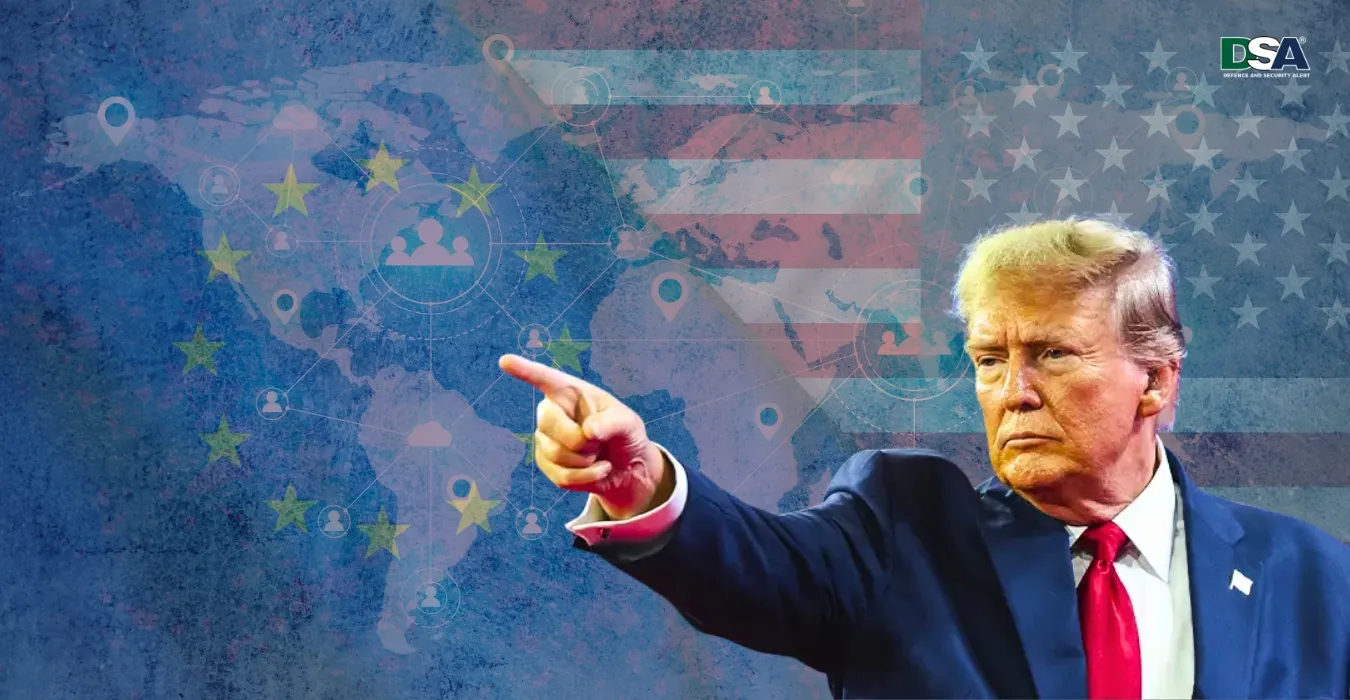
Russia’s ongoing war in Ukraine, China’s growing power around the world, and the increasing complexity of hybrid and cyber threats all make this problem worse. Under Trump 2.0, NATO could break apart, and the EU is under more and more pressure to speed up its quest for strategic autonomy. This article looks at what Trump’s return means, how it affects NATO, how the EU is changing its responses, and what policies can be used to make the world more resilient in a multipolar world.
Trump’s First Term: Change and Realignment
To understand the stakes of Trump’s second presidency (2021–2025) you need to know what happened during his first one (2017-2021). His actions caused problems for NATO and made things worse between the EU and NATO in a number of ways:
1. Attack on Multilateralism: Trump called NATO “obsolete,” said the EU was an economic rival, and pulled out of important agreements like the Paris Climate Accord and the INF Treaty. These actions made people less sure that Washington was the anchor of the liberal order.
2. Using burden-sharing as a weapon Past U.S. leaders pushed allies to spend more on Defence, but Trump did so by shaming them in public, especially Germany. He made a cooperative debate into a divisive one by threatening to pull out troops and calling allies “delinquents.”
3. Transactional Bilateralism: Trump preferred bilateral deals and didn’t follow NATO’s rules, as shown by his agreement to send troops to Poland. This made NATO less united.
4. Mixed Messages about Russia: Even though the U.S. kept sanctions and deterrence in place, Trump’s friendly words about Vladimir Putin especially in Helsinki in 2018 worried EU leaders and weakened deterrence.
Because of these changes, the EU started to doubt the reliability of the U.S. and started new discussions about European strategic autonomy.
Trump 2.0: NATO Stress Tests
Trump’s second term brings back uncertainty, and three fault lines could hurt NATO’s credibility:
Article 5 Credibility: If people keep doubting NATO’s worth, it could give Russia more power, especially on its eastern flank. Even doubts a bout the U.S.’s resolve can lead to violence in the Black Sea or Baltic Sea regions.
Paying for security Trump’s obsession with Defence budgets could make NATO a transactional system where protection depends on how much you give. Some smaller states may feel left out, while larger ones may not want to give in to U.S. pressure.
Bilateralism leads to fragmentation putting favored states first makes NATO less interoperable and slows down joint responses, which gives Russia’s hybrid tactics a chance to work.
NATO’s official structure will stay the same, but its ability to deter could weaken.
Trump’s Power and the Russo-Ukrainian War
The invasion of Ukraine by Russia has changed the way Europe thinks about security. Helping Kyiv is both the right thing to do and the smart thing to do for the EU. But Trump has used the conflict to his advantage in his transactional view of the world. He has questioned U.S. aid, hinted at conditional support, and suggested deals with Moscow that make European capitals nervous.
This lack of clarity makes deterrence weaker at a time when the EU’s security is directly affected by Ukraine’s future. If Washington shows that it is unsure, the EU may have to step in with more money, troops, and political support to stop Russia from winning, which would make the whole continent less stable.
The EU’s Security Response: A Balance between Independence and Cooperation
The EU is working harder to improve its own Defence capabilities because Trump is so unpredictable. Some important steps are:
Strategic Compass (2022) laid out plans for a rapid deployment force of 5,000 troops by 2025, better cooperation between the Defence and industrial sectors, and better protection against cyber-attacks.
European Defence Fund (EDF) and PESCO are programs that bring together resources, pay for new ideas, and encourage buying things together.
France vs. Eastern Europe: France wants to be able to make its own decisions, but Eastern European countries are wary of losing ties with the US because they are afraid of Russia. Germany’s Zeitenwende, a €100 billion fund for its military, shows that the country wants to do better, but things are still moving slowly.
Balancing NATO and Autonomy: A lot of EU leaders say that autonomy should not replace NATO but should work with it. A stronger EU “pillar” in NATO could make the alliance stronger without losing U.S. support.
Wider Partnerships: To protect itself from the U.S.’s unpredictable behavior, the EU is strengthening ties with democracies like Japan, South Korea, and India, which gives it more power outside of Europe.
Choices for a Stronger EU Security Framework
The EU has a few choices when it comes to Trump 2.0:
1. Strengthen NATO’s European Pillar by improving EU coordination, mobility, and capabilities to make the alliance’s deterrence stronger.
2. Make plans for what would happen if NATO didn’t have the U.S. A “NATO-minus-U.S.” advisory group could help Europe and Canada work together if Washington pulls out, even though it would be politically sensitive.
3. Strengthen cooperation between the EU and NATO by focusing on common problems like cyber Defence, protecting infrastructure, and hybrid threats to avoid doing the same thing twice.
4. Build more global partnerships. Work with India, Australia, and Japan on maritime security, technology standards, and crisis management.
In conclusion, building resilience after Trump
Trump’s second term is both a warning and a chance. It warns against relying too much on a U.S. that is unstable, but it also pushes the EU to speed up reforms that have been needed for a long time. Brussels, Berlin, Paris, and Warsaw will decide the future of EU security, not Washington.
Three important things stand out:
1. Close Capability Gaps: The EU needs to spend money on logistics, cyber Defence, and AI so that it doesn’t have to rely on U.S. enablers as much.
2. Build Political Unity: To be a real deterrent, we need to get rid of the divisions between the East and West and the North and South.
3. Balance Autonomy with Alliance Strategic autonomy should make NATO stronger, not weaker. It should also make sure that the EU can act on its own when it needs to while keeping transatlantic unity.
If the EU meets this challenge, Trump 2.0 may not be remembered as the end of transatlantic security, but as the event that finally pushed Europe to become a real strategic power.
NATO Defence Spending (% of GDP, 2022–2025 Estimates)
| Country | Defence Spending (% of GDP) |
| US | 3.5 |
| UK | 2.3 |
| Poland | 4.0 |
| France | 1.9 |
| Germany | 1.6 |
| Italy | 1.5 |
| Spain | 1.4 |
| Lithuania | 2.5 |
References
- European Centre of Excellence for Countering Hybrid Threats (Hybrid CoE). (2021). Annual report 2021. Helsinki.
- European Commission. (2021). EU strategy for cooperation in the Indo-Pacific. Brussels.
- European Union External Action Service. (2022). A strategic compass for security and defence. Brussels.
- Fiott, D. (2019). Strategic autonomy: Towards “European sovereignty” in defence? European Union Institute for Security Studies (EUISS). https://www.iss.europa.eu
- Giles, K. (2019). Moscow rules: What drives Russia to confront the West. Brookings Institution Press.
- Haass, R. (2021). The world: A brief introduction. Penguin Press.
- Jones, S. G. (2021). The future of the transatlantic alliance. Center for Strategic and International Studies (CSIS).
- Kupchan, C. A. (2020). Isolationism: A history of America’s efforts to shield itself from the world. Oxford University Press.
- Macron, E. (2019, November 7). The awakening of Europe [Interview]. The Economist. https://www.economist.com
- Major, C., & Mölling, C. (2022). Germany’s Zeitenwende: Historic shift or empty promise? German Council on Foreign Relations (DGAP).
- Mix, D. E. (2021). NATO: Key issues for the 117th Congress. Congressional Research Service. https://crsreports.congress.gov
- NATO. (2018). Brussels summit declaration. NATO. https://www.nato.int
- NATO. (2022). Defence expenditure of NATO countries (2014–2022). NATO Public Diplomacy Division.
- Polyakova, A., & Meserole, C. (2019). Exporting digital authoritarianism: The Russian and Chinese models. Brookings Institution.
- Rajendram, D. (2019). India’s strategic autonomy and EU relations. European Parliament Policy Department.
- Regaud, N., & Pajon, C. (2021). France and Japan: A strategic partnership for a free and open Indo-Pacific. French Institute of International Relations (IFRI).
- Sloan, S. R. (2016). Defence of the West: NATO, the European Union and the transatlantic bargain. Manchester University Press.
- Szymański, A. (2021). Poland and European security: Between NATO and the EU. Polish Institute of International Affairs (PISM).
- Walt, S. M. (2018). The hell of good intentions: America’s foreign policy elite and the decline of U.S. primacy. Farrar, Straus and Giroux.
